Introduction
Welcome back! In our previous lesson, we delved into the technical "how" of styling bralessness. We explored the specific tools and methods stylists use—from fabric choices and garment structures to layering techniques and adhesive solutions—to create intentional braless aesthetics on screen.
Today, we shift from technique to interpretation. Our goal is to distinguish between bralessness styled for provocation versus naturalism in popular media. Using the visual language we've started to build, we will analyze the intent behind these styling choices. This isn't about applying a rigid binary, but rather learning to read the cues that place a look on a spectrum, from a casual, everyday feel to a high-impact, deliberate statement.
1. Defining the Spectrum: Naturalism vs. Provocation
When a stylist chooses to forgo a bra, they are making a decision that carries inherent meaning. That meaning is shaped by a collection of factors—fabric, silhouette, context, and the celebrity's persona—which combine to create an overall effect. We can broadly categorize this effect along a spectrum with two main poles:
- Naturalism: This approach aims to create a sense of effortlessness, comfort, realism, or authenticity. The absence of a bra feels incidental to the overall look, as if it were a simple choice for comfort or a reflection of the character's relaxed nature. The styling often mimics "real life."
- Provocation: This approach uses bralessness as a central, high-impact statement. The intent is to challenge norms, command attention, emphasize sexuality, or create a moment of "fashion" with a capital F. The absence of a bra is the point.
Let's begin by examining clear examples of each to establish our framework.
2. The Art of Provocation
A provocative braless look is designed to be unforgettable. It often involves high-stakes environments like red carpets or music videos, where making a statement is part of the objective.
To explore this, please read through a few iconic examples from the following article.
13 Best Braless Moments in History
The article '13 Best Braless Moments in History' from L'OFFICIEL provides a gallery of powerful examples. We'll focus on the looks that were clearly designed to make a splash.
Please read the sections on Jayne Mansfield, Jennifer Lopez, and Rihanna. As you read, notice the common descriptive words used: 'bared it all,' 'viral dress,' 'raw Hollywood glamour.'
These three examples share several key visual cues that signal provocative intent:
- Extreme Silhouettes: Jayne Mansfield's deep-cut satin, Jennifer Lopez's navel-plunging Versace gown, and Rihanna's completely sheer "naked dress" all use the garment's structure to maximize exposure in a way that is impossible to ignore.
- Luxurious and Revealing Fabrics: The materials—satin, silk chiffon, Swarovski crystal mesh—are glamorous and delicate. Their sheerness or drape is used to both conceal and reveal, creating a tension that is inherently provocative.
- High-Stakes Context: These looks were debuted at major industry events (a Hollywood party, the Grammy Awards, the CFDA Fashion Awards). The context amplifies the statement, turning a personal style choice into a public spectacle.
Sometimes, the provocative intent is stated outright. The following article provides a fantastic quote from Rihanna about her famous crystal dress.
Going Braless: Female Nipples Place In Fashion History
The article 'Going Braless: Female Nipples Place In Fashion History' from Refinery29 offers a more analytical perspective. It includes a quote that perfectly captures the spirit of provocative styling.
Please read the final two paragraphs of the article, starting from 'There are other figures to think about...'. Focus on Rihanna's direct and unapologetic quote in response to a reporter's question.
Rihanna's question, "Do my tits bother you? They’re covered in Swarovski crystals, girl!" is a masterclass in owning a provocative look. She acknowledges the confrontational nature of her outfit and reframes it as high fashion, daring the viewer to be shocked.
3. The Aesthetics of Naturalism
At the other end of the spectrum, naturalistic braless styling aims for the opposite effect: to look completely unremarkable and effortless. It’s a style choice that's meant to feel authentic to the character or person.
Let's return to the L'OFFICIEL article to find examples.
13 Best Braless Moments in History
We'll now look at examples from the same article that illustrate a more understated, naturalistic approach.
Please read the sections on Debbie Harry and Jennifer Aniston. Note the emphasis on 'staple' style and 'effortless '90s style.'
The looks of Debbie Harry and Jennifer Aniston (as Rachel Green in Friends) exemplify naturalism. The key visual cues here are:
- Everyday Garments: They are styled in simple t-shirts, tank tops, and sleeveless turtlenecks. These are staples of a casual wardrobe, not special-occasion pieces.
- Opaque, Simple Fabrics: The fabrics are mostly cotton jersey or ribbed knits. They are comfortable and functional, and any visibility is a byproduct of the fabric's thinness, not intentional sheerness.
- Context of Authenticity: Debbie Harry's look is tied to the raw energy of punk rock, while Rachel Green's style was presented as the everyday fashion of a young woman in New York City. The bralessness feels like a choice for comfort and ease, consistent with their respective worlds.
4. An Important Nuance: The 'Fashion Tits' Phenomenon
As a statistician, you know the importance of considering all variables. In analyzing braless styling, one significant—and socially constructed—variable is breast size. The Refinery29 article introduces a concept that is critical for understanding why some braless looks are perceived as "natural" while others are not.
Going Braless: Female Nipples Place In Fashion History
Let's revisit the Refinery29 article to explore a key analytical concept it introduces.
Please read the section that begins with 'It was in the '90s, though, that nipples really went mainstream.' Continue reading until you have finished the paragraph defining 'fashion tits.' Pay close attention to this definition.
The concept of "fashion tits"—describing breasts that are "small, perky, and relatively unobtrusive"—is a crucial piece of this puzzle. The article argues that society often deems visible nipples on smaller-chested bodies as more acceptable, reading them as 'high fashion' or 'natural.' In contrast, bralessness on larger-chested bodies is more frequently sexualized or seen as intentionally provocative.
This is not a biological fact but a cultural bias. However, for our purposes of visual analysis, it's essential to recognize this bias because it heavily influences how a braless look is styled and perceived. The '90s naturalism of Jennifer Aniston and Kate Moss, for example, is inseparable from this phenomenon.
5. Visual Analysis: Reading the Spectrum
Now let's apply these concepts to new images.
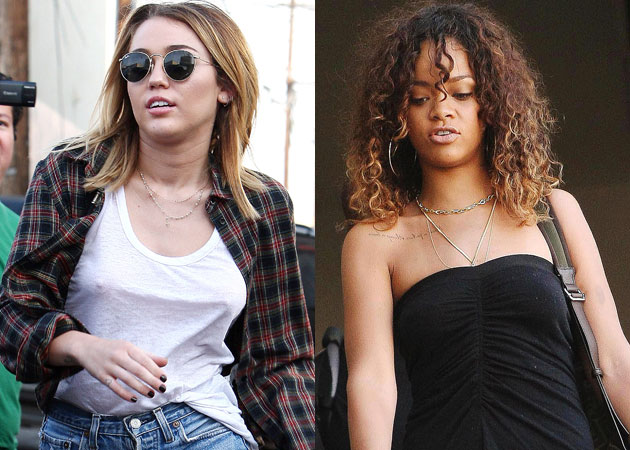
Take a moment to analyze the image above. Both are casual, but they convey slightly different feelings.
- Miley Cyrus: Her look leans more towards raw naturalism. The thin, semi-sheer white t-shirt is a classic "undone" choice. The visible outline of her nipples feels connected to a rock-and-roll, anti-propriety attitude.
- Rihanna: Her look is a more polished form of naturalism. The opaque black bandeau top provides full coverage. It's a clean, minimalist, and controlled take on braless street style.
This demonstrates that even within "naturalism," there are variations in execution and effect.
Now, let's look at an example that shows the full spectrum in a single person.
This triptych is a perfect case study. Let's break it down from left to right:
- The Gown (Elegant Naturalism): The bralessness here serves the integrity of the garment's design. A bra would disrupt the clean, off-the-shoulder line. The intent is elegance, not provocation. The absence of a bra allows the dress to fit as intended, creating a natural and sophisticated silhouette.
- The Crop Top (Pure Naturalism): This is the epitome of casual, comfortable style. In the context of a ribbed top and denim shorts, going braless is a choice of ease and realism. It aligns perfectly with a relaxed, everyday aesthetic.
- The Cut-Out Dress (Deliberate Provocation): Here, the bralessness is the entire point. The garment is designed around the absence of a bra, using cut-outs to frame and reveal the body. This is a bold, high-fashion statement meant to be seen and discussed.
Conclusion
Today we've moved beyond identifying techniques to interpreting intent. By analyzing visual cues and context, you can now place on-screen braless looks on a spectrum from naturalism to provocation.
Key Takeaways:
- Provocation vs. Naturalism: This distinction lies in the intent of the styling. Provocation aims for high impact and challenges norms, while naturalism aims for effortlessness and authenticity.
- Key Visual Cues: Provocative looks often use extreme silhouettes, revealing fabrics, and high-stakes contexts. Naturalistic looks rely on everyday garments, simple fabrics, and a context of comfort or realism.
- The Role of Body Type: Societal biases, as captured by the "fashion tits" concept, mean that breast size is a significant variable influencing whether a look is perceived as natural or provocative.
- It's a Spectrum: As the Madelyn Cline triptych shows, these categories are not absolute. A single person can embody different points on the spectrum depending on the specific combination of garment, fabric, and context.
Next Lesson
In our next lesson, we will continue to build on this foundation by focusing on how bralessness is integrated into a complete outfit. The learning outcome will be to analyze how braless styling interacts with other garments such as sheer tops, blazers, and slip dresses. We will explore the art of layering and combination to see how surrounding pieces can either enhance or downplay the braless statement.