Introduction
Welcome to the twelfth and final module of our course, "Emerging Trends & Cross-Media Influence." In our last lesson, we concluded our deep dive into braless styling by analyzing how the absence of a bra interacts with garments like sheer tops, blazers, and slip dresses to create a complete, composed look.
Today, we pivot from a specific styling choice to a broad design philosophy that is reshaping the fashion industry. Our learning outcome is to identify sustainable and eco-conscious bra designs appearing in recent media. As awareness of environmental impact grows, so does its influence on fashion aesthetics, and lingerie is no exception. We will explore the key materials, processes, and visual cues that define this trend, equipping you to spot these designs on screen and understand the values they represent.
1. What Makes a Bra "Eco-Conscious"?
The term "sustainable" can be broad, but in lingerie design, it generally refers to specific choices in materials, production, and end-of-life considerations. To build our visual vocabulary, we first need to understand these underlying principles.
The following article from Vogue provides an excellent overview of the landscape of sustainable lingerie brands. It details the different strategies and materials that define this movement.
15 Sustainable Lingerie Brands - Eco-Friendly Wardrobe
Let's begin by surveying the field with the article '15 Sustainable Lingerie Brands' from Vogue. This will introduce us to the core concepts and materials that characterize eco-conscious design.
First, read the introduction to understand the overall context. Then, skim through the different brand profiles (from Araks to NK Imode) to get a sense of the variety of approaches. You don't need to memorize every brand, but pay close attention to the recurring keywords related to materials and practices.
From that survey, we can distill the key characteristics of sustainable bra design into three main categories:
1. Materials:
- Natural & Organic Fibers: Organic cotton, biodegradable silk, and rayon from organic bamboo are popular for their softness, breathability, and lower environmental impact during cultivation.
- Recycled Materials: Many brands now use fabrics made from post-consumer waste. This includes recycled polyester or nylon made from plastic bottles (like ECONYL® and Repreve®), and even upcycled cotton scraps.
- Innovative Renewables: Materials like Tencel™ Lyocell, derived from sustainably sourced wood pulp in a closed-loop system, are prized for their soft feel and eco-friendly production.
- Surplus & Deadstock: This involves using leftover fabrics from larger manufacturing runs that would otherwise be discarded, giving them a new life.
2. Production & Process:
- Ethical Manufacturing: Certifications like WRAP (Worldwide Responsible Accredited Production) ensure that garments are made in factories with fair labor practices.
- Eco-Friendly Dyeing: Using plant-based pigments or dyes certified by programs like bluesign®, which eliminates harmful substances from the manufacturing process.
- Reduced Waste: Small-batch production, zero-plastic policies in the supply chain, and using compostable or recycled packaging are common practices.
3. End-of-Life:
- Recyclability: Some brands, like Girlfriend Collective, offer take-back programs (ReGirlfriend) to recycle old garments into new ones.
- Biodegradability: Choosing materials like silk or organic cotton that can naturally decompose at the end of their lifecycle.
2. The Visual Language of Sustainable Bras
These eco-conscious principles often translate into a distinct and recognizable aesthetic. While not a strict uniform, you can learn to identify a common visual language. Generally, the style emphasizes natural comfort, minimalism, and the texture of the fabric itself over complex construction or heavy embellishment.

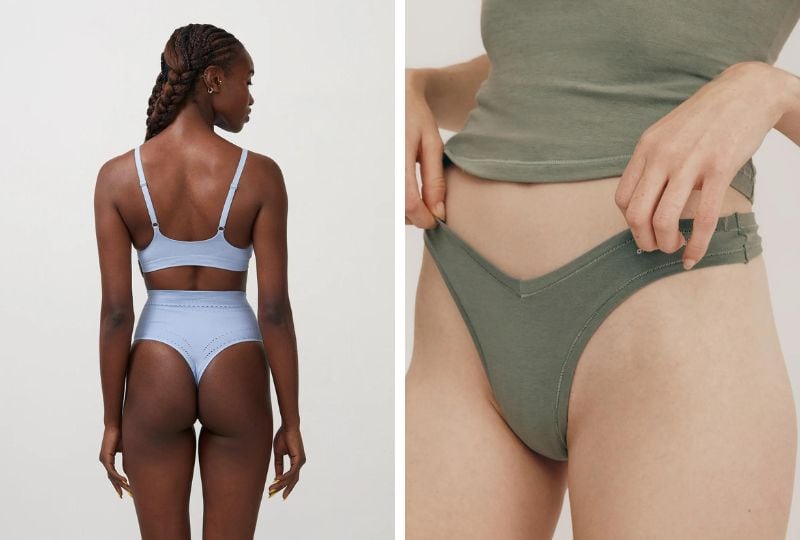
As you can see in these images, the dominant aesthetic is one of understated simplicity. The designs often feature:
- Silhouettes: Soft-cup bralettes (triangle, scoop neck), simple bandeau styles, and other unpadded, wireless forms. The goal is to work with the natural shape of the body rather than dramatically altering it.
- Color Palette: Earth tones, muted pastels, and classic neutrals are common, often reflecting the use of natural dyes or a minimalist philosophy.
- Detailing: The focus is on clean lines and fabric texture (like ribbing) rather than lace, heavy embroidery, or excessive hardware.
This aesthetic serves as a visual counterpoint to mass-produced, "fast fashion" lingerie, signaling a focus on longevity, comfort, and mindful consumption.
3. Case Study in Media: Fruity Booty
To meet our learning outcome, we need to connect these brands and their aesthetics to what we see in media. While many of these brands are worn by celebrities in their daily lives, some, like Fruity Booty, have successfully crossed over into the high-style world of pop music and "It-girl" culture.
This brand is a perfect case study because it combines a sustainable ethos with a more playful and fashion-forward aesthetic, making it a favorite for on-screen and performance looks.
Fruity Booty Is Keeping Every It-Girl's Summer Intimates Drawer Juicy
Let's read a short article on Fruity Booty from Vogue. This will show how a brand with a core mission of sustainability can achieve visibility and influence in popular media.
Read this brief introduction to the brand. Pay attention to its sustainable practice (prioritizing deadstock fabrics) and the list of celebrities who have worn it.
As the article highlights, Fruity Booty is worn by figures like FKA Twigs and Charli XCX, both known for their distinctive music video aesthetics. The brand's use of deadstock fabric means their collections are inherently limited-edition, which adds to their appeal.
This demonstrates a key point: sustainable lingerie isn't a single, monolithic style. While the minimalist aesthetic is common, brands like Fruity Booty show that eco-conscious principles can also be applied to more "sweet yet subversive" designs, featuring unique prints, vibrant colors, and delicate mesh—styles that are perfectly at home in a pop music video.
4. Your Identification Toolkit
When you're watching a film or music video and suspect a bra might be from an eco-conscious brand, you can use this framework to analyze it. Look for a combination of these visual and contextual clues.
| Design Element | Visual / Contextual Clues | Associated Aesthetic | Potential Brands (from our reading) |
|---|---|---|---|
| Material | Appears soft, textured, or matte, like organic cotton or bamboo. Ribbed textures are common. | Natural, Minimalist, Comfortable | Base Range, Brook There, Organic Basics |
| Seamless, often with a slight sheen. Often in solid, basic, or nude-hued colors. | Athletic, Modern Basics | Girlfriend Collective, Everlane, Proclaim | |
| Unique, often floral or quirky prints on sheer mesh or delicate fabrics. | Playful, Fashion-Forward, "It-Girl" | Fruity Booty | |
| Silhouette | Soft-cup triangle, scoop-neck, or square-neck bralette. Unstructured and wireless. | Minimalist, Natural | Araks, Base Range, Everlane |
| Color | Muted earth tones, pastels, or a wide range of "nude" shades. | Inclusive, Understated | Proclaim, Base Range, Summersalt |
| Context | An artist known for environmental advocacy. The production notes or stylist interviews mention a focus on sustainability. | Mission-Driven | (Varies by production) |
This table acts as a mental checklist. While you can't know for certain without confirmation, you can now make a highly educated guess by cross-referencing these visual cues. For example, a simple, ribbed, olive-green triangle bralette seen in a contemporary drama film very likely fits the profile of a brand like Base Range or Brook There.
Conclusion
Today we've added a crucial emerging trend to your visual repertoire. We've seen that sustainable and eco-conscious bra design is not just a behind-the-scenes manufacturing choice, but a driver of a distinct and increasingly visible on-screen aesthetic.
Key Takeaways:
- Eco-conscious bra design is defined by choices in materials (organic, recycled, deadstock), production (ethical, clean dyeing), and end-of-life (recyclable, biodegradable).
- This often translates to a minimalist aesthetic focused on comfort, natural silhouettes, and simple, clean lines, as seen with brands like Organic Basics and Base Range.
- However, the sustainable ethos can also be applied to more fashion-forward, playful designs, as demonstrated by the celebrity-favored brand Fruity Booty.
- You can identify these designs by looking for clues in the material, silhouette, color, and overall aesthetic of the garment.
Next Lesson
In our next lesson, we will explore another powerful influence on modern on-screen styling that often stands in stark contrast to the naturalism of eco-conscious design. We will focus on the learning outcome: Describe the influence of social media aesthetics (e.g., 'Instagram Baddie') on bra styling in film and music videos.