Hello! Welcome to the final lesson in our module on "Testing and Production Deployment."
In our last session, we configured a powerful production server setup using Gunicorn as a process manager for Uvicorn workers. This gave our application parallelism, allowing it to take full advantage of multiple CPU cores. However, this Gunicorn process is still running inside a container, isolated from the public internet. We need a secure and efficient way to expose it to the world.
This brings us to our final learning outcome for this module: to explain the role of a reverse proxy like Nginx in a production deployment for handling SSL and load balancing.
You'll find this architecture very familiar from your Django experience. Just as a production Django app is almost never run directly facing the internet, the same is true for FastAPI. A reverse proxy is the standard, battle-tested front door for any serious web application.
What is a Reverse Proxy?
Before we dive into Nginx specifically, let's clarify what a reverse proxy is and how it differs from a regular (or "forward") proxy you might have used.
- A forward proxy sits in front of client computers. It forwards outgoing requests from clients to the internet, often for purposes like bypassing firewalls or filtering content. It acts on behalf of the client.
- A reverse proxy sits in front of web servers. It accepts incoming requests from the internet and forwards them to the appropriate backend server(s). It acts on behalf of the server.
This video provides a great explanation of the concept.
Proxy vs Reverse Proxy vs Load Balancer | Simply Explained
Watch this segment from TechWorld with Nana to understand the fundamental role of a reverse proxy and how it acts as a 'receptionist' for your backend services.
Watch from 03:41 to 05:40. Focus on the restaurant analogy and the key responsibilities mentioned: distributing requests, providing security, and caching.
Nginx: The Swiss Army Knife of Web Serving
While there are many reverse proxies (like Apache, HAProxy, or cloud-native solutions), Nginx is arguably the most popular, renowned for its high performance, stability, and low resource consumption. In a production FastAPI stack, Nginx takes on several critical roles. We'll focus on the two most important: load balancing and SSL termination.
Role 1: Load Balancing for Scalability and High Availability
In the previous lesson, you learned to run multiple Uvicorn workers on a single machine using Gunicorn. This is a form of scaling. But what if a single machine isn't enough to handle your traffic? Or what if that machine fails?
This is where Nginx's load balancing capabilities come in. It can distribute incoming requests across multiple backend servers, each potentially running its own Gunicorn/Uvicorn setup. This is known as horizontal scaling.
This provides two major benefits:
- Scalability: You can handle massive amounts of traffic by simply adding more application servers to the pool.
- High Availability: If one of your application servers crashes or needs to be taken down for maintenance, Nginx will automatically stop sending traffic to it and route requests to the healthy servers, preventing downtime.
To see how this is configured, let's examine a typical Nginx configuration.
Preparing FastAPI for Production: A Comprehensive Guide
This article provides a clear, practical Nginx configuration for load balancing. It demonstrates how to define a group of backend servers and tell Nginx to proxy requests to them.
Read the section 'Load Balancing' and focus on the Nginx configuration block under 'Nginx as a Load Balancer'. Pay attention to the upstream block, which defines the pool of application servers, and the proxy_pass directive that points to this group.
Role 2: SSL/TLS Termination for Security and Efficiency
Every modern API must serve traffic over HTTPS to ensure data is encrypted in transit. While it's possible to handle this within your Python code, it's highly inefficient and complicates your setup.
Instead, the industry standard is to perform SSL/TLS termination at the reverse proxy.
This means:
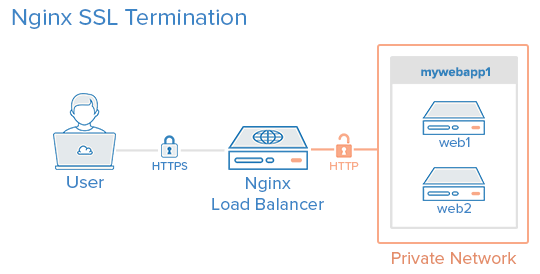
- Nginx handles the secure HTTPS connection with the client.
- It decrypts the incoming request.
- It forwards the request to your Gunicorn/Uvicorn server as a plain, unencrypted HTTP request over your private network.
Why is this better?
- Separation of Concerns: Nginx is written in C and is hyper-optimized for cryptographic operations. It can handle encryption and decryption far more efficiently than a Python process. This frees up your FastAPI application to focus entirely on business logic.
- Centralized Management: You only need to install and renew your SSL/TLS certificates in one place (Nginx), rather than on every single application server. This is a massive simplification, especially in a horizontally scaled environment.
How to Deploy FastAPI to Production
For a complete, production-grade example, this article offers a comprehensive Nginx configuration file that combines SSL termination, load balancing, and other security best practices.
Study the full Nginx configuration file provided in the section 'Nginx Reverse Proxy Configuration'. Identify the upstream fastapi_backend block for load balancing and the server block listening on port 443. Notice the ssl_certificate directives and how proxy_pass forwards traffic to the upstream group. This shows how both roles are combined.
The Complete Production Architecture
Now let's zoom out and look at the entire request lifecycle, from the user to your FastAPI code. The following diagram shows how all the pieces we've discussed in this module fit together. It also includes a comparison to Django architectures, which should look very familiar to you.

Beyond load balancing and SSL termination, Nginx also commonly handles:
- Serving Static Files: Just like with Django, Nginx is extremely efficient at serving static assets (e.g., docs UI files, images), offloading that task from the application server.
- Applying Rate Limiting: Protecting your API from abuse by limiting the number of requests a client can make in a certain period.
- Request/Response Caching: Caching common responses to reduce the load on your backend.
Conclusion
You've now reached the end of our deployment module and have a complete picture of a production-ready FastAPI architecture. You've seen that while the underlying async technology of FastAPI is different from Django's synchronous model, the high-level deployment architecture is remarkably similar and follows established best practices.
Key Takeaways:
- A reverse proxy like Nginx is the public-facing entry point to your application servers.
- It performs load balancing to distribute traffic across multiple application servers, enabling horizontal scalability and high availability.
- It handles SSL/TLS termination, offloading the computationally expensive task of encryption/decryption from your Python application and centralizing certificate management.
- The full production stack for FastAPI is typically Nginx -> Gunicorn -> Uvicorn -> FastAPI Application.
Preview of the Next Lesson:
This lesson concludes our module on Testing and Production Deployment. You now have all the conceptual and practical tools needed to build, test, containerize, and deploy a robust FastAPI application.
In our next and final module, you will begin the Capstone Project. You'll apply everything you've learned—from routing and Pydantic schemas to dependency injection and production architecture—to design and build a complete full-stack API from scratch.