Hello! Welcome to the first lesson in our new module, "Testing and Production Deployment."
In our last lesson, we wrapped up advanced features by learning how to serve non-JSON data like file downloads with FileResponse and stream large datasets with StreamingResponse. These are powerful tools for building feature-rich APIs. But how do we ensure all these features—from simple JSON endpoints to complex file streams—work correctly and continue to work as we add more code? The answer is automated testing.
This lesson kicks off our journey into building robust, production-ready applications. We will tackle the learning outcome: Write synchronous and asynchronous tests for API endpoints using TestClient and httpx.AsyncClient.
Given your experience with Django, you're likely familiar with its testing framework and using APIClient to make requests to your application in tests. Today, you'll learn the FastAPI equivalents, discovering how to write both simple synchronous tests and more powerful asynchronous tests that align with FastAPI's async-first nature.
Why Test? And the Basic Tool: TestClient
Testing is the practice of writing code to verify that your application code behaves as expected. It's the safety net that catches bugs before they reach users, allows you to refactor code with confidence, and serves as living documentation for your API's behavior.
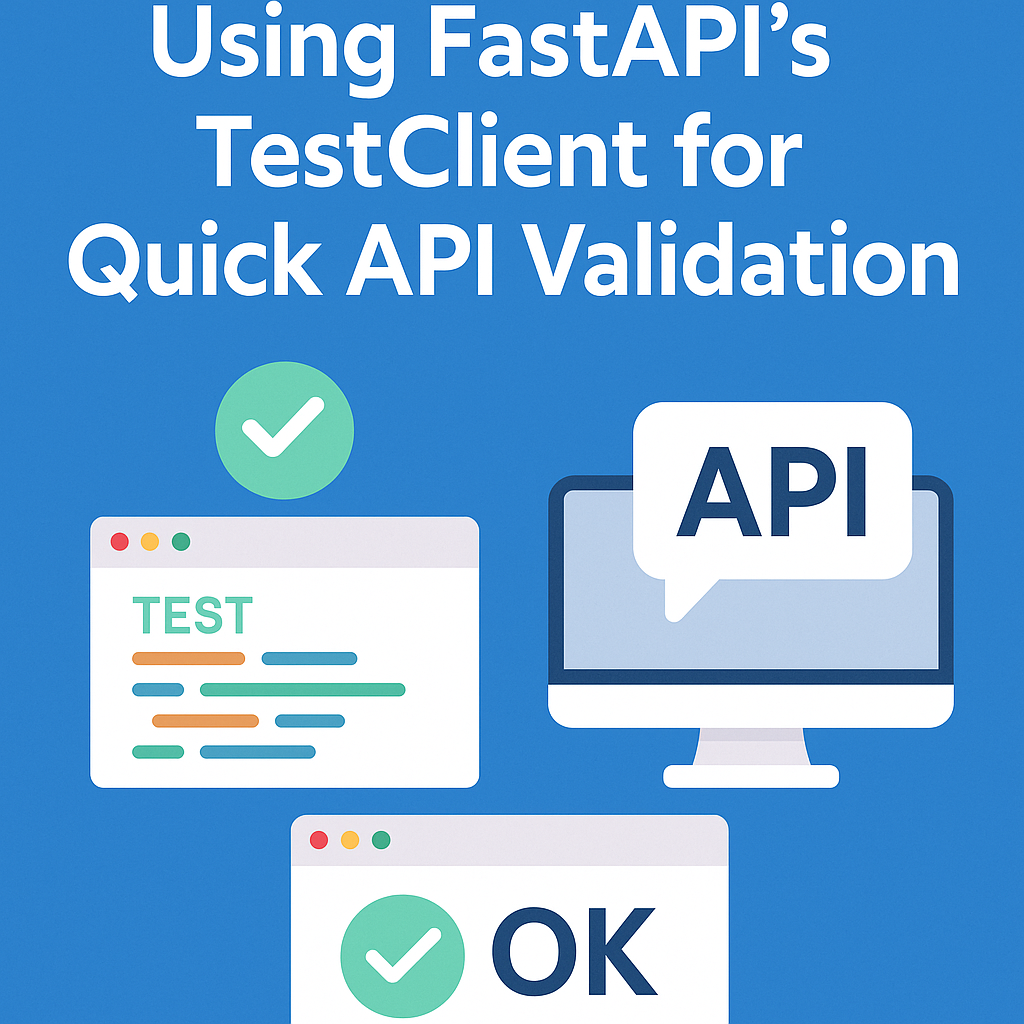
FastAPI provides a straightforward way to test your application without needing to run a live server. The primary tool for this is TestClient.
TestClient is built directly on top of the popular requests library, so the API for making requests (.get(), .post(), etc.) will feel very familiar. It acts as a bridge, routing your test requests directly to your FastAPI application instance.
Let's see how it compares to Django's testing tools.
FastAPI vs Django Rest Framework: A Practical Guide
This article provides a direct, side-by-side comparison of testing a POST endpoint in FastAPI and Django REST Framework. This will help you map your existing knowledge directly to the FastAPI world.
Please read the section titled '4. Testing APIs'. Pay close attention to the code snippets for both FastAPI and DRF. Notice the similarities: you instantiate a client, make a request with a specific method and path, and then assert the response's status code and content.
As you can see, the patterns are nearly identical. In DRF you use APIClient; in FastAPI, you use TestClient. Both allow you to simulate HTTP requests and inspect the results.
Testing Endpoints with Dependencies
Testing a simple, stateless endpoint is easy. But what about an endpoint that needs to talk to a database? You don't want your tests to interact with your production database. This is where FastAPI's Dependency Injection system becomes essential for testing.
Let's watch a video that explains this problem and a clean solution.
Mastering API Testing with FastAPI: Databases, Dependencies, and More!
This segment from ArjanCodes explains why directly creating a database session inside an endpoint is problematic for testing and how refactoring to use dependency injection (Depends) solves this.
Watch from 07:03 to 10:12. The key takeaway is that by injecting the database session as a dependency, you create a seam in your code that allows you to replace the real database with a test database during testing.
By defining a get_db dependency, your endpoint signature changes from this:
# Hard to test
@app.post("/items/")
def create_item(item: ItemCreate):
    db = SessionLocal() # Direct, hard-coded dependency


    # ... logic ...
    db.close()
To this:
# Easy to test
@app.post("/items/")
def create_item(item: ItemCreate, db: Session = Depends(get_db)):


    # ... logic ...
Now, during tests, we can tell FastAPI: "Whenever you see a request for the get_db dependency, don't run the real function. Instead, run this other function that I'm providing just for this test." This is called dependency overriding.
Setting Up a Test Database Environment
So, what do we override get_db with? We need a function that yields a session connected to a dedicated test database. The most common approach for fast tests is to use an in-memory SQLite database.
This video segment will walk you through setting up the test database and performing the override.
Mastering API Testing with FastAPI: Databases, Dependencies, and More!
Now let's see how to create a test database configuration and use FastAPI's dependency_overrides to plug it into our app for testing.
Watch from 10:46 to 15:07. Focus on these key steps: Creating a new SQLAlchemy engine for an in-memory SQLite database (sqlite:///:memory:). Adding the connect_args={"check_same_thread": False} argument, which is specific to SQLite. Creating an override_get_db function that yields a session from this new test engine. Using app.dependency_overrides[get_db] = override_get_db to activate the override.
With this setup, any request made via TestClient will be routed to your in-memory test database, keeping your tests isolated and fast.
Writing Synchronous CRUD Tests
Now that we have the full setup—a TestClient, a testable endpoint using Depends, and a dependency override for the database—we can write tests for our CRUD operations.
We also need to ensure our database tables are created before the tests run and cleaned up afterward. The video demonstrates a simple way to do this with setup and teardown functions, but a more robust method uses pytest fixtures, which we'll see later.
Mastering API Testing with FastAPI: Databases, Dependencies, and More!
Let's see the full implementation of tests for create, read, update, and delete endpoints using the setup we've just discussed.
Watch from 14:55 to 18:02. You don't need to memorize the code, but observe the pattern for each test: Create: POST to /items/, assert status 200, and check if the response body contains the correct data. Read: GET /items/{item_id}, assert status 200, and verify the data. Update: PUT /items/{item_id}, assert status 200, and check for the updated name/description. Delete: DELETE /items/{item_id}, assert status 200, and then make a GET request for the same ID and assert you get a 404 Not Found.
This covers testing with TestClient, which is ideal for synchronous (def) endpoints. But what about the async def endpoints that make FastAPI so powerful?
Asynchronous Testing with httpx.AsyncClient
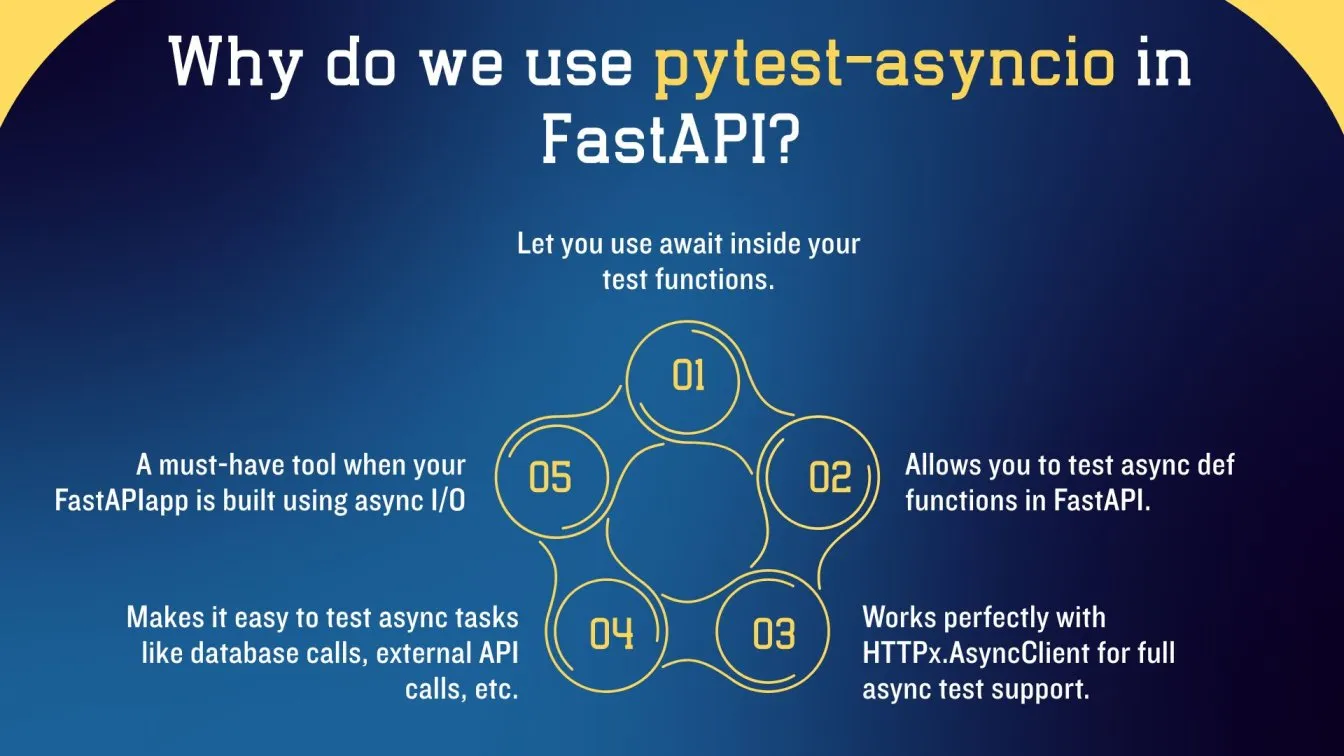
While TestClient can test async endpoints (it runs them in a separate event loop), the modern and more direct way is to use an async-native test client. The standard for this is httpx.
FastAPI is an ASGI application, and httpx can interface with any ASGI app directly, allowing you to await your API calls in your tests. To enable this, you need the pytest-asyncio plugin.
Let's see a quick demonstration of httpx.AsyncClient in action.
HTTPX Tutorial - A next-generation HTTP client for Python
This short clip from a tutorial by Patrick Loeber shows how to use httpx.AsyncClient to test an async FastAPI endpoint.
Watch from 06:13 to 07:33. The key things to note are: The test function is defined with async def. The client is created in an async with httpx.AsyncClient(...) block. The API call is made with await client.get(...).
This pattern is the foundation for all your asynchronous tests.
A Professional Setup for Async Testing
For a real project, you'll want a more structured and reusable way to set up your test client and database. This is where pytest fixtures shine. A fixture is a function that runs before a test to provide data or objects, like a database session or a test client.
Let's look at a professional project structure that uses fixtures in a conftest.py file to manage the async test setup.
FastAPI, Furious Tests: The Need for Speed
This article demonstrates a robust, fixture-based approach for testing async FastAPI applications. This aligns with your goal of learning modern, professional coding practices.
First, read the code in the 'The Fixture Magic (tests/conftest.py)' section. Pay attention to the @pytest.fixture decorators. See how it defines fixtures for the engine, the sessionmaker, the app (with the dependency override), and finally the async client. Then, look at the 'Sample Tests That Actually Work' section, specifically the tests/component/test_users.py file. Notice how the test functions test_create_user_endpoint and test_get_user_endpoint simply accept client as an argument. Pytest automatically provides the configured AsyncClient from the fixture. This is a very clean and scalable pattern.
Using fixtures in conftest.py makes your tests cleaner and more maintainable by abstracting away the setup logic. The test itself can then focus purely on the "arrange, act, assert" pattern.
Here’s a summary of the two clients:
| Client | Based On | Use Case | Test Function | Request Syntax |
|---|---|---|---|---|
TestClient |
requests |
Synchronous testing | def |
response = client.get(...) |
AsyncClient |
httpx |
Asynchronous testing | async def |
response = await client.get(...) |
For a project that heavily uses async/await, httpx.AsyncClient with pytest-asyncio is the recommended approach.
Conclusion
Congratulations! You've taken your first and most crucial step into ensuring your FastAPI applications are robust and reliable. You now have the tools to verify your API's behavior automatically.
Key Takeaways:
TestClientis FastAPI's built-in tool for synchronous testing, with an API similar torequestsand Django'sAPIClient.httpx.AsyncClientis the modern standard for testingasyncendpoints. It requirespytest-asyncioand allows you to useasync/awaitdirectly in your tests.- Dependency Injection is Key for Testability: Using
Dependsfor database sessions allows you to useapp.dependency_overridesto swap in a test database. - Isolate Your Tests: Always use a separate, isolated database for testing, like an in-memory SQLite database, to ensure tests are fast and don't affect real data.
- Fixtures Streamline Setup: Using
pytestfixtures in aconftest.pyfile is a professional pattern to manage complex setup logic for your tests.
Preview of the Next Lesson:
Today, we focused on overriding the database dependency to connect our application to a test database. But what if your endpoint depends on something else, like an external payment gateway or an email service? You wouldn't want your tests to make real payments or send real emails.
In the next lesson, we will expand on the concept of dependency overrides. You will learn how to use dependency overrides in tests to inject mocks for external services or database sessions, giving you complete control over your application's environment during testing.