Hello! Welcome back.
In our previous lesson, we explored FastAPI's BackgroundTasks, a handy feature for running simple "fire-and-forget" operations after sending a response to a client. You learned how to offload tasks like sending an email to prevent blocking the request-response cycle and improve your API's responsiveness.
Today's lesson directly addresses the learning outcome: Explain the use cases for BackgroundTasks versus a dedicated task queue like Celery.
We'll build on what you've learned to construct a clear mental framework for deciding which tool is right for the job. This is a crucial architectural decision, and understanding the trade-offs will be a significant step in your journey to mastering FastAPI. Given your background with Django, you're likely familiar with Celery as the standard for handling background work; this lesson will formalize that knowledge within the FastAPI context.
The Limits of Simplicity: When BackgroundTasks Aren't Enough
As we touched on previously, BackgroundTasks are wonderfully simple because they run within the same process as your FastAPI application and require no extra infrastructure. However, this simplicity is also their biggest limitation.
Let's dive into a resource that clearly outlines the strengths and weaknesses of this approach.
Practical Background Processing with FastAPI: A Job Queue Design Guide
This article from the 'IT & Life Hacks Blog' provides an excellent breakdown of where BackgroundTasks shine and, more importantly, where they fall short. Understanding these limits is the first step in knowing when to reach for a more powerful tool.
Please read the section titled '3. Design points and limits of BackgroundTasks'. Pay close attention to the lists under 'Cases where it fits well', 'Cases where it doesn’t fit well', and 'Common pitfalls and countermeasures'.
Based on the reading, let's summarize the critical limitations of BackgroundTasks:
- No Persistence: Tasks exist only in your application's memory. If the server process crashes or restarts for any reason, any pending background tasks are lost forever.
- No Guaranteed Delivery or Retries: If a task fails—perhaps an external API is temporarily down—it will not be automatically retried. The failure is simply logged (if you've set up logging correctly), and the task is gone.
- No Status Tracking:
BackgroundTasksare truly "fire-and-forget." There is no built-in way to check on the status of a task (e.g., pending, in-progress, success, failure) after it has been dispatched. - Shared Resources & Performance Issues: Because tasks run in the same process as your API, they compete for the same CPU and memory.
- A CPU-intensive task (like generating a complex report) will block the server's event loop, making your entire API unresponsive.
- A memory-intensive task can consume all available memory, potentially crashing the entire application server.
- Limited Concurrency: Synchronous
deftasks are executed in a thread pool with a limited number of workers (the default is 40). If you dispatch many slow tasks at once, you can saturate this pool, causing new tasks to wait.
These limitations make BackgroundTasks unsuitable for anything that is long-running, resource-intensive, or business-critical.
The Robust Solution: Dedicated Task Queues like Celery
When you outgrow BackgroundTasks, you need a dedicated, distributed task queue system. For Python developers, the industry standard is Celery. As a Django developer, you know that the Django + Celery combination is the go-to solution for any serious background processing. The same principles apply to FastAPI.
A system like Celery is designed from the ground up to solve the problems BackgroundTasks cannot. It does this by decoupling the task processing from your web application.
Let's look at the architecture.
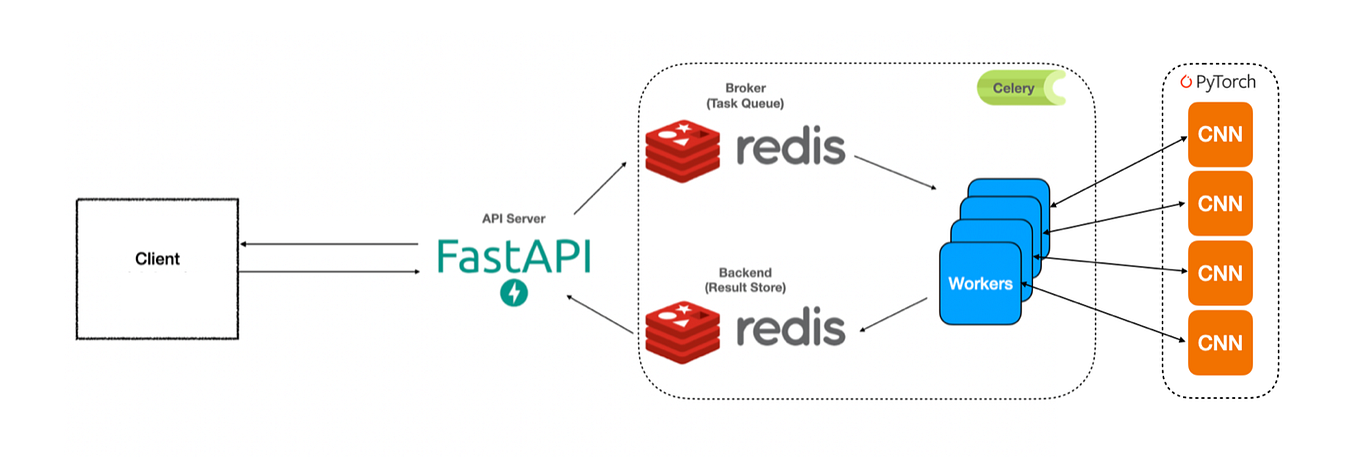
This architecture consists of four key components:
- Client (Producer): Your FastAPI application. Its only job is to enqueue a task (put a message in the queue) and immediately return a response to the user.
- Broker (Message Queue): A message transport service like Redis or RabbitMQ. It acts as a durable middleman, holding the list of tasks to be done. If your FastAPI app or workers crash, the tasks remain safely in the broker, ready to be picked up later. This solves the persistence problem.
- Worker (Consumer): One or more separate processes (or even separate machines) whose only job is to watch the broker for new tasks. When a task appears, a worker pulls it from the queue and executes it. Because these are separate processes, they don't block your API server. You can scale the number of workers independently of your API servers. This solves the shared resources and scalability problems.
- Result Backend: A storage system (like Redis or a database) where workers can store the results and status of completed tasks. This allows your application to check on a task's outcome later. This solves the status tracking problem.
The following video explains this flow and the roles of these components very clearly.
FastAPI Tutorial #12: Background Jobs From Base to Production with Celery, Redis & Docker
This clip from Code Goat's FastAPI tutorial provides an excellent animated explanation of the Celery workflow, showing how all the pieces fit together.
Watch from 28:49 to 35:56. Focus on the architectural diagram the presenter draws. He clearly explains how the request flows from the user, how a heavy task is sent to Celery, queued in Redis, and processed by a worker.
Side-by-Side Comparison: The Decision Matrix
Now that we understand the two approaches, let's put them side-by-side. The article you read earlier provides a perfect comparison table.
| Aspect | BackgroundTasks |
Celery |
|---|---|---|
| Execution Location | Same process as the FastAPI app | Separate worker processes; can be on separate hosts |
| Dependencies | None (built-in to FastAPI/Starlette) | Requires a Broker (e.g., Redis, RabbitMQ) and running workers |
| Execution Timing | After the HTTP response is sent | As soon as a worker is free to take the task from the queue |
| Retries & Delays | Not supported; must be implemented manually | Supported out of the box (e.g., retry, countdown) |
| Task State Management | Not supported; must be implemented manually | Task IDs, status, and results are manageable via a backend |
| Scaling | Tied to the scaling of the API servers | Workers can be scaled independently of the API |
| Best Suited For | Lightweight, short-running, non-critical "fire-and-forget" tasks | Heavy, long-running, critical, or high-volume batch jobs |
(This table is adapted from the resource "Practical Background Processing with FastAPI: A Job Queue Design Guide")
Your Decision Framework: When to Use Each
This comparison gives us a clear framework for making a decision.
Use FastAPI BackgroundTasks when:
- Tasks are quick and simple (e.g., a few seconds at most).
- You can tolerate task loss. If the server restarts and a notification email isn't sent, it's not a disaster.
- You want zero additional infrastructure. It's perfect for small projects, prototypes, or simple features where setting up Redis and Celery workers would be overkill.
- Common examples: Sending a single notification email, calling a logging webhook, invalidating a simple cache entry.
Use Celery (or another dedicated task queue) when:
- Tasks are long-running or resource-intensive. Think video transcoding, generating large PDF reports, or running machine learning inferences.
- Reliability is paramount. Tasks must be completed, even if the server restarts. Examples include processing payments or updating critical user data.
- You need advanced features like scheduled tasks (e.g., run every night at midnight), automatic retries with exponential backoff, or rate limiting.
- You need to scale. If you anticipate processing thousands of jobs, you'll need to scale your workers independently of your web servers to handle the load.
- You need to monitor the queue. Celery has tools like Flower that provide a web UI to monitor your workers and tasks, which is invaluable for production systems.
Background Tasks with FastAPI Background Tasks and Celery + Redis - FastAPI Beyond CRUD (Part 20)
The video by Ssali Jonathan introduces Flower, a web-based tool for monitoring Celery. Seeing this will help you appreciate the robust ecosystem that comes with Celery.
Watch from 36:00 to 41:20. You don't need to follow the code, just observe how the Flower UI provides a detailed, real-time view of tasks, their statuses (success, failure), execution time, and worker health. This is a level of observability BackgroundTasks simply does not offer.
Conclusion
You have now built a solid understanding of the trade-offs between FastAPI's built-in BackgroundTasks and a full-fledged distributed task queue like Celery.
Key Takeaways:
BackgroundTasksare a convenience feature for simple, non-critical, in-process tasks. Their main advantage is simplicity and lack of external dependencies.- Celery is a robust system for reliable, scalable, and complex background job orchestration. It provides persistence, retries, monitoring, and independent scaling at the cost of additional infrastructure (a broker and workers).
- The choice is an architectural one: Start with
BackgroundTasksfor simple needs, but plan to migrate to Celery as your application's workload and reliability requirements grow. For any serious production system with critical background work, Celery is the standard choice.
Preview of the Next Lesson:
We've now covered two advanced FastAPI features: BackgroundTasks and a conceptual overview of integrating with Celery. As applications grow in complexity, ensuring they work correctly becomes paramount. In our next lesson, we will begin the "Testing and Production Deployment" module by learning how to write synchronous and asynchronous tests for API endpoints using TestClient and httpx.AsyncClient.