Hello! Welcome to your very first lesson on the art of fiction writing. Since you're looking to build stories from the ground up, our journey begins with the absolute fundamentals. In this session, we'll explore the essential anatomy of a story, aiming to meet our first learning outcome: to identify the core elements of a story: character, plot, setting, conflict, and theme.
Think of these elements as the primary ingredients a chef uses. Just as a chef must understand flour, water, salt, and yeast before baking bread, a writer must understand these five components to craft a compelling narrative. Mastering this foundation will empower you to move from brainstorming ideas to consciously building your own fictional worlds, which is the first step toward writing the kinds of stories you love to read.
The Five Core Elements: An Overview
Every story you've ever read, from epic fantasy novels to intimate character dramas, is built upon the same five pillars. Let's begin with a simple visual summary of what they are.
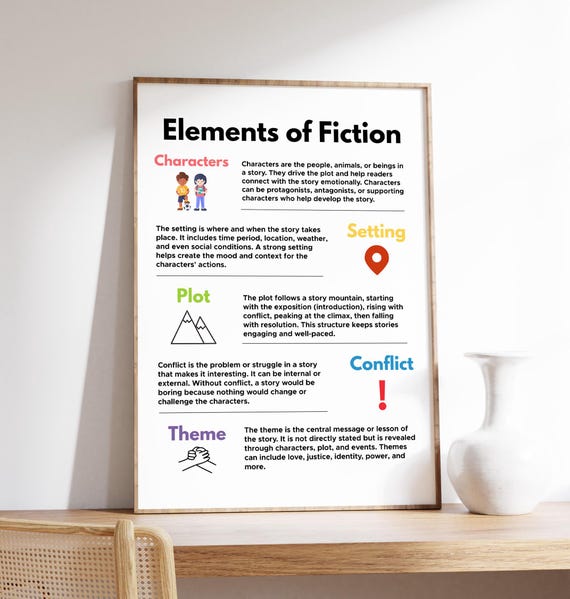
This gives us a great starting point. Now, let's add more detail to these definitions. Since you prefer to understand the theory first, we'll consult a more structured guide that breaks down each element.
The following document, "Five Elements of Fiction," offers clear and concise academic definitions. Please read the sections that define each of our five core elements.
[PDF] Five Elements of Fiction: Plot, Setting, Character, Point of View, Theme
This document provides a clear, structured breakdown of the core components of storytelling. It will give you the formal definitions we'll be working with throughout the course.
As you read, focus on understanding the specific role each element plays: In the Plot section, read the main definition and the descriptions for the five parts, from Exposition through Conflict. Pay close attention to the definition of Conflict and its two main types: Internal and External. Next, read the definition and the five aspects of Setting, from the heading "II. Setting" down to the end of that section. Then, move to the Character section. Read the definitions for Protagonist and Antagonist. Finally, read the main definition of Theme under the heading "V. Theme".
After this reading, you should have a solid grasp of what each element is on its own.
- Character: The who of the story.
- Setting: The where and when.
- Plot: The sequence of events, or what happens.
- Theme: The central idea or message, the what it's all about.
- Conflict: The struggle or opposition, the why it's interesting.
Of all these, conflict plays a uniquely dynamic role. It's more than just an ingredient; it's the catalyst that makes the story happen.
Conflict: The Engine of Story
A story without conflict is just a description or a sequence of inert events. It’s a character sketch, a travelogue, or a philosophical statement—but it isn't a story. Conflict is the engine that drives the narrative forward, forcing characters to act and revealing who they truly are.
Brandon Sanderson, a bestselling author in the fantasy genre you enjoy, has a great way of conceptualizing this. He thinks of Plot, Setting, and Character as three pillars, with Conflict acting as the essential force that connects them all.
The Three Pillars of Storytelling—Brandon Sanderson
In this clip from one of his lectures, Brandon Sanderson explains why conflict is the "glue" that transforms a collection of ideas into a living story.
Watch from the beginning to about the four-minute mark. Pay special attention to these parts: The three pillars: Here, he introduces his model of plot, setting, and character, with conflict in the middle. Key questions: He discusses two powerful questions to generate conflict: "What does my character want, and why can't they have it?" and "What does the character want versus what do they need?".
Sanderson's questions get to the heart of storytelling. The "why can't they have it?" is your story's conflict. This opposition can come from many places. The video below provides an excellent breakdown of the common types of conflict you'll encounter and use in your writing.
Elements of Literary Fiction: Characters, Setting, Plot, Theme, and Point of View
This video from The Learning Depot offers a clear and concise typology of literary conflict.
Please watch the section on conflict, from this segment. The narrator explains the six main types of conflict, expanding on the Internal (Character vs. Self) and External (Character vs. Character, Nature, Society, etc.) categories we saw in the PDF.
Thinking about conflict in these specific terms (e.g., Character vs. Society) is incredibly useful. If you have an idea for a "cold and intelligent" character, you can immediately start asking questions. What if she wants to achieve a professional goal (what she wants), but the rules of her society forbid it (Character vs. Society)? And what if, to succeed, she must learn to trust an emotional rival she despises (what she needs)? Suddenly, you have the seeds of a plot, a character arc, and a theme.
How the Elements Weave Together
The most powerful stories are those where the elements are not just present but deeply intertwined. A character’s internal struggle should be reflected in the external plot. The setting should create obstacles or shape the characters' choices. And most importantly, the resolution of the central conflict should reveal the story's theme.
This brings us to a simple but profound equation for storytelling.

Let's break down this diagram:
- Plot (Left Circle): This is driven by an External Conflict caused by an "Outer Problem." For example, a kingdom is threatened by a dragon. The solution is blocked by some internal problem of the hero.
- Character (Right Circle): This is driven by an Internal Conflict caused by an "Inner Problem." For example, the hero is crippled by self-doubt. The solution to this inner problem is often catalyzed by the external conflict—facing the dragon forces the hero to find their courage.
- Theme (Center): The theme emerges when the character resolves both conflicts. The combined solution—where the hero finds their courage and defeats the dragon—demonstrates the story's central message. The theme isn't stated; it's proven by the character's journey through the plot.
For instance, in the Harry Potter series, the Plot involves the external conflict of defeating Voldemort. The Character arc for Harry involves the internal conflict of accepting his destiny and understanding that his capacity for love is his greatest strength. The Theme that "love is more powerful than death" is not just a nice idea; it's the direct result of Harry resolving his internal conflict, which in turn allows him to resolve the external one.
Conclusion
In this lesson, we have defined the five fundamental building blocks of fiction. Let's recap the key takeaways:
- The Five Core Elements: Every story is constructed from Character, Setting, Plot, Conflict, and Theme.
- Conflict is the Engine: Conflict is the critical element that creates tension, drives the plot, and forces character change. It's the answer to the question, "What does my character want, and why can't they have it?"
- The Elements are Interconnected: The most effective stories weave these elements together. Theme, in particular, emerges naturally from the resolution of a character's internal and external conflicts within the plot.
You now have the basic architectural vocabulary of storytelling. In our next lesson, we will put this theory into practice. We'll learn how to distinguish between a premise and a fully developed story concept, taking the first step in transforming a simple idea into a solid foundation for a story.