Welcome to the seventh lesson in our module on George Herbert Mead. Over the past several lessons, we have assembled a powerful set of theoretical tools from Mead's work. We've explored how the self emerges from social interaction, the roles of the 'I' and the 'Me', the function of the "generalized other," and the developmental journey through the play and game stages.
Today, we will put this entire toolkit into practice. Our learning outcome is to apply Mead’s theory to identity formation in a contemporary social setting. We will move from abstract concepts to concrete analysis, demonstrating how a theory developed a century ago offers profound insights into our 21st-century lives, particularly in the digital realm. This skill of applying classical theory to modern phenomena is not just academically enriching; it is a core competency for writing high-scoring answers in the UPSC sociology paper.
Recapping Mead's Framework
Before we apply the theory, let's briefly consolidate its key components. Mead's central argument is that the self is not a pre-existing entity but is actively and continuously constructed through social interaction and the use of symbols.
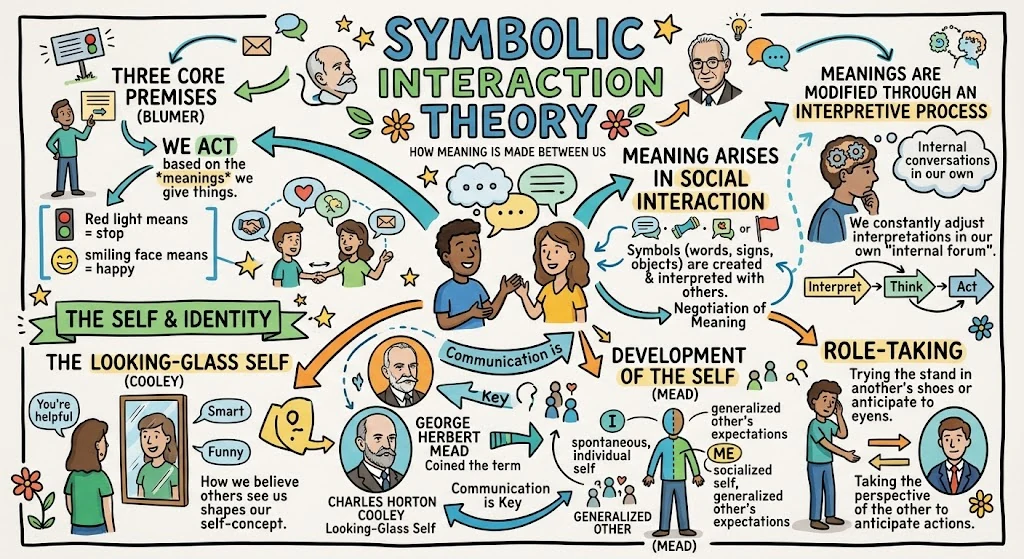
As the chart shows, this process involves several interconnected ideas you are now familiar with:
- Meaning: We act toward things based on the meanings we assign to them, which are created and modified through social interaction.
- The Self ('I' and 'Me'): The self has two aspects—the "Me," which is the socialized self that internalizes the community's attitudes (the generalized other), and the "I," which is our spontaneous, impulsive response to the "Me" and the social situation.
- Development: We develop this complex self through stages, progressing from imitation to play (taking the role of one other at a time) and then to the game (simultaneously understanding a whole system of roles).
With this framework in mind, let's explore its application in a setting that was unimaginable in Mead's time but is central to ours: the internet.
Identity Construction on Social Media
Social media platforms like Instagram, X (formerly Twitter), or Facebook are powerful arenas for identity work. They are not merely platforms for communication; they are stages on which we construct and present a self to an audience. Mead's theory provides an excellent lens for analyzing this.
The profile you curate on a social media platform is a quintessential example of the "Me." It is the self as an object, carefully crafted for social consumption. The photos you choose, the bio you write, and the content you share are all selected based on your understanding of the "generalized other"—the expectations of your followers, friends, and the broader cultural norms of the platform. You anticipate how others will judge your posts, and you shape your self-presentation to elicit positive responses (likes, shares, supportive comments) and avoid negative ones.
The "I" is your spontaneous reaction—the urge to post an unfiltered thought, an unedited photo, or a controversial opinion. However, this "I" is constantly in dialogue with the "Me." Before you hit 'post', the "Me" often intervenes, asking: "What will people think?" This internal conversation, this negotiation between the impulsive "I" and the socialized "Me," is precisely the process Mead described.
Let's explore this application in more detail.
Module 07: How Are Individuals Shaped into Society? – The Online Sociologist
This article from The Online Sociologist directly applies symbolic interactionism to social media. Please read the section titled Symbolic Interactionism: Social Media and the Construction of Beauty.
Focus on how users are not passive consumers but active agents who negotiate meaning. Notice the explanation of how interactions, such as likes and comments, shape both an individual's self-concept and the collective definition of what is considered beautiful or desirable.
As the text explains, social media is a dynamic space where meanings are constantly being created and reinforced. Every trend, hashtag, or viral challenge is a symbol whose meaning is co-constructed by the community. By participating, we are not just presenting a self; we are actively shaping the "generalized other" for everyone else.
The Self in Virtual Worlds: Avatars and Identity Play
Virtual environments, such as those in the Metaverse or in massive multiplayer online games (MMORPGs), offer an even more radical space for identity formation. Your background in computer science gives you a unique appreciation for how these constructed realities operate, allowing for a level of identity experimentation that goes far beyond a social media profile.

In these spaces, a user's avatar is their symbolic presence. It is a digital body and persona that can be designed and modified. This provides a fascinating modern parallel to Mead's developmental stages.
- An Advanced 'Play Stage': A user might experiment with different avatars—changing their appearance, gender, or species. Each new avatar allows them to "play" at being a different kind of person, taking on a new role and experiencing the world from that perspective. They see how others in the virtual world react to this new self.
- The 'Game Stage' in Action: In a complex online game, a player must do more than just control their own avatar. They must understand their role (e.g., healer, tank, damage dealer) in relation to the roles of all their teammates and opponents. They internalize the "rules of the game" and the collective strategy of their group—a perfect illustration of internalizing a "generalized other" to achieve coordinated action.
A recent study on the virtual platform ZEPETO provides powerful evidence of these processes. It explores how users' identities are shaped when they adopt avatars that don't match their offline gender.
This research article from Frontiers in Virtual Reality provides a detailed sociological analysis of identity in virtual worlds, explicitly using Mead's theory. It's a fantastic example of applying classical theory to contemporary research.
First, read the subsection "Symbolic interactionism and self-identity". Pay close attention to how the authors connect avatars to the 'I' and 'Me'. Next, read the section "Symbolic interactionism and virtual space self-identity". This part introduces concepts from Goffman and Butler that build on Mead's ideas, explaining how virtual spaces allow for fluid identity performances. Then, skim the in-depth interview results. Focus on the participant quotes under the headings "Impact on self-perception" and "Real-world implications". Finally, read the subsection "Implications for Gender Sensitivity". Note how the virtual experience of embodying a different gender led to increased empathy and a greater awareness of gender bias in the real world.
This study beautifully illustrates Mead's core principles in a contemporary context:
- The Self is Social: The participants' self-perceptions shifted based on the social interactions they had while using a different avatar. They saw themselves through the eyes of others in the virtual world.
- Interaction Shapes Identity: The experience wasn't just "play"; it had real-world consequences, altering their understanding of gender and increasing their empathy. The virtual experience reshaped their real-life "Me."
- The 'I' and 'Me' Dialogue: The choice to use a male avatar can be seen as an act of the "I"—an exploration. The subsequent experiences and social feedback were then incorporated into the "Me," leading to a new, more complex self-concept. The quote, "Using a male avatar allowed me to explore parts of my identity that I usually suppress," is a powerful testament to this process.
Conclusion
In this lesson, we have moved George Herbert Mead's theory out of the textbook and into the dynamic, complex world of digital interaction. By applying his concepts to social media and virtual environments, we see their remarkable and enduring power. The processes of identity formation he described in the early 20th century are not only still relevant but are arguably amplified in an age where we can literally design, perform, and negotiate our selves on a global stage.
Here are the key takeaways for your UPSC preparation:
- Mead's theory is a practical tool for analysis. It can be applied to understand contemporary social phenomena like online identity, social media behavior, and virtual communities.
- Online spaces are arenas for symbolic interaction. Avatars, profiles, likes, and shares are all symbols that we use to construct meaning and shape our sense of self.
- The concepts of 'I', 'Me', and the 'generalized other' explain the dynamics of online self-presentation. They help us understand the tension between individual expression and social conformity in the digital world.
- Virtual experiences can have real-world consequences. As the ZEPETO study shows, the "play" and "games" we engage in online can reshape our understanding of ourselves and society.
This lesson has equipped you with the ability to use Mead's theory for sociological analysis. In our final lesson for this module, we will synthesize everything we've learned about Mead to tackle the ultimate goal for any UPSC aspirant: writing a concise, evaluative, and high-impact answer that assesses his overall contribution to sociology.