Welcome to your first lesson in the Sociology Paper I course. I'm excited to embark on this journey with you as you prepare for the UPSC examination. You've indicated a desire to start directly with George Herbert Mead's theory of the self, and this lesson is designed to lay a strong foundation for that topic.
Our goal today is to address a fundamental question in Mead's work: How do the mind and the self emerge through social interaction? We will unpack this by exploring how Mead, a central figure in the symbolic interactionist tradition, saw our innermost thoughts and our very sense of identity as products of our social life, rather than as pre-existing biological facts. This perspective offers a profound shift from common-sense understandings and is crucial for sociological analysis.
The Social Foundation of Mind and Self
To begin, it's important to grasp the revolutionary nature of Mead's starting point. While psychology often treats the mind and self as internal entities located within the individual, Mead argued that they are fundamentally social. He proposed that we cannot understand what a "mind" or a "self" is without first understanding the social processes they emerge from. An individual with a fully formed mind and self does not simply enter society; rather, society shapes and creates the mind and self through interaction.
This short video lecture provides an excellent introduction to this core idea. It contrasts Mead's sociological approach with purely psychological ones and sets the stage for understanding the deep connection between mind, self, and society.
#49 Mind, Self & Society | Classical Sociological Theory
Please watch the beginning of the lecture "#49 Mind, Self & Society" from the NPTEL-NOC IITM channel.
Watch the section from the introduction. Pay close attention to how the lecturer distinguishes Mead's micro-sociological focus from other theories and from psychology. The key takeaway is the argument that society plays a "pivotal role" in shaping the mind and self, rather than them being pre-formed.
From Gestures to Mind: The Internal Conversation
Now that we have established the social origin of mind and self, let's explore the specific process through which the mind emerges. For Mead, the mind is not the physical brain, but a behavioral process: the ability to think, to reflect, and to have an internal conversation with oneself.
How does this capacity develop? Mead argues it begins with gestures. Animals communicate through a "conversation of gestures" (e.g., a dog's snarl is a stimulus that causes another dog to retreat). This is a simple stimulus-response interaction. Humans, however, develop something unique: significant symbols.
A significant symbol is a gesture (like a word or a sign) that arouses the same meaning in the person making it as it does in the person receiving it. Language is the ultimate system of significant symbols. When you use the word "tree," you have an idea of a tree in your mind, and you trust that the person hearing you will have a similar idea. This shared meaning is what makes complex thought and society possible.
The ability to use significant symbols allows us to "talk to ourselves," to rehearse actions mentally, to consider different possibilities, and to see a situation from multiple points of view. This internal conversation is the mind, according to Mead. Without social interaction to learn these symbols, the mind cannot develop.
The following segments from the same NPTEL lecture provide a detailed explanation of this process. The lecturer uses the powerful example of "wolf children" to illustrate what happens in the absence of human social interaction.
#49 Mind, Self & Society | Classical Sociological Theory
Continue with the NPTEL lecture, which now dives into the mechanics of how the mind emerges from social life.
First, watch the segment from the argument for interaction. Note the critical statement: "Without interaction, mind could not exist." The example of children reared by wolves powerfully illustrates this dependency on a social environment. Next, watch the explanation of significant symbols. Focus on what distinguishes a simple gesture from a "significant" one and why language is the most important example. Finally, watch the detailed discussion from mind as behavior. This part is crucial. The lecturer explains how the mind is an "internal conversation" that allows us to rehearse and assess potential actions. Pay attention to the example of bargaining with a shopkeeper, which vividly demonstrates this internal process of weighing options based on anticipated social responses.
The Emergence of the Self
Once the mind has emerged through the use of significant symbols, the development of the self becomes possible. For Mead, the self is the ability to step outside of oneself and view oneself as an object. It's the capacity for self-consciousness. Just like the mind, the self is not something we are born with. An infant has no sense of self; it is acquired through social interaction.
How do we learn to see ourselves as objects? By learning to see ourselves as others see us. This process is called role-taking. By imagining how others (our parents, friends, and community) perceive us, we begin to form a concept of who we are. The self, therefore, is a reflection of the social world, pieced together from the viewpoints of others.
The following reading from Topiqos, a resource tailored for UPSC preparation, provides a concise and powerful explanation of this idea. It introduces the concept of the self as an "emergent property."
Mead — Self and Identity | UPSC Notes | Topiqos
This reading frames Mead's concept of the self in a philosophically precise way that is very useful for analysis.
Please read the section titled "Philosophical Dimension: Pragmatism and Emergence." Focus on the idea of the self as an emergent property that arises in the "space between persons." This concept elegantly captures that the self is not reducible to an individual's biology but is created through social relationships.
To reinforce this, the text from Elite IAS, another valuable UPSC resource, clearly states Mead's position on the self.
George Herbert Mead: Self, Mind and Society
This excerpt provides a straightforward summary of Mead's theory of the self, which will be the basis for our next lessons.
In this text, please read the section "Mead’s Concept of Self," starting from the beginning of the section down to the sentence describing the self's origin. This directly connects the self to the ability to see oneself from others' perspectives.
Synthesizing the Process
Let's bring these ideas together. The diagram below provides a visual summary of how different social processes build upon one another to form the self in Mead's theory.
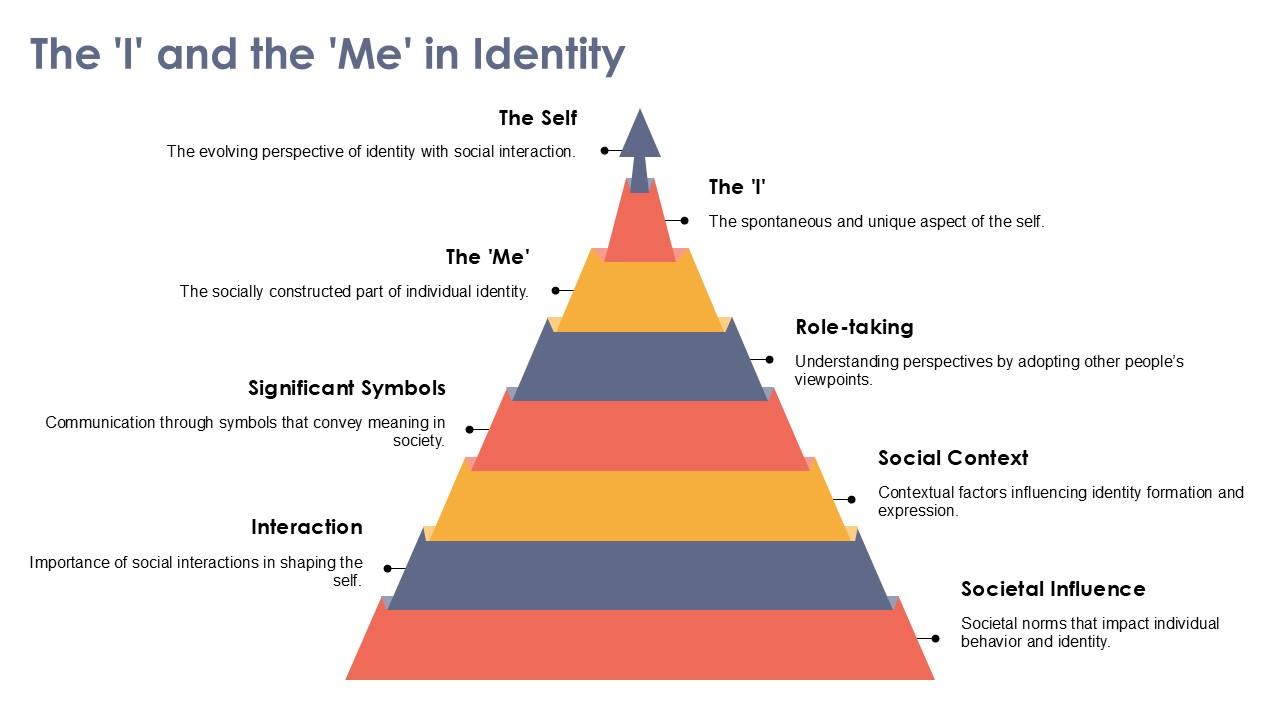
As the diagram shows, the process is layered:
- It begins with societal influence and direct interaction.
- Through interaction, we learn significant symbols.
- These symbols enable role-taking—seeing things from another's perspective.
- This process gives rise to the "Me" (the social self, which we'll discuss next time) and the "I" (your individual response).
- The dialogue between the "I" and the "Me" constitutes the complete Self.
Conclusion
In this lesson, we have explored the foundational principles of George Herbert Mead’s theory of how the mind and self come into being. We have established that for Mead, they are not innate or purely psychological entities but are emergent properties of social processes.
Here are the key takeaways:
- Mind and Self are Social Products: They do not exist at birth but develop through social experience.
- Interaction is Key: The fundamental process is social interaction, which for humans is mediated by significant symbols.
- The Mind is an Internal Conversation: The ability to use significant symbols, particularly language, allows us to think by "talking to ourselves," rehearsing actions and considering alternatives.
- The Self is a Social Object: The self emerges from our ability to take the role of others and see ourselves from their perspective, thereby making ourselves an object of our own thought.
In our next lesson, we will build directly on this foundation. We will examine the role of significant symbols in more detail and begin to distinguish between the two crucial components of the self that Mead identified: the ‘I’ and the ‘Me’. This distinction is essential for understanding the dynamic relationship between individual agency and social control.