Welcome to the final module. It follows what happens at trial with the court’s response to a proven claim: remedies, judgments, appeals, and procedural differences between courts. This lesson focuses on matching a remedy to the problem it is meant to address. A lawsuit might concern an expense already incurred, especially wrongful conduct, or harm that is still threatened. Those are different reasons to ask a court to act.
The distinction matters when reading a complaint or news report. A plaintiff may request millions of dollars or an order stopping the defendant’s conduct. That request is not a finding that the plaintiff is entitled to either remedy.
Start with the kind of relief requested
In a civil case, a remedy is what the court can award if the plaintiff establishes a claim and meets the requirements for that relief. The principal choices include money, an order directing or prohibiting conduct, and a declaration of the parties’ rights.
Covering Civil Cases – Journalist’s Guide
Read the U.S. Courts’ Journalist’s Guide for its overview of what a civil complaint can ask a court to provide.
In “The Plaintiff’s Claim,” read the relief overview, from the opening paragraph through the three-item list. Focus on the difference between an injunction, which directs conduct, and monetary relief, which awards money. Treat the guide’s descriptions of temporary and permanent injunctions as an overview, not as a rule that an injunction automatically follows a request or a trial win.
Suppose someone damages a neighbor’s fence and threatens to remove a tree on the neighbor’s property. Payment for the cost of repairing the fence addresses a past loss. An order forbidding removal of the tree addresses future conduct. A court might consider both if the facts and applicable law support them. Neither follows merely because the neighbor asks.
A declaratory judgment serves a different purpose: it states what the parties’ legal rights are—for example, who has a disputed right to use a piece of land—without itself ordering an act or awarding damages. For this lesson, the central contrast is between money that compensates, money that punishes, and equitable orders that govern conduct.
Compensatory damages: addressing the plaintiff’s loss
Compensatory damages are measured by injury or loss attributable to the defendant’s legally wrongful conduct. Their aim is to compensate the plaintiff, not to express how strongly the court disapproves of the defendant. That is the sense in which lawyers say damages seek to “make the plaintiff whole”: money cannot undo every injury, but it can pay for losses the law recognizes.
Covering Civil Cases – Journalist’s Guide
Return to the Journalist’s Guide for concrete examples of compensatory and punitive awards.
Still in “The Plaintiff’s Claim,” immediately below the three-item relief list, read the damages comparison. It begins with hospital bills and lost wages and continues into the paragraph on punishment. Notice that a loss can be financially documented or less easily priced, such as pain and suffering, if the claim permits recovery for it.
For a simple injury claim, medical bills of dollars and proven lost wages of dollars illustrate direct financial losses. The plaintiff might also seek compensation for pain and suffering where the law allows it, but that amount is not read off a receipt. The plaintiff must establish the relevant injury and support the amount claimed; listing a number in a complaint does not prove it.
Contract disputes offer another illustration. If a seller fails to deliver an ordinary item promised for dollars and the buyer reasonably obtains a comparable replacement for dollars, the additional dollars may be the compensable loss, assuming the original dollars is not also lost. The point is to account for the actual position the breach left the buyer in, without paying twice for the same loss.
The available measures and limits depend on the type of claim and the governing law. But the question that identifies compensation is stable: What loss did this plaintiff suffer that this award is meant to address?
Punitive damages: addressing unusually blameworthy conduct
Punitive damages have a different target: the defendant’s conduct. They are intended to punish sufficiently serious wrongdoing and deter similar behavior. They are not a substitute name for a large compensatory award. A severe injury could justify substantial compensation even if the conduct does not qualify for punitive damages; conversely, angry language about a defendant does not establish an entitlement to punishment.
Imagine two versions of a property-damage case. In one, a driver carelessly backs into a fence. In the other, a person deliberately destroys it as part of a malicious campaign against the owner. Repair costs may be compensable in either version if the legal claim is proved. The second version raises a separate question about punitive damages, but the answer still depends on the applicable law, the required proof, and any limits on the award. Punitive damages are not automatic whenever conduct is intentional.
A straightforward breach of contract normally seeks to compensate the non-breaching party rather than punish the party who broke the promise. The following short reading also introduces an alternative when money cannot adequately address a contract dispute.
damages | Legal Information Institute
Read the Legal Information Institute’s discussion of contract remedies to see why a damages claim is usually compensatory and when a court might consider requiring performance instead.
On the “damages” page, find the contract-law paragraph beginning “Punitive damages are largely not awarded in contract disputes,” immediately before the paragraph beginning “In a tort case.” Read that paragraph through its final sentence. Focus on the ordinary distinction between compensation for a broken promise and an order to perform when the promised item cannot adequately be replaced with money.
A further distinction helps when reading a headline: punitive damages in a civil lawsuit are not a criminal fine. They arise as a potential civil remedy for the plaintiff under applicable law. Their availability, proof requirements, and limits can differ across claims and jurisdictions.
Equitable remedies: addressing conduct that money may not fix
Sometimes the central problem is not the price of what has already happened. The plaintiff needs conduct to stop, or needs a promised act performed. These requests are generally called equitable relief.
An injunction is a court order requiring a party to do something or refrain from doing it. In the fence-and-tree dispute, an award for fence repairs would not necessarily protect a tree that has not yet been cut down. If the plaintiff can establish the applicable requirements, an injunction might prohibit cutting it down. Courts apply distinct standards to injunction requests; concern about future harm alone does not guarantee an order.
Timing also matters. A plaintiff may seek a preliminary injunction while the lawsuit continues, to address threatened harm before the case is finally decided. A permanent injunction is a possible remedy after a final decision on the merits. “Preliminary” does not mean the plaintiff has already won, and “permanent” does not mean the court must grant the requested order after every plaintiff victory.
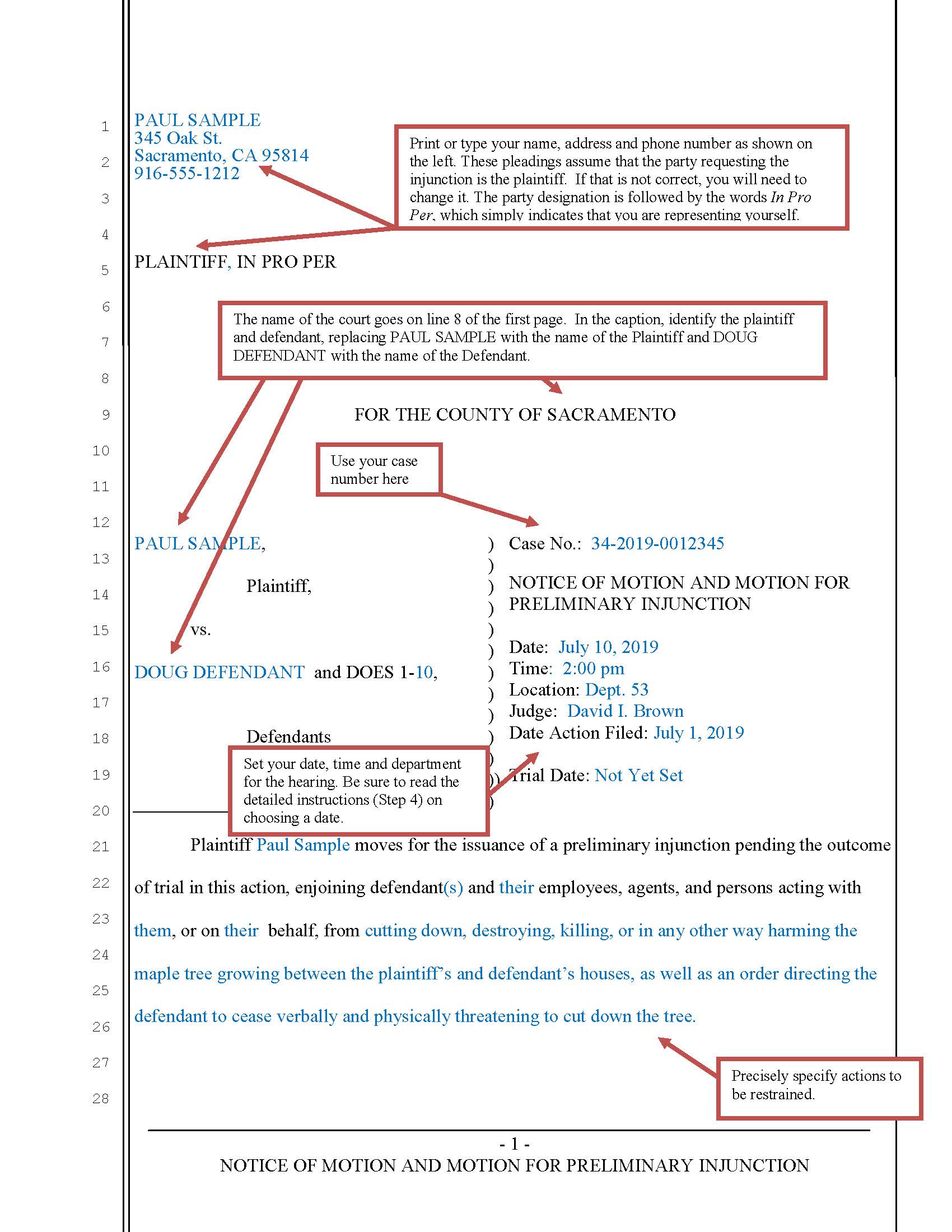
Notice the verbs in the sample motion: the plaintiff moves for an injunction and specifies conduct to be restrained. A reader should not convert that filing into “the court barred the defendant from cutting the tree.” The court must decide the motion. The sample also illustrates why an injunction request should describe the conduct precisely enough for the parties to understand what the proposed order would require.
Specific performance is another equitable remedy: an order requiring a party to carry out a contractual promise. It may be considered when a substitute purchase and money would not adequately replace what was promised—for instance, a particular parcel of land. For an ordinary, readily replaceable item, damages are more likely to address the problem.
Remedies Video Lecture 8 - Specific Performance
Watch Jack Guttenberg’s “Remedies Video Lecture 8 - Specific Performance” for the reasoning behind requiring performance instead of awarding money.
Watch the introduction for the remedy’s purpose, then inadequate damages for the explanation of why a promised item’s replaceability matters. Focus on the general comparison between a usable monetary substitute and something sufficiently unique that payment may not solve the plaintiff’s problem; you do not need to memorize a full test for specific performance.
Equitable relief and damages can address different parts of the same dispute: money for a proven past loss and, where justified, an order concerning future conduct. Courts still must determine whether each requested remedy is legally available and supported by the case.
A quick way to read a remedies request
When you encounter a requested remedy, identify its purpose before evaluating its amount or wording:
| If the plaintiff seeks… | Ask what the remedy is meant to do |
|---|---|
| Compensatory damages | Pay for a legally recognized loss. |
| Punitive damages | Punish and deter sufficiently blameworthy conduct, if the law permits. |
| An injunction | Require or prohibit specific conduct. |
| Specific performance | Require fulfillment of a contractual promise when money would be inadequate. |
Keep request, proof, and award separate. A complaint states what the plaintiff wants; evidence and legal rules bear on whether it is justified; a court order or judgment states what, if anything, is granted.
Conclusion
The key distinction is purpose: compensatory damages respond to loss; punitive damages respond to qualifying misconduct; equitable remedies such as injunctions respond to a need for action or restraint that money may not adequately meet. A single lawsuit can request more than one kind of relief, but no request is itself a court decision.
The next lesson separates a jury verdict from the court’s entry of judgment and from the later task of enforcing that judgment—further distinctions that matter when a report says a party has “won.”