In our previous lesson, we established the theoretical foundations of photobook sequencing, identifying the four main narrative strategies: chronological, thematic, associative, and the emotional arc. With this architectural blueprint in mind, we now transition from theory to practice. This lesson is where your hands-on work truly begins, focusing on the fundamental building block of any sequence: the visual pair.
Just as a sculptor first understands how two forms relate in space before constructing a larger assembly, a bookmaker begins by discovering how two images speak to one another. The arrangement of your final selection of images into a compelling narrative starts with the simple, powerful act of creating pairs and small groupings. This process is the heart of sequencing, where individual photographs start to form a new, collective meaning.
Today, you will learn to identify and create these visual and conceptual connections. By the end of this lesson, you will be able to take your own images and form meaningful pairs and groups based on formal echoes, thematic links, and poetic juxtapositions.
The Life of an Image in Context
An isolated photograph presents a single statement. When placed next to another, a dialogue begins. The meaning of each image is altered, expanded, or even contradicted by its neighbor. This interplay is the engine of a photobook's narrative. Photographer and bookmaker Jason Fulford has built his artistic practice around this very idea, creating books that function as "open metaphors" where the viewer actively participates in creating meaning.
Let's explore his philosophy, which provides an excellent mindset for the task ahead.
Q&A: Jason Fulford, photographer, book-maker, and educator
This interview with Jason Fulford is a masterclass in thinking about how images interact. He emphasizes play, intuition, and the fluid nature of meaning in a sequence.
First, read the section that describes his workshop's focus, beginning at this point, to understand his emphasis on associations. Next, consider his analogy of photography and language in the paragraph starting here. Finally, read his description of the workshop process itself, starting from "But essentially..." to see how he builds complexity from the simple pair.
Fulford’s approach—starting with pairs and gradually building to longer, more complex sequences—is precisely the method we will be following. The goal is not to find a single "correct" solution but to explore the myriad of possibilities your images hold.
The Principles of Connection: Formal and Thematic
Connections between images can be categorized into two broad types: formal and thematic. Your background in fine art and design will make you particularly attuned to these relationships.
1. Formal Connections (Visual Rhymes)
These connections are based on shared aesthetic qualities. They create a visual rhythm that guides the viewer's eye smoothly through the book. Think of it as creating visual rhymes or echoes.
- Shape and Line: An arm's gesture might echo the line of a tree branch. The curve of a road might mirror the curve of a spine. The strict vertical lines of a building could be paired with the vertical stems of flowers.
- Color and Tone: You can create pairs based on a shared color palette (e.g., two images dominated by a cool blue) or a similar tonal range (two high-contrast images, or two soft, low-contrast ones).
- Composition and Weight: Two images might share a similar compositional structure, such as being strongly center-weighted or having the main subject in the bottom-left quadrant. As photographer Aaron Hardin notes, keeping the focal point in a similar location from one page to the next creates a comfortable rhythm for the viewer's eye.
- Juxtaposition: Sometimes, a formal connection can be used to highlight a thematic contrast. You might pair the soft texture of a flower with the sharp texture of a thorny bush, using the similar subject (plants) to emphasize their different natures.
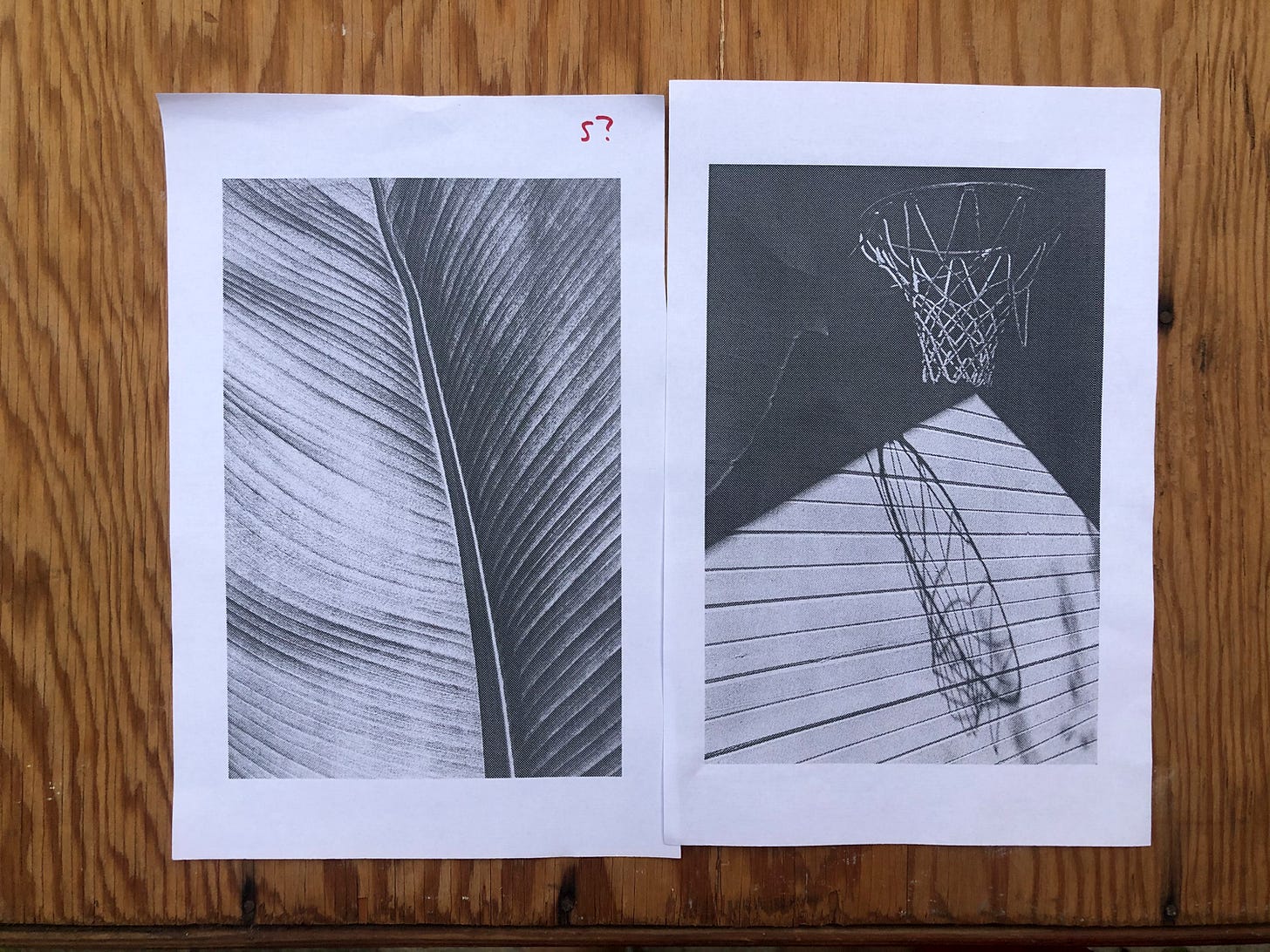
Below is a simple yet effective example of a pair connected by formal qualities. Notice how the strong vertical and diagonal lines in the leaf on the left resonate with the lines of the siding and the basketball hoop's shadow on the right.
2. Thematic Connections (Conceptual Echoes)
These connections are based on the ideas, subjects, or stories within the images.
- Shared Subject Matter: This is the most direct connection—grouping images of the same person, place, or object. This is the basis of a typological or "cluster" approach.
- Conceptual Links: This is more poetic. An image of a bird in flight might be paired with one of an airplane. An image of an empty chair might be followed by a portrait of a person who is absent. These pairings create metaphors and invite interpretation.
- Narrative Progression: These pairs suggest cause and effect, or the passage of time. A photo of storm clouds followed by one of a rain-soaked street. A picture of a young child followed by one of an elderly person.
- Emotional Tone: Two images, though different in subject and form, might share a palpable mood—joy, melancholy, tension, or peace.
Let's see how a professional bookmaker intuitively uses these connections in practice.
How to Sequence Photos for a Photobook
We return to Aaron Hardin's video, "How to Sequence Photos for a Photobook," to see specific examples of him creating pairs, or "dominoing pictures."
Watch the segment from 04:02 to 06:51. Pay close attention to how he articulates the connections he's making: the shape of a child's arms echoing tree branches (formal), and the association between a child and a chain creating an "ominous feeling" (thematic/conceptual).
From Theory to Action: Your Turn
It is now time for you to become the sequencer. The most effective way to do this is to work with physical prints. The tactile experience of moving images around a table allows for a fluidity and intuitive discovery that is often lost on a screen.

Here is your primary task for this lesson:
- Print Your Images: Take the final selection of images you curated in the previous module and print them as small, inexpensive "work prints." A 4x6 or 5x7 size is ideal. Do not worry about print quality; these are for experimentation.
- Clear a Space: Find a large table, or even a clean patch of floor, where you can spread out all your prints.
- Find the First Pair: Begin by picking one image that you feel is strong or central to your project. Look through the rest of your prints and find another image that speaks to it. Don't overthink it. Does it have a similar color, shape, or mood? Place them side-by-side. This is your first pair.
- Repeat: Set that pair aside and repeat the process. Continue looking for pairs that connect formally or thematically. You can also look for contrasts and juxtapositions.
- Build Small Groups: Once you have several pairs, see if you can introduce a third image to create a trio. How does the third image change the conversation between the first two?
- Document Your Findings: As you create pairs and groups that feel promising, take a quick photo of them with your phone. The goal is not to create a final, linear sequence yet. Instead, you are building a vocabulary of visual "phrases" and "sentences" that you will use to construct your book's narrative.
This exercise is about exploration and play. Try creating pairs based only on color. Then, try creating pairs based only on a recurring shape. Then, try creating pairs based on an emotional feeling. See what emerges.
Conclusion
In this lesson, you have moved from understanding abstract sequencing strategies to the practical work of building a sequence's core components. You learned that the dialogue between two images is the foundation of a photobook's narrative, a concept championed by bookmakers like Jason Fulford. You've also learned to identify and create connections based on two main principles:
- Formal Connections: Using visual rhymes in shape, color, and composition to create flow.
- Thematic Connections: Using conceptual echoes in subject matter, ideas, and emotion to build meaning.
Most importantly, you now have a hands-on method to begin exploring the relationships within your own body of work. By creating these initial pairs and small groupings, you are no longer looking at a collection of individual photographs, but at the beginnings of a story.
In our next lesson, we will take these building blocks and begin to arrange them into a full preliminary sequence. We will consider the overall flow, rhythm, and pacing of the book, transforming your visual phrases into a cohesive chapter.