Hello! Welcome to your fifth lesson.
In our last lesson, we put the field axioms to work, proving why the rules for multiplying negative numbers are logical necessities, not just conventions. This demonstrated how a small set of foundational truths can be used to build and justify the arithmetic rules you've used for years.
Today, we will continue this theme by examining the operations of subtraction and division. You might be used to thinking of four fundamental operations: addition, subtraction, multiplication, and division. However, from an axiomatic perspective, there are really only two: addition and multiplication. This lesson will explain the precise relationship between subtraction/division and the inverse elements we've discussed, revealing them as clever applications of addition and multiplication.
By the end of this lesson, you will understand why subtraction is simply "adding the inverse" and division is "multiplying by the inverse," and you'll be able to justify why division by zero is logically impossible in a consistent number system.
1. Redefining Subtraction and Division
Our journey into the axiomatic structure of algebra reveals a more elegant and streamlined system than you might have imagined. The operations of subtraction and division are not fundamental axioms themselves. Instead, they are defined using the concepts of additive and multiplicative inverses.
The following reading provides the formal definitions.
10 Basic proofs involving real numbers
This brief excerpt from a Rutgers University document on real number proofs clearly and formally defines subtraction and division in terms of their inverse elements. This is the core concept of today's lesson.
Please read the short section titled 'Definitions of subtraction and division'. It directly follows the axioms for inverse elements.
As the reading states, the definitions are:
- Subtraction: The expression is defined as shorthand for , which is the sum of and the additive inverse of .
- Division: The expression (or ) is defined as shorthand for , which is the product of and the multiplicative inverse (or reciprocal) of . This definition requires that .
This is a powerful simplification! It means any rule or property related to subtraction or division can be derived by treating them as addition or multiplication problems involving inverses.
The image below summarizes the key properties of real numbers that make this possible. Focus on the "Invertible" row, which shows the existence of the additive inverse () and the multiplicative inverse ( or ), the cornerstones of today's lesson.
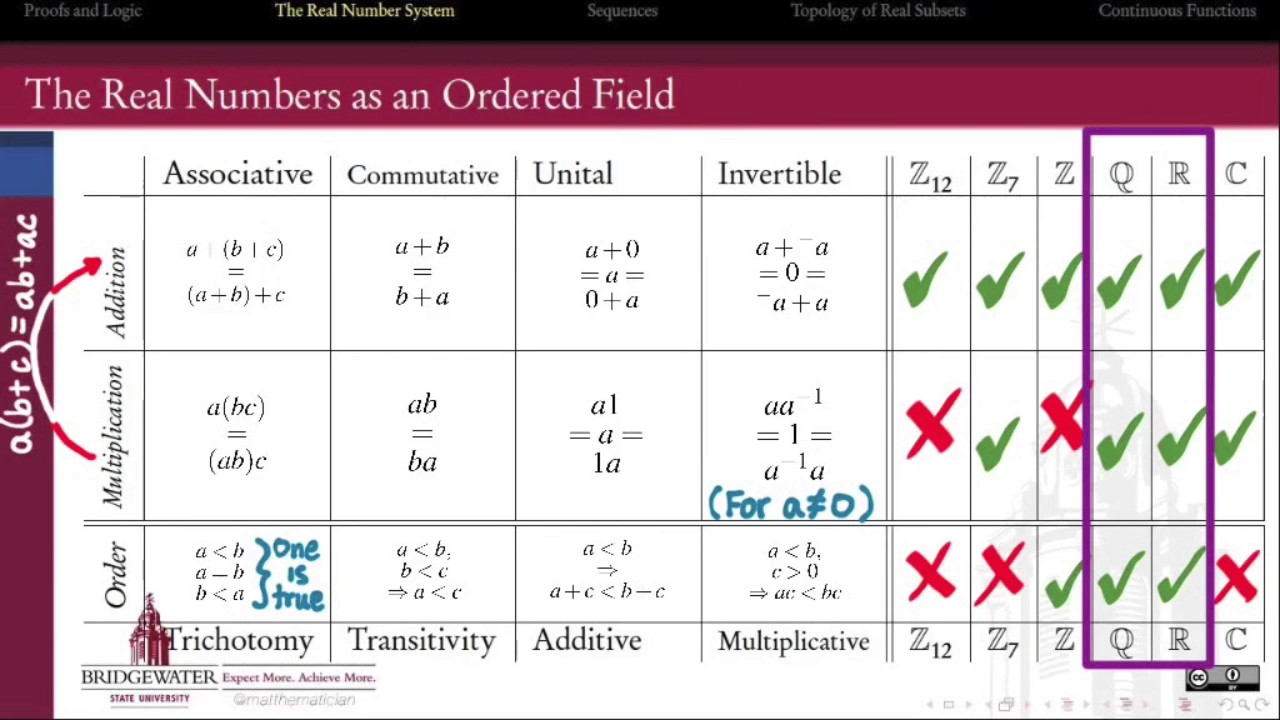
Interestingly, this means subtraction and division are conceptually parallel. Subtraction "undoes" addition by adding the opposite, and division "undoes" multiplication by multiplying by the reciprocal.
The following reading makes this parallel explicit.
Dividing Fractions: Why Invert and Multiply?
This article from The Math Doctors website draws a direct comparison between the definitions of subtraction and division, highlighting their structural similarity.
Read the three short paragraphs that begin with 'Similarly, I've heard subtraction explained as KCC...'. This section neatly summarizes the parallel logic: both are inverse functions accomplished by applying the direct operation to the appropriate inverse.
2. Justifying the "Invert and Multiply" Rule
You have likely been taught the rule for dividing fractions: "invert and multiply." Now, with our formal definition of division, we can prove why this rule is not just a trick, but a logical consequence of the axioms.
The statement is, by our definition, equivalent to . The rule works because the multiplicative inverse of is .
But how do we prove this rigorously? One elegant method is to write the division as a complex fraction and then use a clever trick: multiply by 1. Since multiplying by 1 (the multiplicative identity) doesn't change the value of an expression, we can multiply our complex fraction by a carefully chosen fraction that is equal to 1.
The following video provides a clear, step-by-step algebraic proof. This is a perfect example of the kind of fundamental reasoning you are looking to master.
Pre-Algebra 13 - Reciprocals and Division with Fractions
This segment from the MyWhyU channel provides a general algebraic proof for why dividing by a fraction is the same as multiplying by its reciprocal. It uses variables to show that this holds true for any numbers.
Watch the segment from 7:44 to 10:20. The narrator proves that (n/m) ÷ (p/q) is equivalent to (n/m) * (q/p). Follow the logic closely as he transforms the expression by multiplying it by (q/p)/(q/p), which is a form of 1.
This proof is beautiful because it relies on only a few fundamental ideas:
- Division can be written as a fraction.
- Multiplying by 1 does not change an expression's value.
- A number multiplied by its multiplicative inverse (reciprocal) is 1.
3. The Logical Impossibility of Division by Zero
Now we can address a famous prohibition in mathematics: you cannot divide by zero. Why not? Is it just a rule someone made up? No—it's a logical necessity. Our definition of division as "multiplying by the inverse" holds the key.
Dividing by zero would mean multiplying by the multiplicative inverse of zero. However, the Multiplicative Inverse Axiom explicitly states that every non-zero number has a multiplicative inverse. It leaves zero out.
The crucial question is why the axiom must exclude zero. What would happen if we tried to define a multiplicative inverse for zero? Let's call it . If it existed, it would have to satisfy the property .
The following video demonstrates that allowing this leads to a catastrophic breakdown of logic.
You can divide by Zero, but ... | How Math works
This video from the 'snsus' channel explains the role of axioms and then provides a rigorous proof by contradiction showing why zero cannot have a multiplicative inverse.
Watch from 5:57 to 8:53. The first part (until 6:48) will quickly review the concepts of inverses. The core of the segment (from 6:48 onward) shows how assuming that zero has a multiplicative inverse allows you to prove that 1 = 0, which would render our entire number system useless.
The proof is a classic reductio ad absurdum (proof by contradiction):
- Assume the opposite of what you want to prove: Assume zero does have a multiplicative inverse, , such that .
- Use this assumption along with the other established axioms to derive consequences.
- Show that these consequences lead to a logical contradiction (e.g., ).
- Conclude that the original assumption must be false.
Because allowing zero to have a multiplicative inverse would force our entire axiomatic system into contradiction, we must forbid it. And since division by a number is defined as multiplication by its inverse, division by zero is therefore undefined.
Test your understanding!
In the previous lesson, we proved that for any number , . How does this simple theorem provide another, much shorter, argument for why division by zero is impossible?
Hint: Think about the definition of division as the inverse of multiplication: means that .
Show answer
Let's try to divide a non-zero number, say 5, by 0.
Let's assume the answer is some number, .
So, .
Based on the definition of division as the inverse of multiplication, this must mean that .
However, in the last lesson, we proved that for any number , .
This gives us the statement , which is a contradiction.
Therefore, there is no number that can be the result of . The operation is undefined.
Summary and Next Steps
Today, you have deepened your understanding of the fundamental structure of algebra. We have shown that the familiar operations of subtraction and division are not axioms themselves but are convenient shorthands built upon the concepts of inverse elements.
- Key Takeaways:
- Subtraction is not a fundamental operation; it is defined as adding the additive inverse: .
- Division is not a fundamental operation; it is defined as multiplying by the multiplicative inverse: .
- The "invert and multiply" rule for dividing fractions is a logical consequence of the definition of division and properties of multiplicative inverses.
- Division by zero is undefined because zero does not have a multiplicative inverse. Allowing it to have one would introduce a logical contradiction () that would collapse the entire system of axioms.
In our next lesson, we will address another conventional but crucial part of mathematics: the order of operations (PEMDAS/BODMAS). Now that we have established the axiomatic basis for our operations, we need a clear and unambiguous set of rules for evaluating expressions that contain several of them at once.