Hello! In our last lesson, you did a great job learning to use the Präteritum forms war (was/were) and hatte (had) to talk about past states and possessions. This was a crucial step in making your spoken German sound more natural.
Today, we'll build directly on that skill. You now know how to say "I was a child" (Ich war ein Kind) or "I had an exam" (Ich hatte eine Prüfung). The next step is to put those moments into a larger story. In English, you use the word "when" for many of these situations: "When I was a child..." or "When I had an exam...". German, however, is more precise.
This lesson will teach you how to differentiate between als and wenn for narrating past events. You'll learn the simple but critical rule that governs when to use each, allowing you to distinguish between a single, specific event in your past and actions that happened repeatedly. We'll also briefly touch upon the question word wann to make sure the distinction is completely clear.
Wann, Als, or Wenn? The Basic Rule
In German, three words can translate to the English "when": wann, als, and wenn. Confusing them is a classic mistake for learners, but the rules are quite logical. Let's start with a high-level overview.
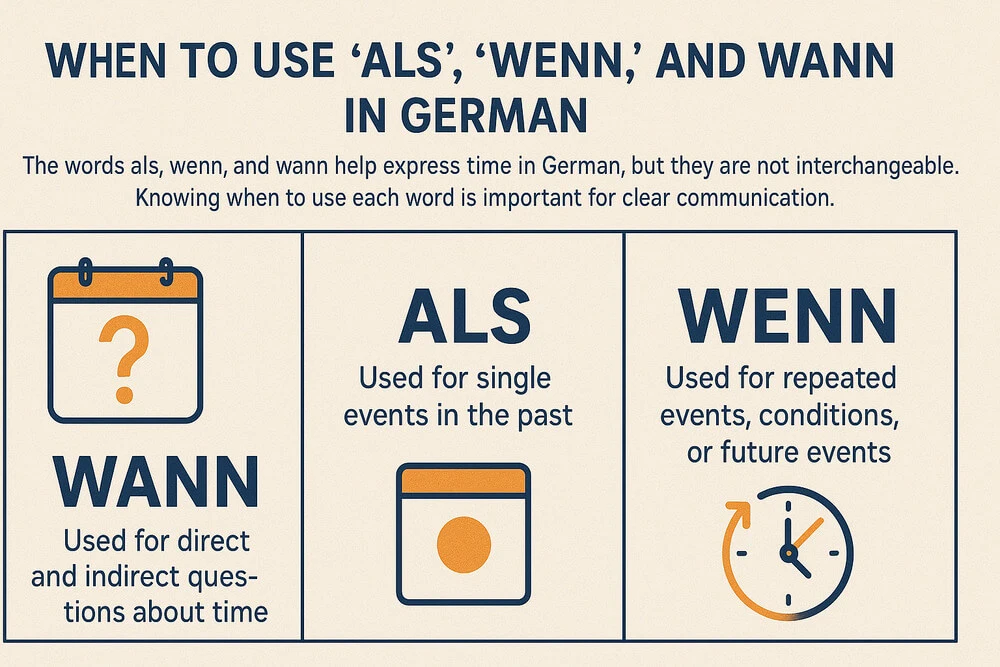
Here's the breakdown:
-
Wann? is the question word. You use it to ask for a point in time.
- Wann beginnt der Kurs? (When does the course begin?)
- Ich weiß nicht, wann der Kurs beginnt. (I don't know when the course begins. - an indirect question)
-
Als is used for a single event or a single, continuous period in the past. It happened only once.
- Als ich 18 Jahre alt war, habe ich meinen Führerschein gemacht. (When I was 18, I got my driver's license.) You only turn 18 once.
- Als ich gestern nach Hause kam, war die Tür offen. (When I came home yesterday, the door was open.) A specific, single moment.
-
Wenn is used for repeated, habitual events in the past, present, or future. If you can say "whenever" in English, you need
wenn.- Wenn ich Prüfungen hatte, war ich immer nervös. (Whenever I had exams, I was always nervous.) This happened multiple times.
- Wenn es regnet, spiele ich Videospiele. (When/whenever it rains, I play video games.) A repeated action in the present.
Our focus today is on differentiating als and wenn for events in the past.
The Key Difference: Once vs. Whenever
The most important distinction you need to make is whether a past event happened once or multiple times. A fantastic video from "Benjamin - Der Deutschlehrer," a channel you've seen before, explains this distinction perfectly.
WENN oder ALS - einfach erklärt 🤓 + TEST | Deutsch lernen
This video provides a very clear, side-by-side comparison that illustrates the core difference between 'als' and 'wenn' in the past.
Please watch the section from this segment. The presenter uses the same sentence with both words ("Als sie traurig war..." vs. "Wenn sie traurig war...") to show how the meaning changes completely. Pay close attention to how wenn implies a repeated action.
As you saw, the difference is about meaning:
als sie traurig war= a specific time in the past when she was sad.wenn sie traurig war= every time she was sad in the past.
Single Periods vs. Multiple Moments
This concept can be tricky. What about something that lasted for years, like your childhood? Is that a single event? Yes! In German, a continuous, unbroken period in the past is treated as a single "event."
Let's watch a bit more of the same video to clarify this.
WENN oder ALS - einfach erklärt 🤓 + TEST | Deutsch lernen
The next part of the video explains 'als' for a single point or period (Zeitpunkt/Zeitraum) and 'wenn' for multiple, separate points in time.
Watch from this section. Notice the examples for als like als ich studiert habe (when I studied) and als ich ein Kind war (when I was a child). These are single, continuous periods. Contrast this with the examples for wenn, which describe multiple, separate situations.
To solidify this, let's turn to a written guide that breaks down all the rules and common mistakes.
Als vs. Wenn vs. Wann in German — Rules, Examples & Quiz
This article from "How to Study German" is an excellent reference. It covers the rules clearly and highlights the most common errors learners make.
First, review the sections on wenn and on als to reinforce what you've just seen in the video. Pay special attention to the note: "Als ich ein Kind war" is a single period in your life. Next, read the section The Key Difference. The table and the "same sentence, different meaning" example for Berlin are very helpful. Finally, look at the first two points in the Common Mistakes section. These are the exact points we are focusing on today.
Word Order in als and wenn Clauses
One last important point you will have noticed in the examples is word order. Als and wenn are subordinating conjunctions. This means they introduce a subordinate clause, and in German, that has a specific grammatical consequence: the conjugated verb moves to the end of the clause.
-
Main clause: Ich war ein Kind.
-
Subordinate clause: ..., als ich ein Kind war.
-
Main clause: Ich hatte Kopfschmerzen.
-
Subordinate clause: Immer wenn ich Kopfschmerzen hatte,...
If the subordinate clause comes first, the main clause starts with its verb.
- Als ich ein Kind war, spielte ich oft Videospiele.
- Wenn ich eine Prüfung hatte, lernte ich die ganze Nacht.
Time to Practice
Let's apply these rules.
Practice 1: Choosing the Right Word
Try this quick quiz from the "How to Study German" article you just read. Choose the correct word for each sentence. The answers with explanations are right there, so you can check your understanding immediately.
Als vs. Wenn vs. Wann in German — Rules, Examples & Quiz
This interactive quiz will test your ability to differentiate 'als', 'wenn', and 'wann' in context.
Go to the section "Test Yourself: 5 Quick Questions" and try to answer all five questions. Read the explanations carefully, especially for questions 1, 3, and 5, which deal directly with past events.
Practice 2: Applying the Rules
Now, let's try to complete some sentences related to your interests. Choose either als or wenn.
- _____ ich meinen ersten Patienten behandelt habe, war ich sehr konzentriert.
(When I treated my first patient, I was very focused.) - Früher, _____ ich ein schwieriges Videospiel gespielt habe, habe ich oft in Online-Foren nach Tipps gesucht.
(In the past, whenever I played a difficult video game, I often looked for tips in online forums.) - _____ ich letztes Jahr auf der Modemesse war, habe ich viele neue Designer gesehen.
(When I was at the fashion trade fair last year, I saw many new designers.) - Immer _____ meine Lieblings-Vloggerin ein neues Video hochgeladen hat, habe ich es sofort angesehen.
(Whenever my favorite vlogger uploaded a new video, I watched it immediately.)
(Check your answers at the end of the lesson.)
Key Takeaways
Excellent work! Mastering the difference between als and wenn is a huge step forward in your ability to tell stories in German.
- Wann? is for asking about time.
- Als is for a single, specific event or a single continuous period in the past. Think "that one time when...".
- Wenn is for repeated or habitual actions in the past, present, or future. Think "whenever...".
- Both
alsandwennare subordinating conjunctions, which send the conjugated verb to the end of their clause.
This lesson has been your first deep dive into German subordinate clauses. In our next module, "Media, Opinions, and Subordinate Clauses," we will expand on this concept significantly. You'll learn how to use other crucial conjunctions like dass (that), weil (because), and ob (if/whether) to express your opinions about your interests, like vlogs and video games. What you've learned today about verb position is the foundation for all of that!
Practice 2 Answers:
- Als (This was a single event: the first time.)
- wenn (This was a repeated action: whenever you played a difficult game.)
- Als (This refers to a specific, single event: the trade fair last year.)
- wenn (Immer wenn... is a clear signal for a repeated action.)