Hello! Welcome to your first lesson in our course on the Indian Economy.
Today, we'll start at the very beginning by exploring the single most important concept in all of economics: scarcity. This idea is the foundation upon which the entire discipline is built. Our goal is to understand this core economic problem by seeing how the simple choices you make every day—like how to spend your time or money—are, at their heart, the same kind of choices that a nation of over a billion people, like India, has to make.
By the end of this lesson, you'll be able to explain why scarcity makes choice necessary and how this leads to fundamental questions every society must answer. This will set the stage perfectly for our next lesson, where we'll look at the different types of economic systems countries use to deal with this very problem.
1. The Fundamental Economic Problem: Unlimited Wants, Limited Resources
At its core, economics is the study of how people make choices under constraints. The central constraint is scarcity. Think about your own life: you might want a new laptop, the latest smartphone, more time to work on coding projects, and more time to relax. However, you have a limited amount of money and only 24 hours in a day. You can't have or do everything you want.
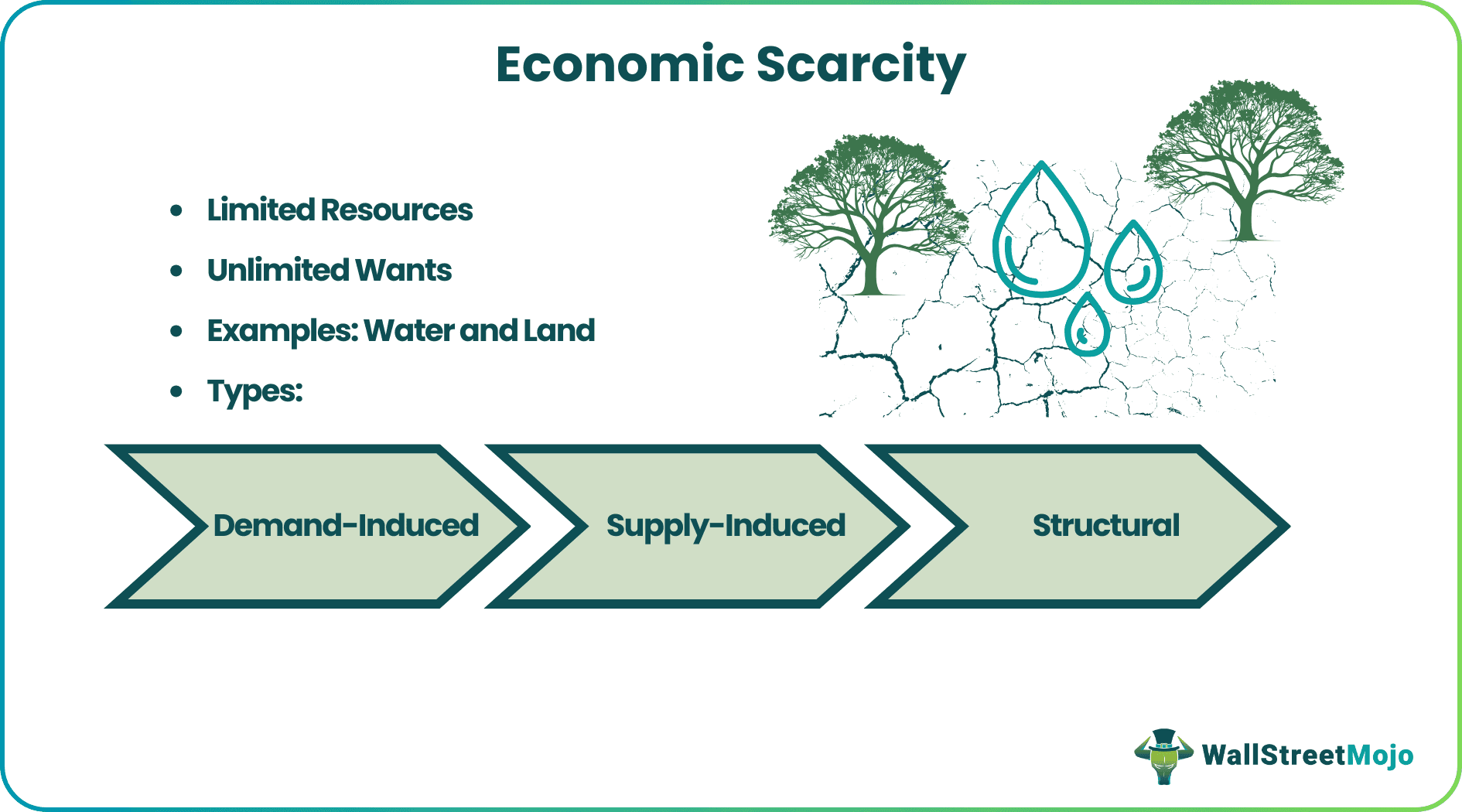
This fundamental tension between unlimited wants and limited resources is the problem of scarcity. It applies to individuals, families, businesses, and entire nations.
To get a clear and concise introduction to this idea, please watch the first minute of the following video.
Scarcity, Trade-offs, and Cost/Benefit Analysis
This short clip from Professor Dave Explains introduces the concept of scarcity by contrasting our endless wants with the finite nature of the resources available to fulfill them.
Watch the segment from the beginning until timestamp 01:02. Focus on how it defines scarcity as the driver of all economic choices.
As the video explains, scarcity forces us to choose. This is the basic problem of economics. The infographic below provides a simple visual summary of this core concept.
2. Scarcity Necessitates Choice
Because we can't have everything, we must decide what we will have and what we will go without. This act of deciding is what economics is all about. An excellent way to visualize this is through a simple, practical example.
The following video presents a scenario with students and chairs to make the abstract idea of scarcity tangible.
Scarcity, the Basic Economic Problem
This video from Jason Welker uses a classroom experiment to demonstrate how scarcity immediately creates the need for an allocation system—a way to decide 'who gets what'.
Watch from the beginning until timestamp 03:22. Pay attention to how the 'chair problem' forces the students to think about different ways to allocate a scarce resource.
The "chair problem" in the video is a small-scale version of the problems faced by the entire Indian economy. Just as there were not enough chairs for all the students, a country does not have enough resources (like land, water, labor, and money) to fulfill all its citizens' wants and needs.
This forces a country to make critical choices:
- Should more money be spent on building roads or on improving schools?
- Should we use land for farming or for building new factories?
- Should the government provide electricity for free to farmers or use that money to build new power plants?
These are not just theoretical questions; they are practical challenges that governments and societies face daily.
The very word 'economics' has its roots in this idea of managing scarce resources. To explore this connection, let's turn to a short reading.
ECONOMICS - Chanakya IAS Academy
The provided text from Chanakya IAS Academy explains how the concept of managing a household budget is the original basis for the science of economics.
Please read the first two sections, titled 'ABOUT ECONOMY AND ECONOMICS' and the paragraph that follows it, ending just before 'HOW DO WE DEFINE ECONOMICS?'. Focus on the analogy between managing a household ('OIKOS NEMEIN') and managing a nation's economy.
3. Trade-offs and Opportunity Cost: The True Cost of a Choice
Every time you make a choice, you are also choosing to give something up. This is called a trade-off. The value of the thing you gave up is a crucial concept in economics called opportunity cost.
Opportunity cost is the value of the next-best alternative that was not chosen.
For example, the opportunity cost of you spending one hour studying this lesson is the benefit you would have gained from your next-best use of that hour, whether that was coding, reading a novel, or resting.
Given your background in computer science, you can think of it like scheduling processes on a single-core CPU. When the scheduler decides to run Process A, the opportunity cost is the computation that Process B (the next-highest priority process) could have completed in that same time slice.
Let's return to the video from Professor Dave to see how this applies on a personal, business, and government level.
Scarcity, Trade-offs, and Cost/Benefit Analysis
This segment explains trade-offs and defines opportunity cost with clear examples, connecting individual decisions to large-scale government policies.
Watch from timestamp 01:02 to 04:07. Notice how the same logic of opportunity cost applies to a student choosing to study, a restaurant setting wages, and a government setting its budget.
The government example is particularly important. When the Government of India decides to allocate ₹50,000 crores to a new national highway system, that money cannot be used for anything else. The opportunity cost is not just the money itself, but the schools, hospitals, or defense equipment that could have been funded instead. Understanding opportunity cost is key to analyzing government policy and economic decisions.
4. The Three Fundamental Economic Questions
Because every society faces the problem of scarcity, every society—whether it's India, the USA, or China—must answer three basic questions. How they answer these questions defines their economic system.
To learn about these questions, please read the following excerpts from a helpful document.
the economic problem : scarcity and choices
This reading from Patna Women's College uses simple analogies to introduce the three fundamental questions that arise from scarcity and choice.
First, read the slide titled 'The Economic Problem (Wants and Scarce Means)' for its simple analogies. Then, skip to the slide titled 'Resource Allocation' and read through to the end of the slide 'FOR WHOM to Produce?'. Focus on understanding what each of the three questions means.
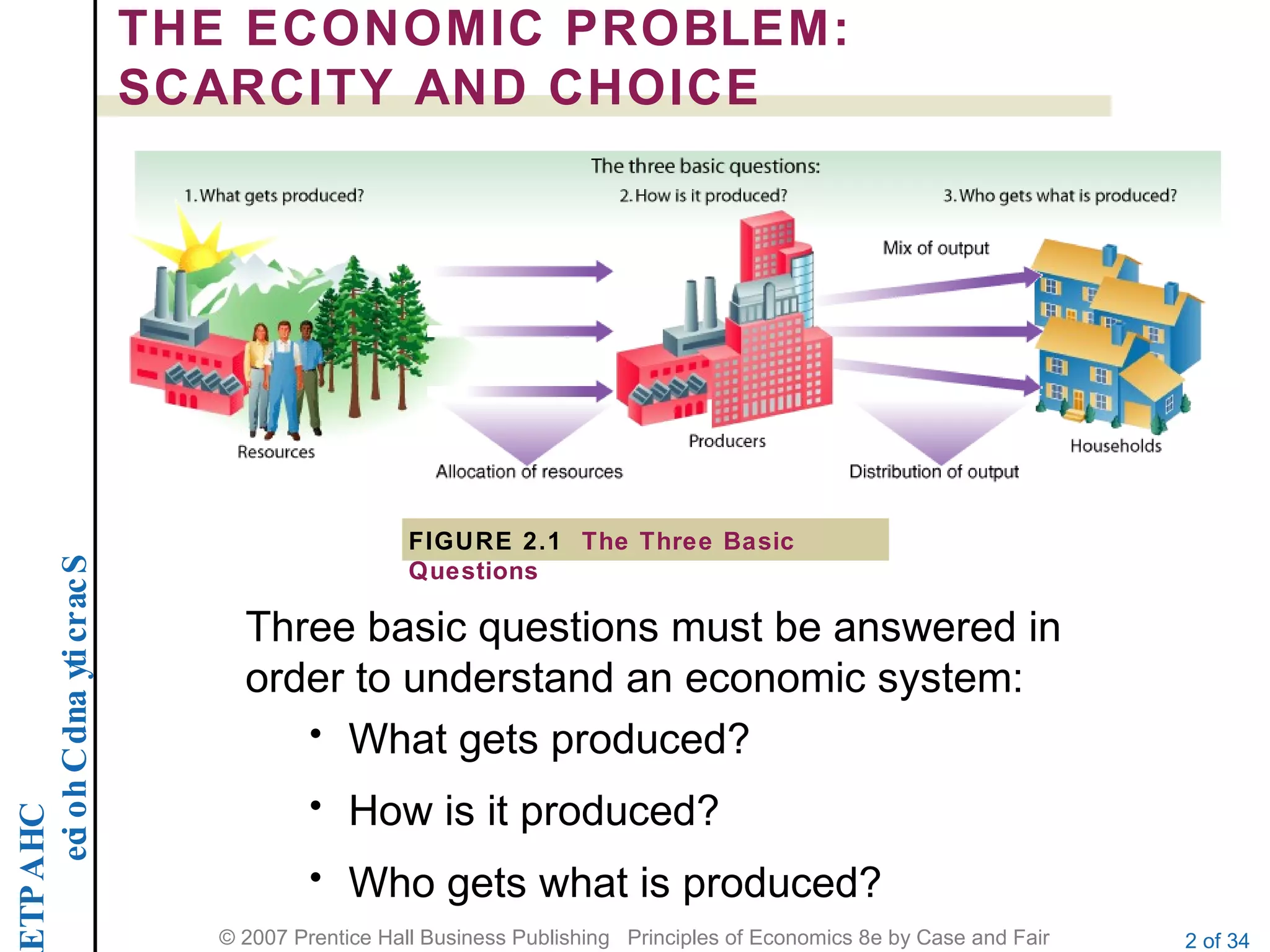
As the reading explains, the three fundamental economic questions are:
- What to produce? Which goods and services should an economy create? More cars or more buses? More software or more textiles?
- How to produce? What combination of resources should be used? Should we use more labor or more machinery? (This is often described as choosing between labor-intensive and capital-intensive methods).
- For whom to produce? Who gets to consume the goods and services that are produced? Should they be distributed equally, or should those who can pay more get more?
This diagram provides a clear visual summary of how these three questions fit into the structure of an economy.
Conclusion
In this lesson, we have explored the foundational concept of economics. You now have the conceptual tools to understand why economics exists and what problems it seeks to solve.
Here are the key takeaways:
- Scarcity is the basic economic problem, arising from the conflict between our unlimited wants and the world's limited resources.
- Scarcity forces everyone, from individuals to nations, to make choices.
- Every choice involves a trade-off, and the value of the best alternative you give up is the opportunity cost.
- All societies must answer three fundamental economic questions: What to produce?, How to produce it?, and For whom to produce it?
In our next lesson, we will build directly on this foundation. We will examine the three major types of economic systems—Capitalist, State, and Mixed economies—and see how they represent different ways of answering these three fundamental questions. We will use the USA, the former USSR, and India as our primary examples to bring these concepts to life.