Welcome back!
In our last lesson, we focused on the crucial first layer of support—selecting the right bra or adhesive solution to work with your chosen blouse neckline. We established how underpinnings create the initial lift and shape. Now, we move to the next layer: the blouse itself.
Today's lesson addresses the learning outcome: Assess how a blouse's fit—including dart placement and side seam shaping—affects cleavage framing.
A well-constructed saree blouse is more than just a covering; it's a structural garment that actively sculpts and frames the bust. Your background in bra design gives you an inherent understanding of how fabric, tension, and seams can create shape. We will apply those same principles to deconstruct how a blouse's architecture is the final word in defining cleavage.
1. The Blouse as a Shaping Garment
Think of a fitted saree blouse as a sophisticated soft-cup bra. While the underpinning provides the primary lift, the blouse's own seams and darts refine that shape, creating a smooth, intentional silhouette. A perfect fit isn't just about comfort; it's about ensuring every structural element of the blouse is performing its function to enhance and frame the bust.
The two most critical elements in this process are the darts and the side seams. Let's examine each one's role.
2. The Architecture of Darts and Seams
Darts are the tailoring magic that transforms a two-dimensional piece of fabric into a three-dimensional form that accommodates the bust. Their placement, shape, and type dictate exactly how the fabric cups and supports the breast tissue.
Standard Bust Darts
These are the simplest form of shaping. A single dart typically runs from the side seam towards the bust apex. Its purpose is to create volume in the front panel of the blouse. The closer the dart points to the apex and the deeper it is, the more pronounced the 3D shape will be. For cleavage emphasis, the goal is a dart that creates just enough room for the bust without being baggy, allowing the fabric to sit snugly around the curves.
Princess Seams: The Contouring Powerhouse
Princess seams are significantly more effective for sculptural fitting than simple darts. These are long, curved seams that run from the shoulder or armhole, over the bust apex, and down to the hem.
- Function: Instead of just adding volume, princess seams allow a tailor to build a precise, body-hugging contour. By adjusting the curve of the seam, a blouse can be designed to lift, separate, or push the breasts together.
- Effect on Cleavage: For a cleavage-enhancing fit, princess seams are superior. They can be cut to provide inward pressure from the sides, encouraging the breasts toward the center, much like the angled cups of a plunge bra.
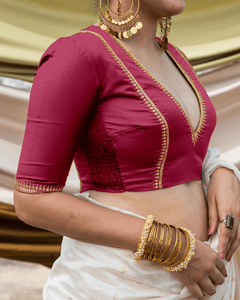
Katori Blouse: The Built-in Bra
The Katori blouse is the ultimate example of structural shaping, essentially building a bra right into the garment. It uses a unique two-piece cup construction.

The genius of the Katori design is that the seam-work itself creates a three-dimensional cup that lifts and holds the bust. This makes it an excellent choice for achieving a defined, rounded shape, often with enough support that minimal underpinning is required.
3. The Anchor: Side Seam Shaping
The side seams are the unsung heroes of blouse fitting. They do more than just connect the front and back panels; they anchor the entire structure and control the silhouette.
Imagine the side seam and back panels of a blouse as the equivalent of a bra's band. As you know, the band provides the vast majority of a bra's support. Similarly, in a blouse:
- A straight, vertical side seam provides a stable anchor but little active shaping.
- A curved side seam that nips in at the waist and flares out slightly at the underarm can help push the bust forward and prevent side spillage.
- Proper tension is key. The side seams must be snug enough to hold the front of the blouse taut against the body, ensuring the darts and front panels are doing their job of shaping the bust. If the side seams are too loose, the front will sag, and the shaping effect will be lost.
4. Correcting Fit with Construction
A well-fitted blouse can do more than just accommodate your shape; it can actively correct for fit issues introduced by generic, ready-to-wear underpinnings.
You might find the following article on thoracic shaping particularly interesting. It discusses how the cross-sectional shape of a person's ribcage (e.g., a "deeper" egg shape vs. a "wider" oval shape) affects bra fit, often causing the bust to splay outwards. Given your background in statistics and social research, the extensive comments section, filled with anecdotal data from women describing these exact fitting issues, may provide a fascinating qualitative insight.
Thoracic Shaping - Bra fitting problems
Please read 'A question of thoracic shaping' by Kathleen Fasanella. This will provide a high-level, anatomical perspective on fit that connects directly to our discussion.
Read the beginning of the article, starting from the introduction down to the end of the section with the heading 'Now let’s give these cross sections a sex change operation (below):'. Focus on the diagrams and the explanation of how a bra designed for an 'oval' chest can cause the bust points to splay apart on an 'egg-shaped' chest. This illustrates a common problem that expert blouse tailoring can help mitigate by using seams to pull the bust back to the center.
The key takeaway is that while a standard bra might push your breasts apart, the seams of a perfectly tailored blouse can apply inward pressure, counteracting this splaying effect and creating the centralized cleavage you desire. The blouse becomes the final corrective and shaping tool.
5. A Practical Guide to Assessing Fit
When you try on a saree blouse, you're not just checking if it closes. You are assessing its structural integrity. The following guide, drawing on professional tailoring advice, will help.
Trending Banarasi Saree Blouse Designs
The article 'Trending Banarasi Saree Blouse Designs' has an excellent, practical section on tailoring that we can adapt for our purpose.
Please read the section titled 'Tailoring & fitting — practical tips every buyer should know'. We will use these points as a foundation for our fit assessment checklist.
Here is your checklist for assessing a blouse's fit for cleavage framing:
- Dart & Seam Placement: Do the darts or the apex of the princess seams point directly towards your nipple? If they are too high, low, or wide, the shaping will be off-center.
- Fabric Tension: Is the fabric taut across the bust, or is there gaping and pulling? The fabric should lie smoothly over the curves of the bust and flat against your sternum (for non-plunge styles). Any pulling indicates the fit is too tight, while gaping means it's too loose.
- Side Seam Alignment: Do the side seams run straight down your sides, or are they pulled towards the front or back? A pulled seam indicates an imbalance in the fit between the front and back panels, which will compromise support.
- The Movement Test: As the article suggests, always test your range of motion. Lift your arms, bend forward, and twist your torso.
- Does the blouse ride up significantly?
- Does your breast tissue spill out from the neckline or from under the hem?
- Do the seams shift dramatically out of place?
A blouse that passes these tests is not just a good fit; it is a well-engineered garment actively working to frame and support your bust.
Conclusion
Today, we've dissected the architecture of a saree blouse, learning to see it as a powerful shaping tool. By assessing darts, seams, and overall fit, you can now ensure your blouse works in perfect harmony with your underpinnings to create a flawless, sculpted look.
Key Takeaways:
- Darts Create Dimension: Darts and, more effectively, princess seams transform flat fabric into a 3D shape that cups the bust.
- Specialty Cuts Add Support: The Katori blouse is a prime example of a design with a "built-in" bra structure, offering significant lift and shape through its paneling.
- Side Seams Provide the Anchor: Well-fitted side seams are crucial for holding the front of the blouse taut and ensuring the shaping elements can do their job.
- A Good Fit Sculpts: A perfectly tailored blouse can correct for issues like bust splaying, working with your underpinning to create the final, desired cleavage presentation.
In our next lesson, we will zoom out to the final layer of this styling process. We will explore how the choice of saree fabric and the artful drape of the pallu can be used to either dramatically reveal or subtly tease the cleavage you've so carefully constructed.