Hello again! Welcome to the second lesson in our "Foundations of Cleavage Styling" module.
In our last session, we established a technical framework for discussing cleavage, defining four key presentations: Center, Upper, Sideboob, and Underboob. We also analyzed the core garment-engineering principles—like adduction and elevation—that produce these effects.
Today, we will build directly on that foundation. Our goal is to analyze how a neckline's depth, width, and shape influence the visual emphasis on cleavage. We'll move from the underlying structural principles to the visible geometry of the garment's cut. You'll learn to see necklines not just as style choices, but as precise tools for framing the bust and directing the viewer's eye.
The Geometry of a Neckline: Depth and Width
At its most basic, a neckline's potential to showcase cleavage is a function of its geometry. The two primary variables are depth (how low it goes) and width (how far it extends towards the shoulders).
- Depth primarily controls the vertical exposure, influencing whether you reveal the top of the intermammary cleft (center cleavage) or the upper swell of the breasts (upper cleavage).
- Width controls the horizontal exposure, opening up the décolletage and collarbones.
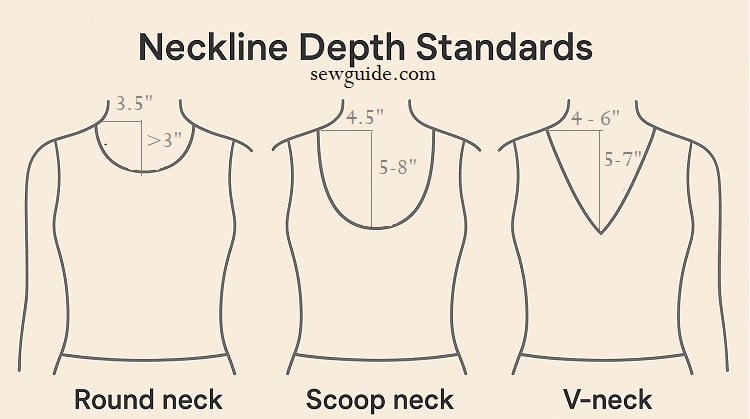
The interplay between depth and width defines the specific shape of the neckline, and it's this shape that determines how the cleavage is framed. Let's analyze the most important shapes.
Analyzing Key Neckline Shapes
Different shapes are engineered to highlight different aspects of the bust. To explore this, we'll consult an excellent resource that breaks down the most common neckline types from a design and construction perspective.
Types of Necklines: 18 Styles & How to Choose the Best One
The article 'Types of Necklines' from ModaKnits offers a detailed look at various neckline styles. We'll focus on the sections that describe shapes most relevant to cleavage emphasis.
Please read the following four sections: V-Neck: Focus on why this shape visually elongates the upper body. Plunge Neck: Note how this is an extreme version of the V-neck and the techniques mentioned for adjusting its depth. Scoop Neck: Pay attention to the comparison with a crewneck and how it exposes more of the upper chest. Sweetheart Neck: Understand how its unique heart-like shape is designed to accentuate the bust.
Let's synthesize what you've just read and connect it back to our cleavage typology.
The V-Neck Family: V-Neck and Plunge
As the reading highlights, the V-neck's primary function is to create a strong vertical line that draws the eye downward. This makes it the quintessential choice for framing center cleavage.
- Shallow V-Necks: These offer a subtle focus, hinting at the cleavage without significant exposure. They elongate the neck and provide what the article calls "breathing space."
- Plunging V-Necks: This is simply a V-neck with extreme depth. It creates a dramatic, high-impact look entirely centered on the intermammary cleft. The structural challenge here is less about creating cleavage (the cut does the work of revealing it) and more about ensuring the garment stays in place.

The Curved Neckline Family: Scoop and Sweetheart
Unlike the sharp, directional line of a V-neck, curved necklines create a softer, wider frame.
- Scoop Necks: With their wide, rounded shape, scoop necks are excellent for showcasing the décolletage and collarbones. They are particularly effective at framing upper cleavage, emphasizing the rounded swell of the breasts rather than the central valley.
- Sweetheart Necks: As the name and the reading suggest, this neckline is explicitly designed to mimic the curves of the bust. The two arcs rising over each breast, meeting at a central point, make it uniquely suited to framing and enhancing both upper cleavage and center cleavage simultaneously. It provides the lift-and-frame effect of a scoop neck with the central focus of a V-neck.
A Deeper Analysis: Interaction with Breast Anatomy
Your background in bra design has likely made you very aware that a garment's effectiveness is not absolute; it depends on the body wearing it. The same neckline can produce vastly different results based on the wearer's natural breast placement.
The following article offers a superb analysis of this very topic. It moves beyond generic advice and into the specifics of how breast separation influences styling choices.
How the Placement of Your Breasts Impacts What You Wear
Let's read excerpts from the article 'How the Placement of Your Breasts Impacts What You Wear' on the Inside Out Style Blog. It introduces a critical variable in our analysis: the natural width between the breasts.
Please read the two short sections titled 'Wide-Set Breasts' and 'Narrow Set Breasts'. Pay close attention to how the author contrasts the effect of a V-neck versus a scoop neck for each type.
This is a crucial point that elevates your analytical ability. Let's distill the key insight:
- For narrow-set breasts, which naturally have a more defined central cleft, a V-neck can create a very pronounced, obvious cleavage. As the author notes, some may find this "too booby" and prefer a scoop neck to de-emphasize the cleft and showcase the upper bust instead.
- For wide-set breasts, there is more space in the center of the chest. A V-neck may not produce significant cleavage but will create an open, balanced look. In this case, creating visible center cleavage requires an undergarment (like a push-up bra) to mechanically bring the breasts together (adduction), which the V-neck then frames.
This interaction is a perfect example of why styling is a system: the neckline shape (garment) interacts with the breast placement (body) and the underpinnings (support) to produce the final visual outcome.
Practical Application
Let's watch a short video where a stylist discusses her go-to neckline choices. As you watch, analyze her recommendations through the lens of everything we've discussed today.
20 TIPS FOR STYLING A BIG BUST // Full Chest Style Guide + Recommendations ♡
In this clip from '20 TIPS FOR STYLING A BIG BUST,' Jessica Neistadt explains why she favors lower necklines.
Please watch the segment from 07:49 to 08:25 and then from 11:38 to 12:16. Notice which necklines she recommends (square, scoop, V-neck) and her reasoning about 'balance'. Also, listen to how she describes modifying the depth of a button-up shirt to control the effect, from 'low-key' to 'more cleavage'.
Her advice perfectly encapsulates our topic. By "balancing" the frame, she means using the neckline's shape and depth to break up the visual mass of the bust area. Her trick of unbuttoning a shirt is a direct manipulation of neckline depth to change the visual emphasis, moving from a conservative look to one that intentionally highlights center cleavage.
Conclusion
In this lesson, we dissected the geometry of necklines to understand how they function as styling tools for cleavage emphasis.
Key Takeaways:
- Neckline geometry is defined by its depth and width, which together determine its shape.
- V-necks and Plunge necks create a strong vertical line, making them ideal for framing and drawing attention to center cleavage.
- Scoop and Sweetheart necks use wide curves to frame the décolletage, making them particularly effective for showcasing upper cleavage. The Sweetheart is a hybrid that frames both.
- The ultimate visual impact of a neckline is a result of the interaction between the garment's cut and the wearer's unique anatomy, specifically whether their breasts are narrow-set or wide-set.
In our next lesson, we will add another layer to our analysis: fabric. We will explore how properties like weight, drape, and stretch interact with these neckline shapes to either cling to and reveal the bust's form or drape over it in a way that creates shape and movement.