Hello. Last lesson distinguished primary dysmenorrhea from secondary dysmenorrhea: the difference is whether another condition contributes to the pain, not how intense the cramps feel. This lesson looks at four possible causes of secondary pain—endometriosis, adenomyosis, fibroids, and pelvic inflammatory disease (PID). You will learn the symptom patterns that make each worth considering, while keeping a firm boundary between a clue and a diagnosis. Allow about 30–40 minutes for the reading, short video, and comparisons.
Four causes, several overlapping symptoms
It helps to begin with where each condition occurs. Endometriosis involves tissue similar to the uterine lining outside the uterus. In adenomyosis, similar tissue is found within the muscular uterine wall. Fibroids are noncancerous growths in or on the uterus. PID is an infection of the reproductive organs. Those differences help explain why their symptoms can differ—but all four can involve pelvic or period pain.
Read the four condition entries in the American College of Obstetricians and Gynecologists’ Chronic Pelvic Pain FAQ. Treat the symptoms as possibilities, not diagnostic checklists.
Read the American College of Obstetricians and Gynecologists’ descriptions of PID, endometriosis, adenomyosis, and fibroids to get a first view of their characteristic clues.
In the list of causes of pelvic pain, start at the “Pelvic inflammatory disease (PID)” entry and continue through the “Fibroids” entry, stopping before “Urinary tract problems.” Read the four entries; the brief “Dysmenorrhea (painful periods)” entry between them is a reminder of the mechanism covered earlier. Notice which entries mention bleeding, pain at other times of the month, pressure, or signs of infection.
A useful reading rule is to look for a combination and pattern, not one symptom in isolation. Heavy bleeding, for example, may occur with adenomyosis or fibroids. Pain beyond the first days of a period may raise suspicion of endometriosis, but it does not prove it. Even the absence of a seemingly distinctive symptom can be misleading: PID does not always cause fever or discharge.
Endometriosis: pain that may extend beyond ordinary cramps
Endometriosis is often associated with period pain that becomes worse over time or lasts beyond the first day or two of bleeding. Pain may also occur at other points in the month or during sex. A particularly informative clue is a bowel or bladder symptom that repeatedly gets worse around the period. The timing matters: a loose stool during one painful period is less specific than a recurring pattern of painful bowel movements that tracks the cycle.
Cleveland Clinic’s short video illustrates several of these clues. Its warning about disabling pain is a reason to seek help, not a claim that severe cramps always mean endometriosis.
5 Warning Signs of Endometriosis
Watch Cleveland Clinic’s 5 Warning Signs of Endometriosis for examples of how symptoms may extend beyond menstrual cramps.
Watch severe cramps, noting the explicit caution that neither all endometriosis nor all severe cramps fit one pattern. Continue with persistent pain and pain during sex. In bowel symptoms, focus on symptoms that become more noticeable during menstruation, rather than treating digestive symptoms alone as proof of endometriosis.
The underlying idea is that the source of pain need not be confined to the uterine contractions that cause primary cramps. Yet symptoms cannot reveal whether endometriosis is present or where it might be located. Someone with endometriosis may have only some of these clues, and the same clues can have other causes.
Adenomyosis and fibroids: two reasons bleeding may change
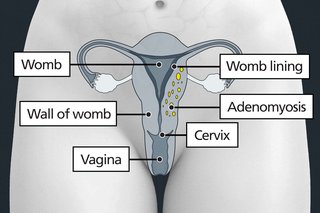
Adenomyosis and fibroids both involve the uterus, so they can be especially difficult to distinguish by symptoms alone. Adenomyosis means tissue resembling the lining is present within the uterine muscle wall. Its characteristic combination is heavy menstrual bleeding and painful periods, sometimes with pain that worsens over time. The illustration shows the location of that tissue, not a pattern that can be recognised from pain alone.
Fibroids, by contrast, are growths that can form in or on different parts of the uterus. They may cause heavier or more frequent bleeding and a feeling of pressure or pain in the lower abdomen or lower back. Some fibroids cause no symptoms at all. The word fibroid does not, by itself, explain every painful period in someone who has one.
Suppose a person describes increasingly heavy periods and cramps. Adenomyosis could be considered, but so could fibroids—and other explanations. If the same person also describes a persistent sense of lower-abdominal pressure, fibroids may become more relevant to discuss. That extra clue helps guide assessment; it still does not settle the cause. Nor must a person have only one condition at a time.
PID: an infection that may not follow the menstrual cycle
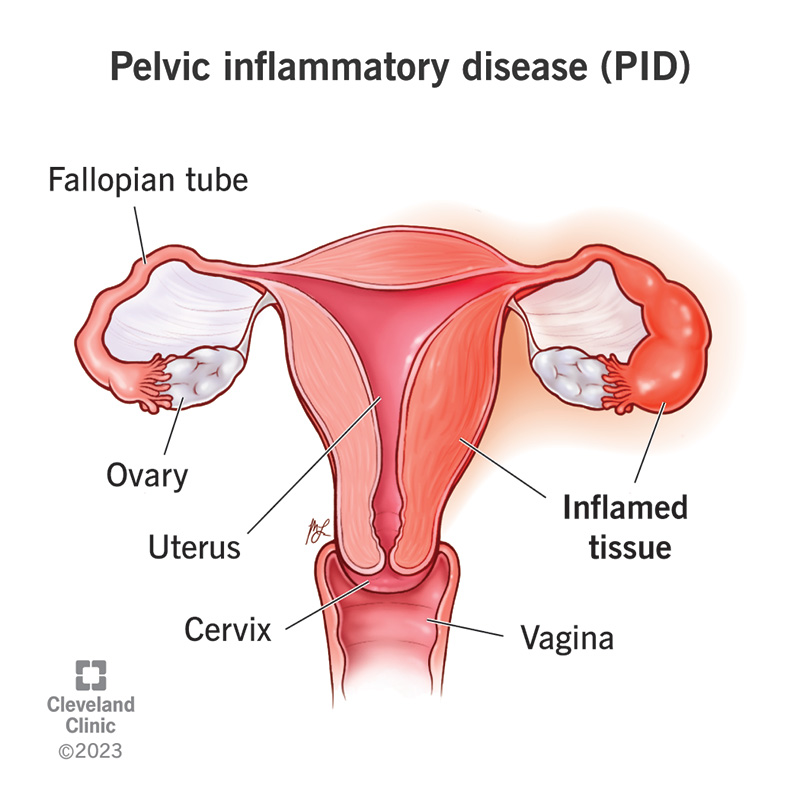
PID differs from the other three because it is an infection, rather than tissue in an unusual location or a uterine growth. It can cause lower pelvic pain that is not limited to periods. Fever or unusual vaginal discharge alongside pelvic pain makes infection an important possibility. PID can cause acute pain or contribute to longer-lasting pelvic pain, and some cases have few or no noticeable symptoms. No fever, therefore, does not rule it out.
The distinction matters for action as well as classification. New pelvic pain with fever or unusual discharge warrants prompt medical assessment, rather than waiting to see whether it resembles familiar cramps. Sudden severe pain or feeling seriously unwell also calls for urgent assessment; the next module will work through when same-day care or emergency care is appropriate.
Using the clues without turning them into diagnoses
Here is a compact way to keep the four patterns apart:
| Condition | Clues that may raise suspicion |
|---|---|
| Endometriosis | Period pain that worsens or lasts longer; pain between periods or during sex; bowel or bladder symptoms that worsen around periods |
| Adenomyosis | Heavy bleeding together with painful periods, sometimes worsening over time |
| Fibroids | Heavy or frequent bleeding with lower-abdominal or lower-back pressure or pain |
| PID | Lower pelvic pain, sometimes with fever or unusual discharge; symptoms may also be subtle or absent |
These are associations, not tests. Heavy bleeding does not distinguish adenomyosis from fibroids. Pain during sex does not uniquely indicate endometriosis. Pelvic pain without fever does not exclude PID. And a person can have a condition without showing its characteristic pattern.
The practical purpose of matching clues is to describe what is happening clearly enough to seek appropriate care—not to decide at home which label is correct. A clinician can consider the timing of pain, bleeding changes, associated symptoms, and other possible causes together. The fact that symptoms overlap does not make them unimportant; it makes the whole history important.
Key takeaways
Endometriosis can suggest itself through pain beyond typical cramps, particularly cycle-linked bowel or bladder symptoms. Adenomyosis often pairs painful periods with heavy bleeding; fibroids may add heavy or frequent bleeding and pressure. PID is an infection that may cause pelvic pain with fever or unusual discharge, though it can also be subtle. None can be confirmed or ruled out from symptoms alone.
Next, you will use pain and bleeding patterns to distinguish situations needing a routine appointment, same-day assessment, or emergency care.