Welcome back. In our previous two lessons, we explored Computer Science & Engineering (CSE) and Electronics & Communication Engineering (ECE) as separate disciplines. You learned that CSE is centered on software, data, and algorithms, while ECE is grounded in the physical world of circuits, hardware, and signals.
Now it's time to bring these two portraits together and place them side-by-side. The goal of this lesson is to directly compare CSE and ECE to help you understand their unique challenges, their distinct tools, and, crucially, the exciting areas where they overlap. By the end of our session, you will have a much clearer framework for thinking about which path might resonate more strongly with your own interests and skills.
The Two Sides of a Coin: Software and Hardware
At the most fundamental level, the difference between CSE and ECE can be understood as the difference between writing the instructions and building the machine that executes them. CSE is the discipline of abstraction, logic, and algorithms, while ECE is the discipline of physical systems, circuits, and signals. They are not rivals, but rather two essential halves of the same technological reality.
The following video from the "Clarity in Career" channel provides an excellent explanation of this core distinction.
CSE vs ECE after JEE — AI just changed the answer
This video cuts through common misconceptions to define CSE and ECE based on their fundamental purpose.
Please watch the first two segments. First, watch the section that defines what CSE and ECE are, focusing on the idea of instructions versus the machine. Then, continue with the analogy of them being two sides of the same coin, which highlights their interdependence.
As the video explains, one field creates the software and the other creates the hardware it runs on. This leads to different kinds of challenges. CSE problems often revolve around logic, efficiency, and managing complexity in abstract systems. ECE problems are frequently constrained by the laws of physics, dealing with signal integrity, power consumption, and the properties of materials.
This infographic provides a concise visual summary of this difference.
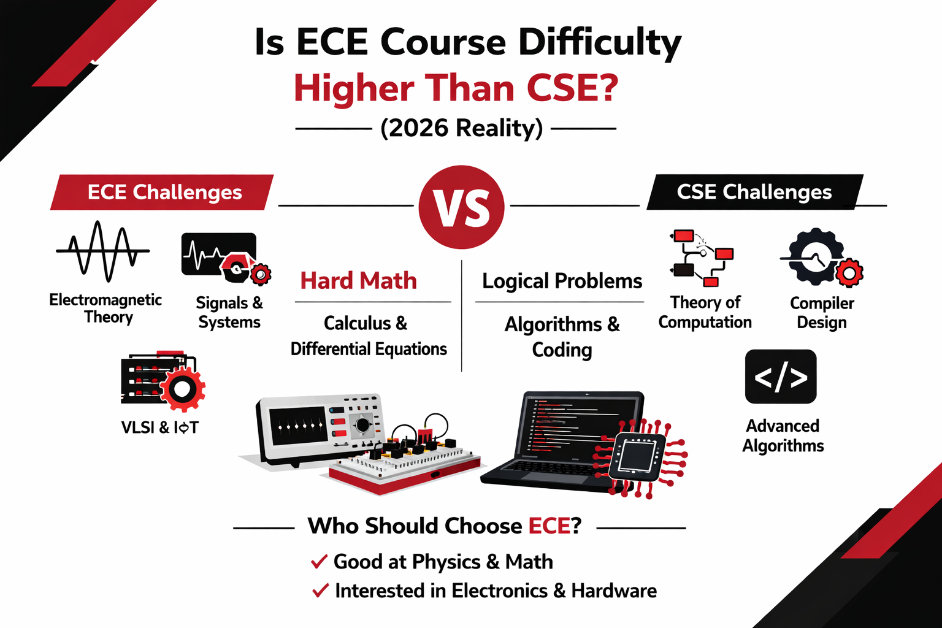
To solidify this distinction, let's examine a direct comparison table.
CSE and ECE Difference: Which Is Best for Your Career?
This article from Shiv Nadar University provides a very clear summary table comparing the two fields across several dimensions.
Please read the table in the section Key Differences. As you read, pay close attention to the rows for "Primary Focus," "Core Subjects," and "Hardware vs Software." Notice how the tools listed for each field reflect this fundamental divide.
A Tale of Two Curricula
This fundamental difference in focus naturally leads to different paths of study. While you will find some common ground in the early stages of a university program, the specializations diverge significantly. Your background in calculus, basic circuits, and programming will serve you well in the foundational courses of either major.
This next video from Zach Star offers a concrete breakdown of what you would actually study in an Electrical Engineering (EE, a close relative of ECE) versus a Computer Engineering (a field that blends CSE and ECE) curriculum. The comparison is highly relevant for our purposes.
Electrical Engineering Vs Computer Engineering - How to Pick the Right Major
This video walks through the typical course progression for EE and Computer Engineering students, showing where they overlap and where they specialize.
Watch the following sections to see how the academic paths differ: First, see the shared foundation, which includes programming, circuits, and signals. Next, explore the courses unique to Electrical Engineering, such as power systems, communications (AM/FM), and electromagnetism. Note how these topics heavily involve continuous signals and physical phenomena. Then, look at the courses unique to Computer Engineering, which lean more into software, discrete math, and computer architecture. Finally, the video provides a quick summary and answers the question of who uses more math. Your calculus background would be more heavily utilized in the advanced physics-based courses of ECE.
As you can see, an ECE path would build on your physics and calculus knowledge to tackle problems in electromagnetism and signal processing. A CSE path would leverage your programming and logical thinking skills to dive deeper into algorithms, data structures, and computational theory.
The Overlap: Where Hardware Meets Software
Perhaps the most dynamic and rapidly growing areas in technology are where CSE and ECE converge. This is where the code gets "close to the metal."
The quintessential example is Embedded Systems Engineering. As we touched on in our last lesson, this is the field dedicated to programming the microcontrollers inside countless devices—from smart watches and medical implants to automotive control units and industrial robots. An embedded systems engineer must be fluent in both hardware and software, able to write efficient C or Python code while also debugging circuit behavior with an oscilloscope.
The senior project examples from the video you just watched provide a perfect illustration of this collaboration.
Electrical Engineering Vs Computer Engineering - How to Pick the Right Major
Let's revisit the Zach Star video for its excellent examples of student projects, which show the distinct and overlapping roles of each major.
Focus on the final segment detailing careers and senior projects. Pay special attention to the sense and avoid UAV (drone) project. Notice how the computer engineers worked on the perception algorithm (the software logic), while the electrical engineers worked on the wireless communication and power systems (the hardware and signal physics).
This UAV project is a microcosm of modern product development. You can't build a drone, a self-driving car, or an IoT device without deep expertise from both CSE and ECE.
Other key areas of overlap include:
- VLSI (Very-Large-Scale Integration): The design of microchips requires ECE knowledge of semiconductor physics and circuit layout, but it's done using complex software tools (EDA - Electronic Design Automation) and involves writing hardware description languages, which is a CSE-like skill.
- Robotics: Creating a robot involves ECE for motor control, sensor integration, and power management, and CSE for motion planning, machine vision, and artificial intelligence.
- Computer Architecture: Designing the next generation of CPUs involves ECE principles for the physical layout and timing of transistors, and CSE principles for designing the instruction set and how the CPU processes data efficiently.
Conclusion
Today, we've directly compared Computer Science & Engineering and Electronics & Communication Engineering. You've learned that they are not competing fields, but rather complementary disciplines—two sides of the same coin.
Here are the key takeaways:
- Problems and Focus: CSE tackles problems in the abstract world of information, algorithms, and software. ECE tackles problems in the physical world of circuits, signals, and hardware.
- Tools and Skills: CSE professionals rely on programming languages, algorithms, and data structures. ECE professionals use tools like oscilloscopes and simulation software (like MATLAB), and rely on a deep understanding of physics and calculus.
- The Overlap: The two fields meet powerfully in areas like embedded systems, robotics, and chip design. In these domains, professionals need to understand both the software logic and the underlying hardware it controls.
As you reflect on these two paths, consider this question: When you look at a complex device like a smartphone, is your first instinct to wonder about the software—the operating system, the apps, the data flow? Or is it to wonder about the hardware—the processor chip, the radio antenna, the display technology? There is no right answer, but your natural curiosity can be a powerful guide.
This lesson concludes our high-level orientation. In the next module, we will begin our first technical deep-dive. We will start at the perfect intersection of CSE and ECE: the Digital Bridge, where we will explore how binary numbers and logic gates form the fundamental building blocks of all modern computing.