Hello. This course approaches public relations as more than getting a project noticed. We will look at how creators and organisations establish relationships with people who can question their claims, interpret their work, or decide whether to trust them. That leaves room for inventive responses, but it also makes a basic question essential: what change are you actually trying to bring about?
This lesson focuses on that question. By the end, you should be able to read a short creative-project brief and distinguish an objective about reach or sales from one about trust or legitimacy—even when all four appear in the same campaign.
What is supposed to change?
Imagine a small team preparing to release an interactive story. It wants 20,000 trailer views and 500 sales in its first month. It also wants players who rely on keyboard navigation to believe its accessibility information, particularly after a tester reported being unable to pass a dialogue choice without a mouse.
These wishes are related, but they do not describe the same change. Trailer views concern exposure: how often a piece of communication was seen. Sales concern transactions. The third wish concerns a relationship: whether a particular group has good reason to rely on what the team says. More views could help sell the game without resolving that question. Equally, the team could become more trustworthy in its accessibility information without immediately selling more copies.
Watch this short contrast between PR and advertising before we sharpen the distinction.
Public Relations vs Marketing vs Advertising: What's the difference?
Watch “Public Relations vs Marketing vs Advertising: What’s the Difference?” from PRLab for its account of credibility, public response, and the different aims often attached to PR and paid promotion.
Watch PR and credibility, especially the discussion of stakeholder trust and listening to reactions. Then watch advertising’s aims for its contrast with visibility and commercial results. As you watch, treat these as useful tendencies rather than fixed borders between professions.
The video gives trust a central place in PR. Its emphasis on earned media—coverage or endorsement not bought as an advertisement—is useful, but the channel does not, by itself, tell you the objective. A creator can put an honest correction in their own newsletter as part of rebuilding trust. Conversely, they might pursue a favourable review mainly to increase sales. Ask what the activity is intended to change, not merely where it appears.
It is also too neat to say that PR never promotes and marketing never listens. Creative projects often need both commercial success and credible relationships. The distinction is analytical: it lets you name which result you mean rather than treating every favourable number as evidence of the same success.
Read a brief for its underlying objective
A short brief often mixes ends with means. “Pitch reviewers,” “post a statement,” and “make a trailer” are activities. “Secure five reviews” and “reach 20,000 viewers” describe visibility results. “Sell 500 copies” describes a commercial result. None tells you, on its own, whether people regard the creator as reliable or entitled to make a particular claim.
A useful complication is that publicity itself can serve different purposes. The following reading makes that explicit.
Publicity as Public Relations - Sage Publishing
Read the excerpt from “Publicity as Public Relations,” published by Sage, to see why publicity cannot be equated with either promotion or reputation alone.
Near the beginning of the excerpt, find the list opening “Publicity can be deployed for various purposes.” Read the four kinds, paying particular attention to the difference between promotional and relational programs. Then find the subsection “Strategic Uses.” Read its first four uses, continuing through the remainder of the fourth use until just before “Fifth.” Notice the passage about people comparing stated values with their own experience.
The promotional and relational categories matter here. Publicity can help people discover and try a work; it can also help sustain a pattern of interaction with people who have a stake in it. These purposes can overlap, but neither substitutes for the other.
Return to the interactive-story brief. A reader who encounters its trailer has been reached. A reader who buys it has made a purchase. A player who relies on keyboard controls and finds the team’s accessibility information accurate has a basis for trust. That last judgment depends on more than wording. If the controls do not work as described, a polished statement may increase attention while making the trust problem worse.
Legitimacy is related to trust but not identical to it. Trust asks, roughly, “Can I rely on what this creator says or does?” Legitimacy asks, “Is this creator regarded as a credible, accountable participant in this activity or conversation?” For example, a project built from community-contributed stories might seek contributors’ recognition that its use and crediting of their work follows acceptable terms. A large audience cannot grant that recognition on contributors’ behalf, and sales cannot establish it.
Neither term means universal approval. Some people may dislike a work while regarding its maker as candid and responsible. A good PR objective names the relationship it hopes to improve without assuming that the public owes the project affection, agreement, or forgiveness.
Reach is evidence of contact, not evidence of trust
The distinction becomes clearer when you consider what each result could establish. AMEC’s Barcelona Principles V4.0 places organisational and communication objectives alongside activity, outputs, audience responses, outcomes, and impact. Its point is not that every project needs a large measurement system. It is that counting what you put into the world is different from learning what it changed.
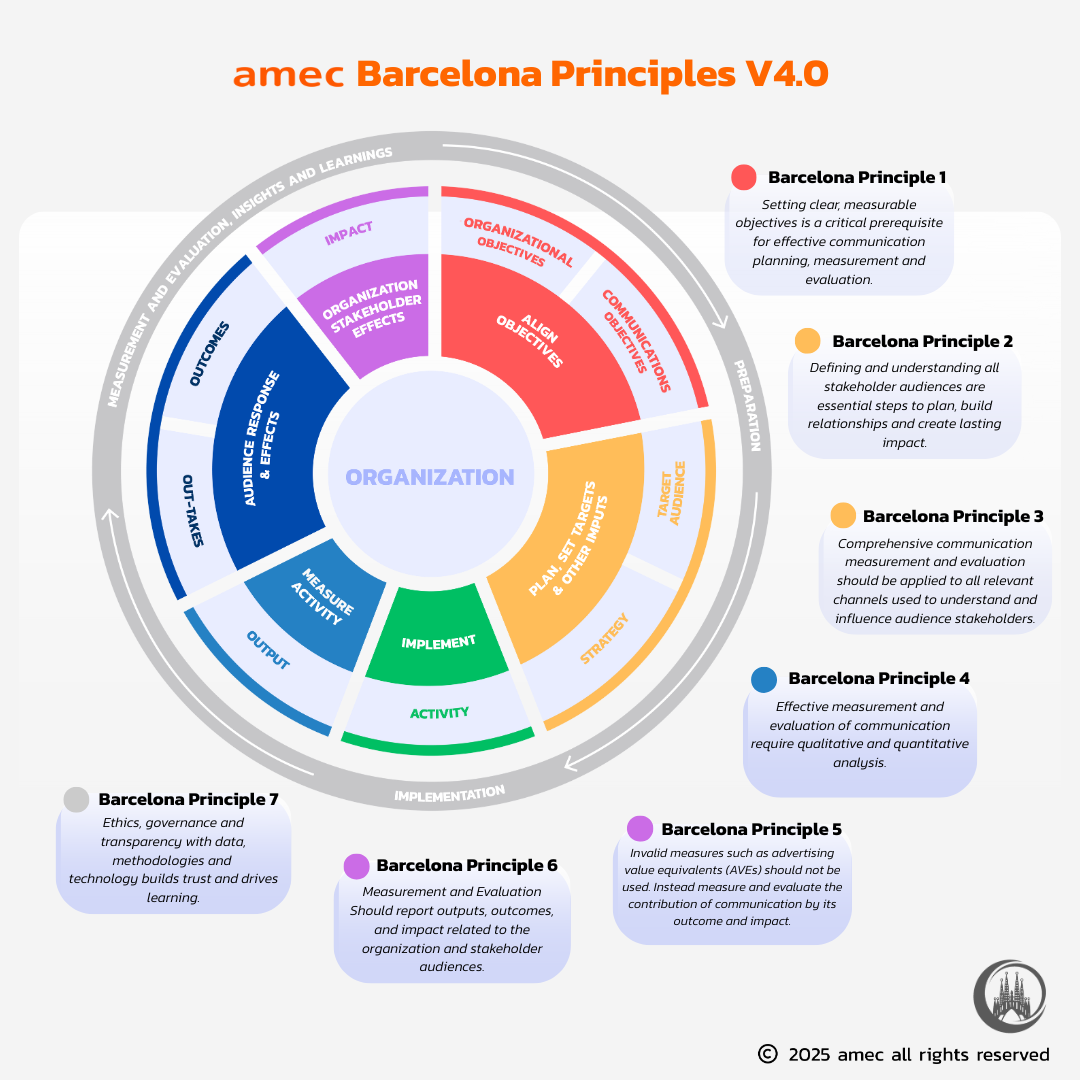
For the interactive story, the following observations answer different questions:
| Observation | What it could tell you |
|---|---|
| The trailer received 20,000 views. | The message gained exposure; it does not show what viewers believed. |
| The game sold 500 copies. | A commercial target was met; buyers may still have reservations. |
| Keyboard-dependent testers can accurately describe which controls work, and their accounts match what the team publishes. | The team’s information is becoming usable and credible to a relevant group. |
The last row is not a magic “trust score.” It combines what people understand with what they can verify through experience. That makes it more informative than counting favourable comments alone. It also illustrates a limit of communication: an objective such as being trusted on accessibility is not something a message can achieve while the underlying claim remains false.
Reach can still be a perfectly sensible objective. If almost nobody knows the game exists, increasing awareness may be the immediate priority. Sales can be essential to keeping the project viable. The mistake is not pursuing either one; it is reporting reach or sales as proof that a relationship has improved.
A compact way to diagnose a brief is to ask what would count as failure despite apparently good numbers. Suppose the team gets extensive coverage and meets its sales target, but players who depend on keyboard controls still cannot tell which features work. The reach and sales objectives may have succeeded; the trust objective has not. Conversely, if those players can now rely on the team’s descriptions but sales remain flat, there may be meaningful PR progress without commercial success.
This test keeps the objective attached to the people whose judgment matters. It also leaves room for creative judgment later in the course: a project might invite scrutiny, share an unfinished account of its work, or make a change visible rather than simply declare itself trustworthy. Which response makes sense depends first on the relationship you are trying to establish, not on a preferred publicity tactic.
Takeaways
In a creative-project brief, reach asks who encountered the work or its message; sales asks who bought it. A PR objective asks what should change in a public’s warranted understanding of, trust in, or recognition of the project. The categories can support one another, but success in one is not proof of success in another. To identify the objective, name the desired change and ask whose experience could confirm—or contradict—it.
Next, we will examine that last question more closely: a creative project has publics with different stakes and relationships to it, not one undifferentiated “audience.”