Recommended resources
The freely available resources this lesson will direct you to.
Hello! In our last lesson, we focused on integrating an external content moderation layer as a critical safety component. This creates a "safe corridor" for our agent to operate within. With these robust guardrails in place, we can now consider granting the agent more autonomy. However, this cannot be an abrupt switch; it must be a deliberate, evidence-based process.
This brings us to today's learning outcome: to define a graduated autonomy plan, starting with heavy human oversight and reducing it as confidence grows. This is a cornerstone of responsible AI deployment and is absolutely critical for building trust with the clients you will serve. You will learn how to design a system that "earns" its freedom, moving from a heavily supervised assistant to a trusted, autonomous team member based on proven performance.
1. The Principle of Earned Autonomy: The Agentic Trust Framework
In agentic system design, we treat autonomy not as a default state, but as a privilege that must be earned through demonstrated trustworthiness. A powerful mental model here is to think of your agent as a new employee. You wouldn't hire someone and on their first day give them full access to company financials and decision-making power. You would start them with limited responsibilities under close supervision and grant more autonomy as they prove their competence and reliability.
The Agentic Trust Framework (ATF), developed by the Cloud Security Alliance, formalizes this concept for AI agents. It provides a structured, phased approach to governance that aligns perfectly with the system design focus of this course.
The Agentic Trust Framework: Zero Trust Governance for AI Agents
The article 'The Agentic Trust Framework: Zero Trust Governance for AI Agents' is the primary resource for today's lesson. It outlines a comprehensive model for managing agent autonomy that is both conceptually clear and operationally practical. We will use this as our blueprint.
Please read sections 1 through 6 of this document. It's a detailed read, but it provides the complete framework we'll be discussing. As you read, focus on: Section 4, 'The Agent Maturity Model': This is the core of the framework. Pay close attention to the four levels (Intern, Junior, Senior, Principal) and how the agent's capabilities and the required human involvement change at each stage. Section 5, 'Promotion Criteria: The Five Gates': This section translates the abstract idea of 'earning trust' into concrete, measurable criteria. This directly addresses your goal of making decisions based on 'evidence, not vibes'. Section 4.6, 'ATF in Practice': This short case study shows how the framework is applied in a real-world scenario.
The ATF provides a clear path:
| Level | Name | Autonomy | Human Involvement |
|---|---|---|---|
| 1 | Intern | Observe + Report | Continuous oversight |
| 2 | Junior | Recommend + Approve | Human approves all actions |
| 3 | Senior | Act + Notify | Post-action notification |
| 4 | Principal | Autonomous | Strategic oversight only |
This progression from pre-approval (Junior) to post-notification (Senior) is the most critical step-up in autonomy. Making this leap safely requires a robust system for proving the agent's reliability.
This multi-level model is a common pattern for structuring human-agent collaboration. The image below provides an alternative, but conceptually similar, five-level visualization of this journey.
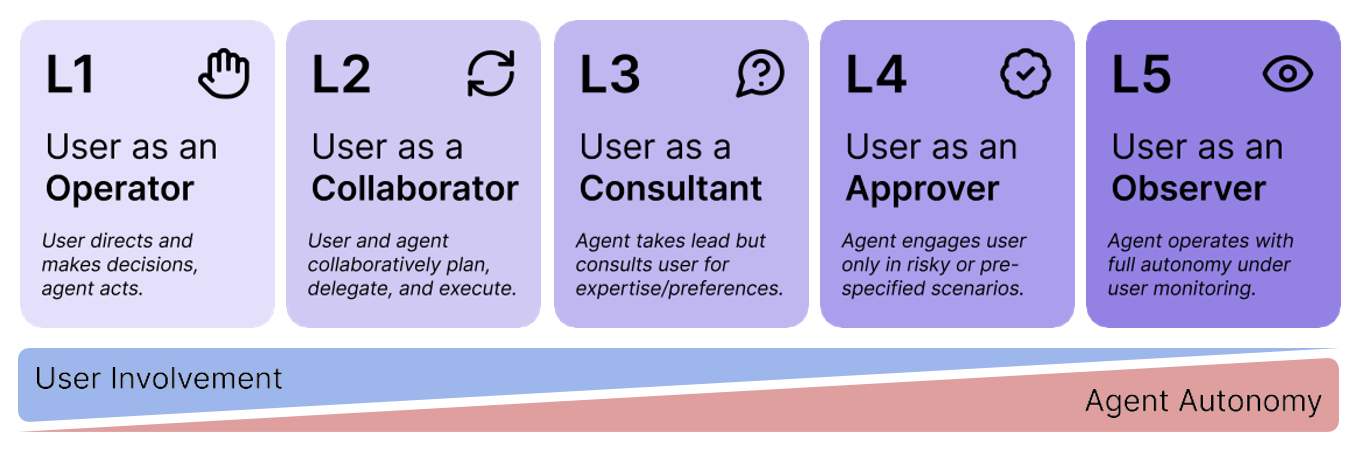
2. Gathering the Evidence for Promotion
The "Five Gates" in the ATF—Performance, Security Validation, Business Value, Incident Record, and Governance Sign-off—are not just a checklist; they are a formal contract for promotion. To pass through these gates, particularly the Performance gate (e.g., >95% recommendation acceptance rate to promote from Junior to Senior), you need a systematic way to collect and interpret evidence of the agent's behavior.
This is where evaluation becomes the engine of your graduated autonomy plan. You cannot simply feel that an agent is ready for promotion; you must prove it with data. The process involves building a strong evaluation dataset and, critically, establishing human judgment as the ground truth.
How to Systematically Setup LLM Evals (Metrics, Unit Tests, LLM-as-a-Judge)
The video 'How to Systematically Setup LLM Evals' by Dave Ebbelaar provides an excellent, practical guide to this process. It explains why starting with human evaluation is non-negotiable before you can automate the process.
Please watch from 17:55 to 31:46. This is a dense section, but it's crucial. Focus on: Why human evaluation is the 'golden standard' and cannot be skipped. The iterative process of using human critiques to create an 'aligned LLM-as-a-judge'. The practical spreadsheet example showing how to track human vs. model agreement. This is how you generate the quantitative evidence (like '95% accuracy') required by the ATF.
This evaluation process is the missing link between the theory of the ATF and its practical implementation. By systematically comparing your agent's performance against human expert judgment, you generate the auditable evidence needed to justify a promotion in autonomy to a client or internal stakeholder.
3. The Mechanism of Autonomy: Confidence Scoring
The crucial transition in the ATF is from the Junior level (human approves all actions) to the Senior level (agent acts and notifies). How does the system decide it no longer needs to ask for approval on every single action? The answer lies in confidence estimation.
A Senior agent doesn't operate blindly. It acts autonomously when it is confident and escalates to a human when it is not. Therefore, a key part of your system design is implementing a mechanism for the agent to assess its own confidence.
This concept is at the heart of the "Human-in-the-Loop" (HITL) design pattern.
AI Agents 3 - Agentic Design Patterns
Let's revisit a key design pattern from Prof. Ghassemi's lecture. This clip succinctly explains how confidence enables graduated autonomy within the HITL pattern.
Watch from 31:32 to 33:05. Pay close attention to the statement: 'You can also configure this so that you bypass human verification when the confidence is high.' This is the technical implementation of the Junior-to-Senior promotion.
But how do you measure confidence? Since you have a strong computer science background, you'll appreciate that this is a deep and active area of research. We can't rely on an LLM simply "sounding" confident. We need quantifiable methods.
There are two main families of techniques:
- Model-Internal (White-Box): Using signals from inside the model, like the probability distribution (logits) over its next token choice.
- External (Black-Box): Treating the model as an opaque box and using external strategies to infer confidence.
For system design, external methods are often more practical and robust. Let's look at an article that provides a comprehensive survey of these techniques.
Measuring Confidence in LLM responses
The article 'Measuring Confidence in LLM responses' by George Karapetyan is an excellent, in-depth resource. We'll focus on the 'External Methods' which are most relevant to system architecture.
Please read the section 'External Confidence Estimation Methods (Black-Box)'. Focus on understanding these key strategies: Self-Consistency: Asking the model the same question multiple times in different ways. High agreement implies high confidence. This is computationally expensive but very effective. External Verification: Using a tool (like a search engine or calculator) to fact-check the agent's answer. If the answer can be verified against a trusted source, confidence is high. These methods provide the signals your system can use to decide whether to act autonomously or escalate to a human.
By combining a framework like the ATF with a rigorous evaluation process and a reliable confidence scoring mechanism, you can design a system that safely and demonstrably earns its autonomy.
This diagram of an LLM Agent Operating System illustrates how these concepts fit together, with multiple points for human intervention that can be dynamically engaged based on the agent's assessed performance and confidence.

Conclusion
In this lesson, we have moved from establishing static safety guardrails to defining a dynamic, evidence-based plan for managing agent autonomy. This is a sophisticated approach that moves beyond a simple "on/off" switch for human oversight and treats the human-agent relationship as an evolving partnership.
Key Takeaways:
- A Graduated Autonomy Plan is a structured process for increasing an agent's responsibilities as it demonstrates trustworthiness.
- The Agentic Trust Framework (ATF) provides a ready-made, four-level model (Intern, Junior, Senior, Principal) that you can use to design and communicate this plan to clients.
- Promotion between levels is not time-based; it must be earned by passing evidence-based Promotion Gates, which are validated through systematic evaluation against human judgment.
- The technical mechanism enabling the jump from pre-approval to post-notification autonomy is confidence scoring, using techniques like self-consistency or external verification to decide when to act versus when to escalate.
By mastering this concept, you are equipped to design agentic systems that are not only powerful but also responsible, auditable, and worthy of your clients' trust.
In our final lesson for this module, we will address a crucial "soft skill" for delivering these systems: how to communicate the rationale for human-in-the-loop design to non-technical stakeholders. You now have the technical framework; next, we'll learn how to explain its value.