Recommended resources
The freely available resources this lesson will direct you to.
- Master ALL 20 Agentic AI Design Patterns [Complete Course]www.youtube.com
- Human-in-the-Loop (HITL) for AI Agents: Patterns and Best Practiceswww.youtube.com
- [PDF] The Effect of AI Delegation on Human Task Performance ... - arXiv.orgarxiv.org
- Architecting Agentic Communities using Design Patternsarxiv.org
Hello! Welcome to the first lesson in our module on "Human-in-the-Loop and Guardrails."
In our previous module, we established a rigorous, evidence-based process for evaluating and improving agentic systems. You learned how to measure performance, analyze failures, and build automated quality gates. That ability to quantify an agent's reliability is the essential prerequisite for this module's topic. After all, you can't decide how much to trust an agent until you can measure how trustworthy it is.
This lesson addresses a fundamental architectural choice in any agentic system: identifying which decisions in a workflow require human oversight versus full agent autonomy. This is not a simple binary choice but a spectrum of collaboration. Your ability to design this spectrum correctly is critical for managing risk, ensuring quality, and building client trust. For your goal of delivering agentic AI as a service, a well-designed human-in-the-loop (HITL) strategy is often the key differentiator between a clever prototype and a production-ready, reliable system.
1. The Spectrum of Human Involvement
A common misconception is that "human-in-the-loop" simply means a human occasionally approves or rejects an agent's output. A more sophisticated architectural view treats humans as integrated participants within the system. The decision is not if a human is involved, but how, when, and at what level of authority.
This framework provides a clear overview of how to structure this thinking.
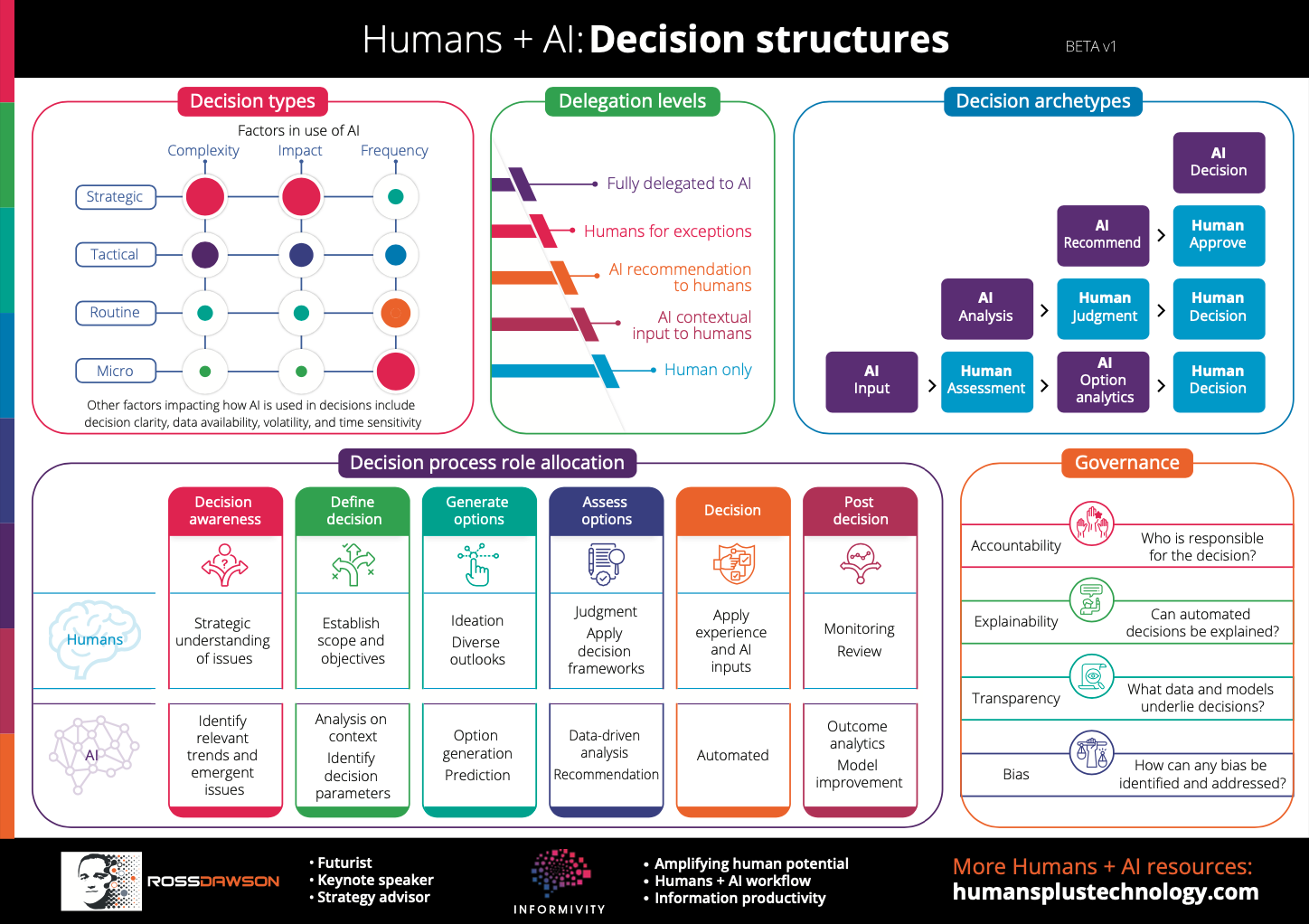
As you can see, the decision to involve a human is a function of the task itself. To formalize this, we can draw on the concept of Agentic Communities, which are systems where AI agents and human actors collaborate within a shared, governed framework.
Architecting Agentic Communities using Design Patterns
The paper 'Architecting Agentic Communities using Design Patterns' provides a formal vocabulary for integrating humans into agentic systems. It moves beyond thinking of humans as external supervisors and treats them as first-class participants with defined roles.
Please read section 2.1 ('LLM Agent, Agentic AI and Agentic Community') to understand this three-tier classification. Then, read the paragraph in section 3.2 ('Catalogue Overview') that begins 'Agentic Community patterns coordinate...' and section 6.3.1, focusing on the definition of 'Roles'. Note the specific human roles identified: domain experts, decision approvers, exception handlers, and supervisors. This gives us a precise language for describing human involvement.
This academic framing elevates the discussion. Instead of just "adding a human," you are designing specific roles into your architecture. This sets the stage for a more principled approach to deciding when and where these roles are necessary.
2. A Framework for Deciding: When is Human Oversight Required?
The decision to mandate human involvement is driven by a risk/reward analysis. Full autonomy is faster and cheaper but carries the risk of unmitigated failure. Human oversight is slower and more expensive but provides a crucial safety net. Here are the primary triggers that call for human oversight.
A. High Stakes and Irreversibility
This is the most common and critical reason. When an agent's action has significant, irreversible consequences—financial, legal, physical, or reputational—full autonomy is often unacceptable.
- Financial: Authorizing a payment over a certain threshold.
- Legal: Sending a legally binding contract to a client.
- Safety-Critical: Adjusting parameters on a physical machine in a factory.
- Regulatory Compliance: Submitting a report to a regulatory body like the SEC.
The video below discusses this in the context of common design patterns.
Master ALL 20 Agentic AI Design Patterns [Complete Course]
In this comprehensive course on agentic design patterns, Mark Kashef explains the core rationale for the Human-in-the-Loop pattern.
Please watch the segment on the 'Human in the loop' pattern from 34:09 to 36:04. Pay attention to the three main use cases mentioned: high-stake decisions, regulatory compliance, and catching edge cases. Notice the trade-off he highlights between trust and latency.
B. High Uncertainty and Ambiguity
Sometimes the agent itself recognizes its own limitations. This can happen when:
- The input is ambiguous or appears to be an edge case.
- The agent's internal confidence score for its proposed action is below a predefined threshold.
- The agent detects a significant drift from its expected performance, a concept we touched on in our evaluation module.
- An external tool call fails, and the agent's exception handling logic determines that human intervention is the safest fallback.
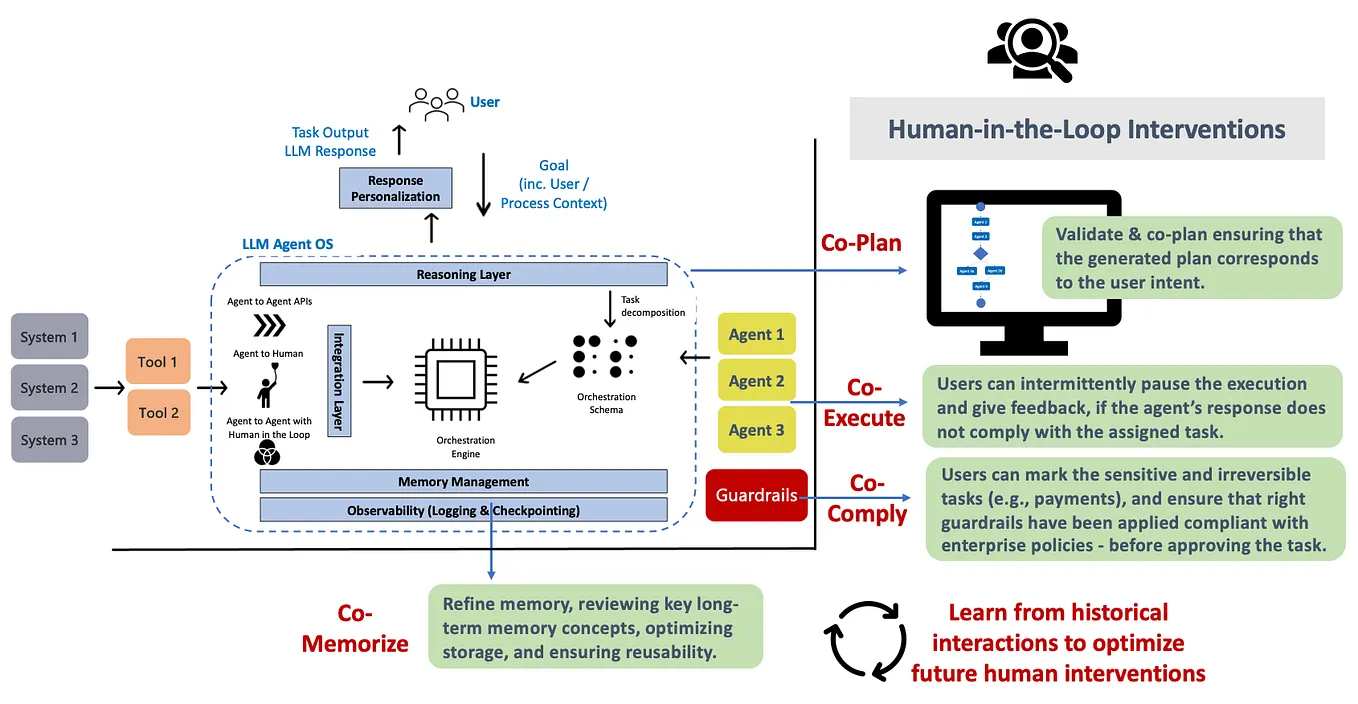
In these scenarios, the agent proactively escalates to a human, effectively asking for help. The diagram below shows how different types of human intervention can be architecturally integrated to handle these situations.
C. Inherent Human Judgment
Certain tasks rely on uniquely human capabilities that are difficult or impossible to replicate in an LLM. These include:
- Deep Domain Expertise: A senior physician reviewing an AI-generated diagnosis.
- Ethical Nuance: A human resources manager reviewing an AI's recommendation for a personnel issue.
- Subjective Quality: An editor reviewing an AI-generated marketing campaign for brand tone and creative flair.
In these cases, the AI acts as a powerful assistant or a "first-draft" generator, but the final decision authority rests with the human expert.
3. Beyond Risk: Using HITL for Performance Optimization
So far, we've treated HITL as a risk mitigation tool. However, a more advanced perspective is to use it as a performance optimization strategy. The goal is not just to prevent failure, but to achieve the best possible outcome by dynamically allocating tasks to the best-suited performer—whether human or AI.
This is the core idea behind AI Delegation. In this model, the AI doesn't just defer when it's uncertain; it actively delegates tasks it predicts a human can perform better.
[PDF] The Effect of AI Delegation on Human Task Performance ... - arXiv.org
This paper, 'The Effect of AI Delegation on Human Task Performance,' investigates the behavioral and performance impact when an AI delegates tasks to humans. It provides a compelling, evidence-based argument for a more dynamic form of HITL.
Please read the Abstract and Section 1 (Introduction) to grasp the concept of AI delegation. Then, read Section 5.2 ('Effect of AI Delegation on Task Performance') and Section 6 ('Discussion'). The key finding is that a human-AI team outperforms either member working alone, because the AI learns to delegate tasks that better align with human capabilities.
The implications of this are profound for system design. You can build an agentic system that:
- Uses its own capabilities for tasks where it has high confidence and a history of success.
- Delegates tasks to a human where the human has historically demonstrated superior performance (e.g., tasks requiring visual nuance or complex reasoning that the AI struggles with).
This reframes HITL from a simple "safety brake" to a sophisticated load-balancing and optimization mechanism.
4. Architectural and Strategic Implications
Deciding to incorporate human oversight is not merely a feature; it is a fundamental architectural commitment. Given your background, the technical challenges are as important as the conceptual drivers.
A workflow that needs to pause and wait for human input—which could take minutes, hours, or even days—cannot be a simple, stateless request-response process. It requires a durable, stateful architecture capable of managing long-running executions.
Human-in-the-Loop (HITL) for AI Agents: Patterns and Best Practices
The team at Temporal, a company specializing in durable execution, provides an excellent technical deep-dive into the challenges of building real-world HITL systems.
Watch the section from 05:18 to 12:22. The speaker outlines the four key architectural challenges of building HITL systems, such as the UX being a separate process and tasks outliving process lifetimes. Then, watch from 26:00 to 29:27 for an explanation of 'durable execution' and how it solves these problems. This will give you a clear sense of the architectural complexity involved and the types of solutions required.
Finally, the level of human oversight should not be a static, one-time decision. A powerful strategy is to plan for Progressive Autonomy. Your system can be designed to evolve over time, earning trust and reducing its reliance on human intervention as its performance is validated.
The "Architecting Agentic Communities" paper (resource LINK, section 6.6) describes this progression:
- Advisory Mode: The agent only recommends actions; a human must approve every step.
- Supervised Mode: The agent acts autonomously within predefined boundaries, but a human monitors its actions and can intervene.
- Autonomous Mode: The agent acts fully autonomously, with a human only reviewing actions post-hoc or handling escalations.
By linking this strategy to the evaluation framework from our last module, you can create a data-driven path to increase autonomy, demonstrating to clients that the system's independence is earned through proven, measured reliability.
Conclusion
In this lesson, we have developed a multi-faceted framework for deciding between human oversight and full agent autonomy. This decision is central to designing systems that are not only capable but also safe, reliable, and effective.
Key Takeaways:
- It's a Spectrum: The choice is not a binary switch but a spectrum of collaboration, with humans playing defined roles like approvers, experts, or exception handlers.
- Risk-Driven Decisions: The primary drivers for human oversight are high-stakes consequences, regulatory compliance, high uncertainty, and tasks requiring uniquely human judgment.
- Optimize for Performance: Beyond risk, HITL can be used to optimize overall team performance by delegating tasks to the participant (human or AI) best equipped to handle them.
- Architecture is Key: Implementing HITL requires a commitment to durable, asynchronous, stateful system architecture.
- Plan for Progressive Autonomy: Design your system to earn trust over time, with a clear, data-driven path from heavy human supervision to greater autonomy.
In our next lesson, we will get more tactical. Now that we know when and why to involve a human, we will focus on designing the specific mechanisms for that involvement: approval checkpoints and escalation triggers. We will explore how to build the review queues, notification systems, and user interfaces that make human-in-the-loop a practical reality.