Recommended resources
The freely available resources this lesson will direct you to.
- Master ALL 20 Agentic AI Design Patterns [Complete Course]www.youtube.com
- You Can Learn AI Agent System Design In 19 Min | RAG, Vector Database, Evals, Function Callingwww.youtube.com
- Designing Agentic AI Workflows: Six Steps for Enterprise- ...www.faktion.com
- Choosing the right orchestration pattern for multi agent ...www.kore.ai
Introduction
Welcome back. In our last lesson, we established a rigorous process for scoping a client engagement, moving from a high-level business problem to a well-defined Scope of Work (SoW) with a feasible agentic solution. You now have the blueprint for a full-scale system that is aligned with your client's strategic goals.
However, moving directly from a blueprint to a full build can be risky, especially with novel technologies like agentic AI. It requires significant upfront investment and leaves little room for early feedback. This is where a Proof-of-Concept (PoC) becomes an indispensable strategic tool.
Today's lesson focuses on our next learning outcome: Design a minimal proof-of-concept workflow by selecting the most critical agents, tools, and data needed to demonstrate core value. A PoC is not a scaled-down version of the final product; it is a surgical strike designed to answer the most important question: "Does the core mechanism of our proposed solution work and deliver tangible value?" By the end of this lesson, you will be able to translate your full-scope design into a lean, focused PoC architecture ready for implementation.
1. Defining the "Minimal Viable Path" for Your PoC
The first and most critical step in designing a PoC is to resist the urge to build too much. The goal is to isolate the single most valuable and uncertain part of the workflow you designed during scoping. This is your "minimal viable path."
Think of the 80/20 principle: what 20% of the proposed workflow will deliver 80% of the "wow" factor or de-risk the biggest technical or business assumption?
A great way to identify this path is to revisit the end-to-end process map you created. For each step, ask:
- Value: Which step, if automated, would solve the most painful part of the client's current problem?
- Uncertainty: Which step relies most heavily on an agent's reasoning capabilities and is least amenable to deterministic logic?
- Feasibility: Which step can be demonstrated with a manageable number of tools and data sources?
Let's ground this in a practical example.
Designing Agentic AI Workflows: Six Steps for Enterprise ... - Faktion
Recall the comprehensive HR Employee Onboarding workflow from the Faktion article we looked at last time. It's a perfect example of a large, multi-step process. We'll analyze it to see how we might carve out a PoC.
Review the section 'Example - Agentic Employee Onboarding Process', focusing on the table that maps roles, tasks, tools, and data sources. Imagine you've proposed this entire workflow to a client. Now, you need to pick one slice for a PoC.
Looking at the HR onboarding example, several PoC candidates emerge:
- Candidate A (Low Hanging Fruit): Automate the
Welcome Coordinator Agent's task. This is simple but low-value; it's a glorified mail merge and doesn't showcase agentic reasoning. - Candidate B (High-Value, High-Complexity): Automate the entire
IT ProvisioningandTraining Assignmentflow. This is high-value but involves multiple systems (Jira, LMS, etc.) and complex dependencies, making it a poor choice for a minimal PoC. - Candidate C (The Sweet Spot): Focus on the
Document Collection Agentand theHR Knowledge Agent. This path hits the sweet spot. It tackles a clear bottleneck (manual document chasing) and demonstrates powerful agentic capabilities:- Structured Output: The
Document Collection Agentmust process unstructured documents (ID, tax forms) and extract structured data. - RAG: The
HR Knowledge Agentmust answer new-hire questions by retrieving information from a knowledge base of HR policies.
- Structured Output: The
For a PoC, you would select a single path like Candidate C. Your PoC's objective becomes: "To demonstrate that a multi-agent system can (1) intelligently process new hire documents and (2) accurately answer policy questions using a provided knowledge base." This is specific, measurable, and directly showcases the core value of agentic AI.
2. Designing the PoC Architecture: Agents, Tools, and Data
Once you've defined your minimal viable path, you can design the architecture for the PoC. This involves making deliberate choices about which agents, tools, and data are absolutely essential.
To see this process in action, let's analyze a well-designed system for an e-commerce customer support bot. The architecture presented is essentially a perfect blueprint for a PoC.
You Can Learn AI Agent System Design In 19 Min | RAG, Vector Database, Evals, Function Calling
The video 'You Can Learn AI Agent System Design In 19 Min' provides an excellent case study of designing an agent system from scratch. Pay close attention to how the presenter breaks the problem down and assigns specific roles to different components.
Watch the following segments, thinking about how each decision contributes to a focused PoC design: Goal & Scope (00:17 - 03:28): Note how a broad problem ('customer support') is narrowed to a specific scope ('returns, exchanges, order status') with clear business rules. This is your minimal path. Agent Architecture (05:24 - 09:58): Analyze the roles of the Router Agent and the Planner Agent. This is a classic PoC pattern: one agent to classify the task, another to execute it. Tools (Function Calling) (09:47 - 11:16): Observe the list of potential tools (Stripe, Shopify, 3PL APIs). For a PoC, you might select only one or two critical functions, or even mock them initially. Data (RAG) (12:27 - 14:41): Understand how a Vector DB is used to provide the agent with private business knowledge (e.g., return policies). A PoC would use a small, representative set of policy documents.
This example beautifully illustrates the key architectural decisions for a PoC:
1. Select Critical Agents:
You don't need all six agents from the HR workflow. Start with the fewest agents that can complete the minimal path. A common and highly effective pattern for a PoC is a two-agent team:
- A Router/Dispatcher Agent: This agent analyzes the initial input and routes it to the correct specialist. This demonstrates the system's ability to understand intent.
- One or two Specialist/Planner Agents: These agents are responsible for executing the core tasks of your minimal path (e.g., a
DocumentProcessingAgentor aKnowledgeQueryAgent).
2. Select Critical Tools (and Mock the Rest):
Identify the one or two external actions that are absolutely essential to prove the concept. In the e-commerce example, this might be calling the Shopify API to check an order status.
Crucial PoC Strategy: For all other tool interactions, use mock interfaces. Instead of integrating with a live CRM in your PoC, create a function that simply prints "[MOCK] Updating CRM with new ticket..." and returns a successful response. This isolates the agent's reasoning logic from complex and time-consuming integration work, allowing you to focus on proving the core agentic behavior first.
3. Select Critical Data:
If your PoC involves RAG (Retrieval-Augmented Generation), you don't need the client's entire knowledge base. Curate a small, high-quality dataset that is representative of the final use case. For the HR PoC, this might be 5-10 key policy documents. For the e-commerce bot, it would be the official return and exchange policy documents. This allows you to test the retrieval and synthesis mechanism without the overhead of a full-scale data ingestion pipeline.
3. Choosing the Right Orchestration Pattern for a PoC
With your agents, tools, and data selected, the final design question is: how will they coordinate? This is the role of orchestration. While there are many complex patterns, for a PoC, simplicity and clarity are paramount.
Choosing the right orchestration pattern for multi agent systems
The article 'Choosing the right orchestration pattern for multi agent systems' from Kore.ai provides a clear taxonomy of orchestration models. We will focus on the pattern most suitable for PoCs.
Read the sections introducing the three patterns: 'Supervisor pattern', 'Adaptive agent network pattern', and 'Custom pattern'. Pay special attention to the 'When to use' and 'When to avoid' guidance for the Supervisor pattern. Finally, read the 'Implementation recommendations'.
As the article suggests, the Supervisor pattern is almost always the correct choice for a PoC. In this model, a central orchestrator (or "Supervisor" agent) decomposes the task, delegates work to specialized agents, and synthesizes the final response.
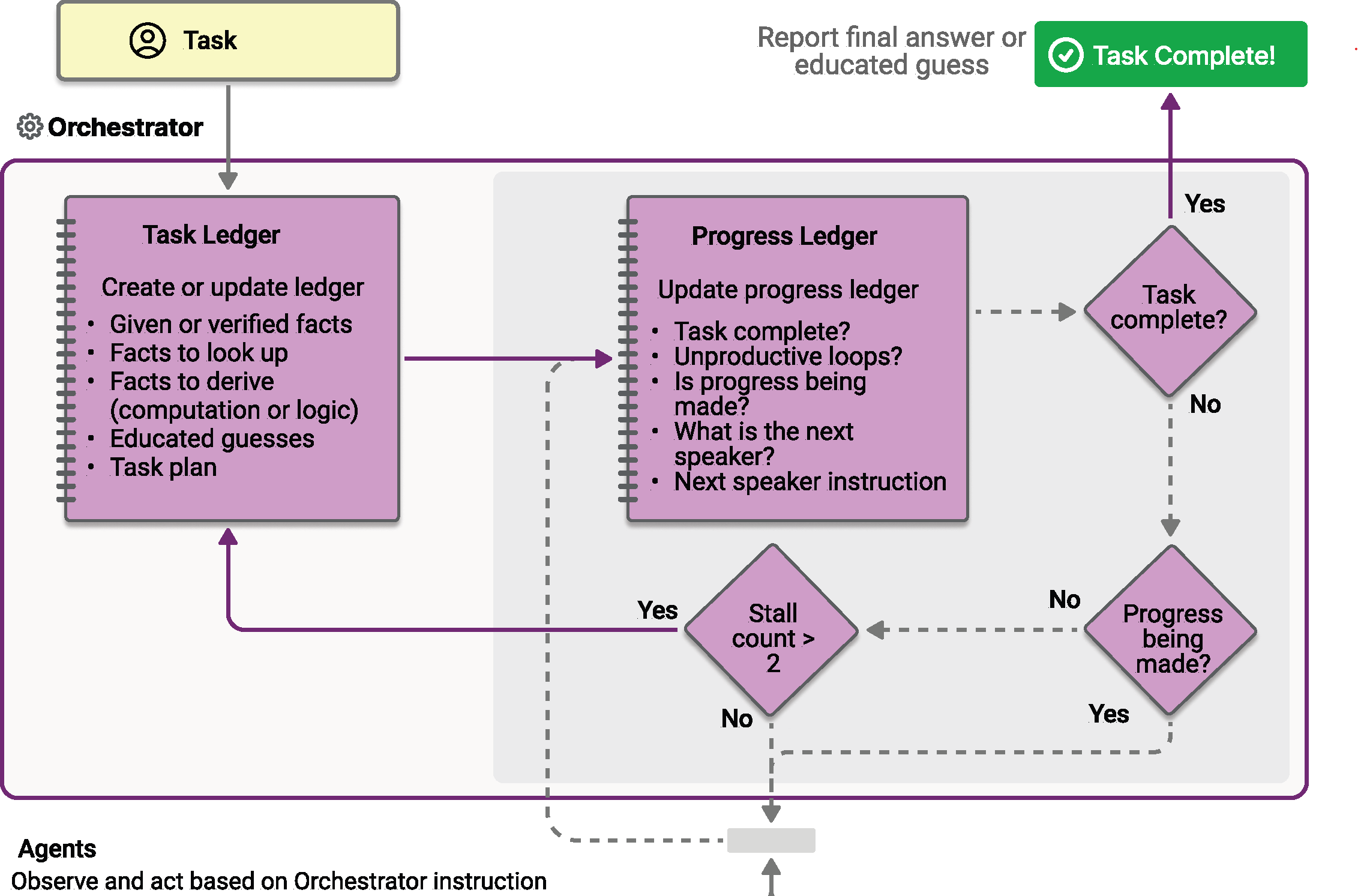
Why is the Supervisor pattern ideal for a PoC?
- Clarity & Traceability: The logic is centralized and explicit. You can easily follow the "thinking process" of the orchestrator, which is invaluable for debugging and for demonstrating the workflow to a client.
- Control: It gives you precise control over the sequence of events, preventing unpredictable agent-to-agent interactions that can complicate a demonstration.
- Simplicity: It's a straightforward architecture to implement. The "Router Agent" in the e-commerce video is a simple form of a Supervisor.
The alternative, a decentralized "Adaptive agent network," allows for faster, more fluid interactions but is harder to debug and control, making it a less suitable choice for an initial PoC. The "Custom pattern" is reserved for highly complex, regulated environments and represents an implementation overhead you want to avoid at this stage.
Let's look at a video that visually summarizes several key agentic patterns, including those that fit within a Supervisor model.
Master ALL 20 Agentic AI Design Patterns [Complete Course]
To solidify these concepts, let's watch a quick overview of several agentic design patterns. This will help you connect the theoretical patterns to visual workflows.
Watch the segments on 'Planning' (00:18:22 - 00:20:52) and 'Multi-agent Collaboration' (00:20:41 - 00:23:42). Notice how both of these patterns implicitly or explicitly use a central coordinator or planner to manage the workflow. This is the essence of the Supervisor pattern.
The Planning and Multi-agent Collaboration patterns described in the video are practical implementations of the Supervisor model. Your PoC will likely use one of these structures: an orchestrator agent that creates a step-by-step plan and executes it, or a manager agent that delegates tasks to a small team of specialists.
Conclusion
You have now learned how to bridge the gap between a comprehensive project scope and a focused, high-impact Proof-of-Concept. The design of a PoC is an exercise in strategic reduction, aimed at maximizing learning and demonstrating value while minimizing initial effort.
Key Takeaways:
- Start with the Minimal Viable Path: Identify the single workflow slice that offers the highest value and de-risks the most significant assumptions of your project.
- Select Critical Components: Choose the minimum number of agents, tools, and data necessary to execute the minimal path. A common PoC architecture is a
Routeragent delegating to aSpecialistagent. - Mock Extensively: Use mock APIs and tools for non-essential integrations to isolate and focus on the core agentic logic.
- Use the Supervisor Pattern: Employ a centralized orchestration model for your PoC. It provides the clarity, control, and traceability needed for effective development, debugging, and client demonstration.
In our next lesson, we will move from design to action. You will learn how to implement the key components of a PoC, including writing simplified agent instructions and creating the mock tool interfaces we discussed today. This is where your architectural blueprint starts to become a tangible reality.