Introduction
Welcome to the first lesson in your journey into philosophy, politics, and economics. We begin with a skill that is the bedrock of all three disciplines: logical reasoning. In any of these fields, progress is made by constructing and evaluating arguments. Therefore, before we can explore complex ideas like justice, ideology, or market efficiency, we must first learn how to see the architecture of the reasoning that supports them.
This lesson addresses the first learning outcome of our course: to identify and reconstruct the structure of an argument, including its premises, intermediate steps, and conclusion. Think of this as learning to parse a new kind of language. Just as in computer science where you analyze source code to understand its logic, flow, and output, here you will learn to dissect texts and speeches to reveal their underlying argumentative structure. By the end of this lesson, you will be able to take a piece of prose, identify its core persuasive claim, find the evidence offered in its support, and map out how these pieces fit together.
What is an Argument?
In everyday language, an "argument" might mean a heated disagreement. In philosophy and critical reasoning, however, the term has a precise definition. An argument is a set of statements, one of which (the conclusion) is purported to be supported by the others (the premises). The premises are the reasons or evidence given to persuade you that the conclusion is true.
For a formal definition and a simple example, please start by reading a short section from the "Philosophical Skills" guide.
[PDF] PHILOSOPHICAL SKILLS by Jonathan Spelman
This reading will introduce the core concepts of premises, conclusions, and the standard form used to represent arguments.
Please read the first two sections of this guide, "What are arguments and what are they good for?" and "What does it mean to evaluate an argument?". Pay close attention to the definition of a sound argument, though we will explore that concept more in future lessons.
As you just read, philosophers often use a standard form to represent arguments clearly. This involves listing the premises first, each on its own line (P1, P2, ...), followed by the conclusion (C). This format strips away non-essential language and makes the argument's logical structure explicit.
The following short video explains and demonstrates this process, highlighting why it is such a useful tool for analysis.
Argument Standard Form - Definition, Examples, Benefits
This video defines argument standard form and explains its benefits for clear thinking.
Please watch the entire video. Pay special attention to the section explaining the benefits of using standard form, as it clarifies why this structured approach is so valuable for analyzing reasoning.
Identifying an Argument's Components
The first challenge in reconstruction is parsing a regular text or speech—which is often messy, repetitive, and filled with asides—to find the premises and the conclusion.
Indicator Words
Fortunately, language often provides signposts. Certain words and phrases signal that a reason (a premise) or a main point (a conclusion) is being presented.
- Conclusion Indicators: therefore, so, thus, hence, consequently, it follows that, as a result
- Premise Indicators: because, since, for, given that, as, for the reason that
The video below provides a good overview of how to use these indicator words and what to do when an argument doesn't contain any.
Identifying Premises and Conclusions
This video from Kevin deLaplante provides practical tips for finding premises and conclusions in natural language.
Watch the video from the beginning to learn about indicator words. Then, continue watching the next segment on arguments without indicators, which explains how to identify the main point by analyzing the context.
When you encounter a passage with no indicators, the key question to ask is: "What is the single main point the author is trying to get me to accept?" That's your conclusion. Then ask: "What reasons or evidence are they providing to get me to accept that point?" Those are your premises.
Reconstructing Complex Arguments
Arguments are not always a simple set of premises leading to a final conclusion. Often, they have a more complex, hierarchical structure. A premise might itself be the conclusion of a smaller, supporting argument. We call such a claim an intermediate conclusion.
This is analogous to a program where a main function calls a helper function. The helper function's return value (the intermediate conclusion) is then used by the main function to compute its final result (the ultimate conclusion).
There are three basic ways premises can work together to support a conclusion:
-
Linear Structure (or Chain): One premise leads to an intermediate conclusion, which in turn serves as a premise for the next step, and so on, in a chain.
- Example:
P1 → C1(as P2) → C2
- Example:
-
Branching Structure (or Convergent): Two or more independent premises each provide separate support for the conclusion.
- Example:
P1 → CandP2 → C
- Example:
-
Joint Structure (or Linked): Two or more premises only support the conclusion when taken together. They are not independent.
- Example:
(P1 + P2) → C
- Example:
The following diagram illustrates a complex argument with multiple intermediate conclusions, showing how foundational premises build up to support an ultimate conclusion.

To understand these structures better, let's turn to a more detailed guide on argument reconstruction.
How to Reconstruct an Argument - Titivillus - WordPress.com
This reading will explain the different ways premises can be organized to support a conclusion.
Please read the section titled "Organize Parts". Focus on understanding the distinction between the linear, branching, and joint structures.
The Full Reconstruction Process
We can now outline a systematic process for reconstructing an argument from a text. Think of this as an algorithm for logical analysis.
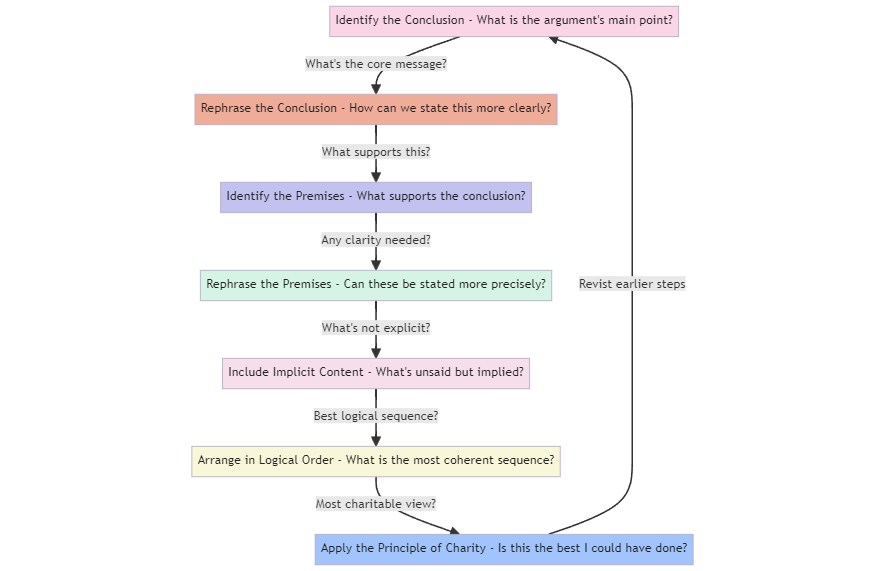
Following this model, the steps are:
- Identify the final conclusion. What is the author's main point?
- Identify the explicit premises. What reasons does the author explicitly state?
- Filter out "excess verbiage." Arguments are often embedded in text that includes repetitions, examples, rhetorical flourishes, or asides. The goal is to isolate the core logical structure. Be careful not to discard something essential—this is where judgment is required.
- Clarify and organize. Rephrase the premises and conclusion for clarity if needed. Then, determine the structure: are the premises working independently (branching), together (joint), or in a sequence (linear)? Map this out.
- Identify intermediate and suppressed premises. Look for the "missing links." An intermediate conclusion is a statement that acts as a conclusion for some premises and a premise for another. A suppressed premise is an unstated assumption the argument needs to be logically complete. For example, the argument "Socrates is a man, so Socrates is mortal" has a suppressed premise: "All men are mortal." Making these implicit steps explicit is key to a full reconstruction.
Let's briefly examine the idea of suppressed premises.
How to Reconstruct an Argument - Titivillus - WordPress.com
This reading explains the role of unstated, or "suppressed," premises in arguments.
Read the first part of the section "Fill in Gaps". This will introduce why it's important to identify the assumptions an argument relies on. We will delve deeper into this when we discuss argument validity.
Conclusion
In this lesson, we have established the foundational skills for logical analysis. You learned that arguments are composed of premises that provide support for a conclusion. You also learned how to identify these components using indicator words and context, and how to represent their relationships using standard form and structural diagrams (linear, branching, and joint). Finally, you saw that a full reconstruction often involves making implicit assumptions, or suppressed premises, explicit.
These skills are not just academic. They are crucial tools for clear thinking that allow you to engage critically with political rhetoric, philosophical theories, and economic models.
In our next lesson, we will build directly on this foundation. Now that you can reconstruct an argument's structure, we will begin the work of evaluating it. You will learn to distinguish between two major types of arguments—deductive and inductive—and understand the different standards we use to judge whether they are strong or weak.