Welcome to the final lesson of our first module. Over the past seven lessons, we have systematically covered every unit of UGC NET Paper 1, from aptitude and reasoning to the core knowledge areas of ICT, Environment, and Higher Education. You have built a strong foundation. Now, it is time to integrate this knowledge and test your skills under exam conditions.
Today's lesson is centered on a single, crucial learning outcome: solving a timed, mixed-set of Paper 1 MCQs and analyzing your performance to identify weak areas. This is not just a test; it is a diagnostic exercise designed to make your revision for the final exam as targeted and efficient as possible. We will simulate the exam, then I will guide you through a structured process to analyze your results, turning this practice session into a powerful learning tool.
1. The Strategic Importance of Mock Tests
To crack the JRF, a high score in Paper 1 is not just helpful—it's often the deciding factor. While knowledge is essential, success in the NET exam also hinges on time management, accuracy, and the ability to perform under pressure. This is where mock tests become indispensable.
The following article from Professor Academy, "How to Score 70+ in UGC NET Paper 1," reinforces this point and outlines a strategy that aligns perfectly with our crash course approach.
How to Score 70+ in UGC NET Paper 1 | Proven Tips & Smart Strategy
This article provides a research-backed strategy for excelling in Paper 1. It emphasizes the critical role of practicing with previous year questions (PYQs) and mock drills.
As you read, focus on these key strategic points: Why Scoring High Matters: Read the section Why it Matters to understand the competitive edge a strong Paper 1 score gives you. The Role of Practice: Pay close attention to the section Practice Religiously. The author highlights that a majority of questions are conceptual repeats, making mock drills a high-return activity. The Analysis Loop: Note the advice to Attempt Daily Mock Tests. The key is not just attempting but analyzing the results to pinpoint and work on weak areas.
To effectively analyze your performance, it's useful to remember the relative importance of each unit. The two images below provide a clear visual breakdown of question distribution and recommended priorities. Keep these in mind as you review your mock test results later.
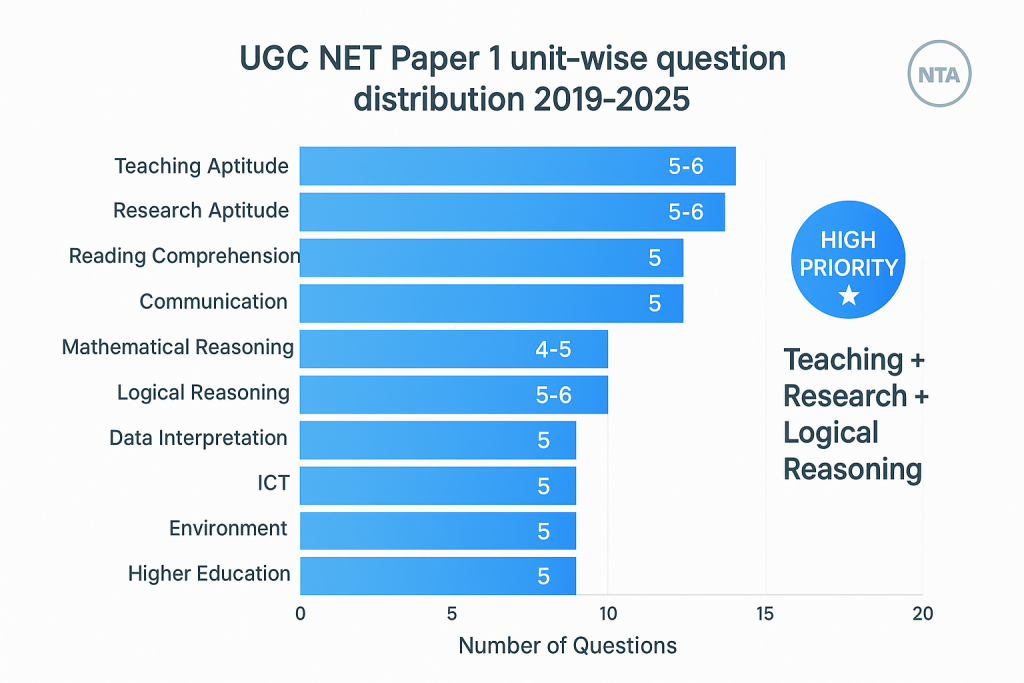
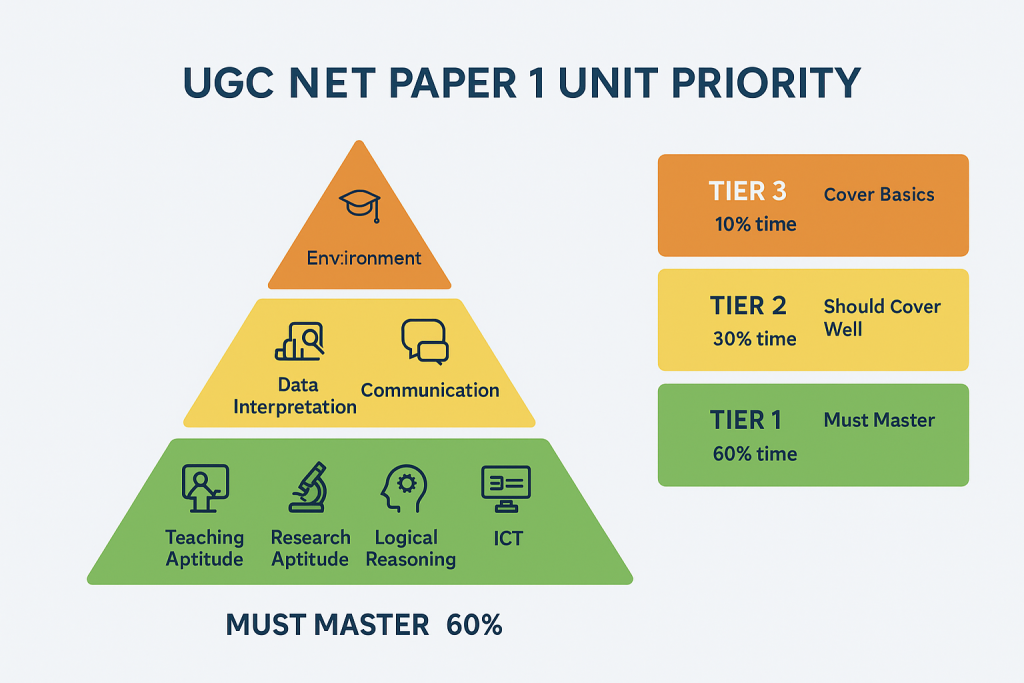
2. The Paper 1 Mock Test Challenge
Now it's time to put your learning into practice. The following resource provides a free, full-length mock test for Paper 1, consisting of 50 questions with a 60-minute time limit, mirroring the actual UGC NET exam pattern.
Instructions for the Test:
- Find a quiet space where you will not be disturbed for the next hour.
- Set a timer for 60 minutes.
- Attempt the test as if it were the real exam. Do not use any notes or external resources.
- Answer every question. There is no negative marking in the UGC NET exam.
- Once you start the timer, complete the entire test in one sitting.
UGC NET Mock Test 2026 June Exam (Hindi & English) - Adda247
This resource from Adda247 provides a timed mock test that simulates the real exam environment. This is the central activity of our lesson.
Please navigate to the section titled "Free UGC NET Mock Test (June Exam)". Find the test labeled UGC NET Paper 1 Mock Test 1 and begin.
3. Performance Analysis: The Real Learning Begins
Completing the test is only the first step. The most valuable part of this exercise is the analysis that follows. A detailed review will transform your test score from a simple number into a roadmap for your final weeks of preparation.
Once you have your results, follow this structured analysis process. You can create a simple table or use a notebook to track your findings.
Step 1: Overall and Unit-wise Performance
- Calculate Your Score: Note your total number of correct answers (out of 50). Each question is worth 2 marks.
- Categorize by Unit: Go through each question and categorize it into one of the 10 Paper 1 units (e.g., Teaching Aptitude, DI, Logical Reasoning, ICT, etc.).
- Calculate Unit Accuracy: For each unit, count how many questions you answered correctly. This will immediately reveal your strongest and weakest areas in a quantifiable way.
Step 2: Deep Dive into Your Errors
For every question you answered incorrectly, identify the root cause of the error. This is crucial. Was it...
- A Conceptual Gap? You were unfamiliar with the theory, term, or formula (e.g., you didn't know the characteristics of a specific logical fallacy or the recommendations of an education committee).
- A Misinterpretation? You knew the concept but misunderstood what the question was asking, perhaps due to tricky wording.
- A Calculation Error? You made a simple mistake in a Mathematical Reasoning or Data Interpretation problem.
- A Time-Pressure Mistake? You knew the answer but rushed and selected the wrong option.
Step 3: Review Your Time Management
- Pacing: Did you finish the test within the 60-minute limit?
- Time Sinks: Were there specific questions or sections (like Reading Comprehension or DI) where you spent a disproportionate amount of time?
- Strategy: Did you attempt the paper sequentially, or did you tackle your stronger sections first? Reflect on what worked and what didn't.
4. Deconstructing Exam Questions: An Expert's View
To help you with your analysis, let's review how experts break down complex questions. Watching a solved example can clarify concepts and reveal effective problem-solving strategies. The following video clips tackle typical high-level questions from Paper 1.
UGC NET Paper 1 | UGC NET Paper 1 TOP 100 PYQs | UGC NET Paper 1 by Masroor sir
This video from Adda247 UGC NET features an instructor solving and explaining MCQs from a previous year's paper. We'll look at two examples to model the process of question analysis.
Please watch the following segments: Metacognition (Teaching Aptitude): Watch the detailed breakdown of a question on metacognition from this part. Notice how the instructor uses the definition of metacognition ("thinking about thinking") and the process of elimination to arrive at the correct set of statements. This is a great example of handling multi-statement questions. Criterion-Referenced Testing (Teaching Aptitude): Review the explanation of Criterion-Referenced vs. Norm-Referenced testing from this segment. The instructor uses clear analogies (JRF cut-off, "Sharma ji ka beta") to distinguish between testing against a standard and testing against a group. This clarifies a commonly confused topic.
As you watch, consider how this approach can inform your own review. Don't just check if your answer was right or wrong; strive to understand the underlying logic and the distractors.
Conclusion
This lesson marked the culmination of our journey through Paper 1. By taking a timed mock test and, more importantly, performing a structured analysis, you have moved from passively acquiring knowledge to actively diagnosing your own strengths and weaknesses.
Key Takeaways:
- Practice is Diagnosis: Mock tests are not just for practice; they are your primary tool for identifying specific areas that need more attention.
- Analyze Your Errors: The most significant learning comes from understanding why you made a mistake. Categorizing errors into conceptual gaps, misinterpretations, or silly mistakes will guide your revision.
- Strategy Matters: Time management and question-selection strategy are skills that can be honed through practice and analysis, and are just as important as content knowledge.
You have now completed the first major milestone in our crash course. With a clear understanding of your Paper 1 standing, we will now pivot to your core subject. In the next module, Fundamentals of Management & Communication, we will begin our deep dive into Paper 2, starting with the very building blocks of management: its core concepts, classical and modern theories, and the essential functions that define a manager's role.