Welcome to the second module of our course, "Adaptive Strategy and Governance." In our previous lessons, we laid the strategic foundation for our transformation. We diagnosed the organization, built a guiding coalition, crafted a vision, justified it with a business case, and, most recently, solidified the program's authority with a transformation charter. With the "why" and "what" firmly established, we now turn to the "how."
This lesson addresses a fundamental challenge in executing large-scale change: planning in the face of uncertainty. Traditional, multi-year project plans are often rigid and can quickly become obsolete as the business landscape shifts. For a complex transformation, a more resilient and adaptive approach is required. Today, we will explore how to apply iterative planning techniques, specifically rolling wave planning, to your transformation program, enabling you to navigate uncertainty while still delivering predictable progress.
The Limits of Upfront Planning
Your experience in project and product management has likely shown you that even the most detailed upfront plans rarely survive contact with reality, especially in software development. A large-scale transformation, which can span years and affect every part of the organization, magnifies this problem exponentially.
Many transformations fail because they are built on unrealistic plans that underestimate the time, cost, and effort required. Let's start by hearing an expert perspective on why this happens so frequently.
How to Create a Realistic Digital Transformation and Software Implementation Project Plan
In this video, digital transformation consultant Eric Kimberling discusses the common pitfalls of implementation planning.
First, watch the introduction to understand the core problem of unrealistic expectations and why they lead to failure. Then, jump to the section explaining what's missing from typical software vendor plans. Notice that the missing pieces—business process improvement, organizational change management—are central to the transformation work we've been discussing.
Kimberling's point is crucial: a plan that only covers the technical software build is not a transformation plan. The real complexity lies in the human and process elements, which are inherently difficult to predict far in advance. At the start of a two-year program, uncertainty is at its peak. We know the destination (our vision), but the exact path is unclear.
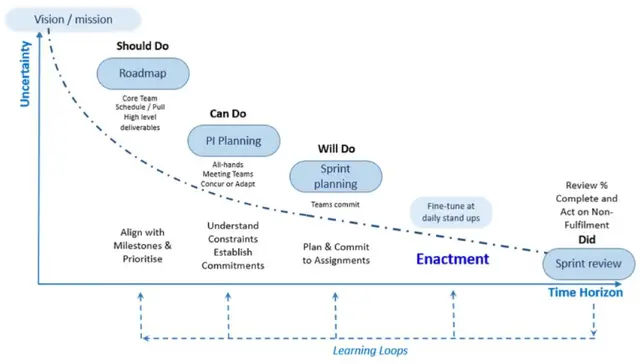
As the diagram "Planning from uncertainty to enactment" shows, our planning must adapt as we move along the time horizon. We start with high-level direction and progressively add detail as we get closer to the work. This is the core principle of iterative planning.
Rolling Wave Planning: The Core Technique
The formal term for this adaptive approach is rolling wave planning. It's an iterative technique where you plan upcoming work in detail while keeping work further in the future at a higher, more flexible level.
Agile Practice Guide - Rolling Wave Planning
This short video by David McLachlan provides a clear, concise definition of rolling wave planning.
Watch the first three minutes to understand the concept. Pay attention to how he defines it as an iterative technique and connects it to the concept of progressive elaboration, which will be familiar from your project management background.
As the video explains, this method embraces the fact that your knowledge is greatest for near-term activities. Instead of creating a detailed, multi-year Gantt chart, you create a high-level roadmap and then break down only the next "wave" of work into detailed tasks. This creates a rhythm of planning, executing, learning, and re-planning.
Scaling Up: From Project Tactic to Transformation Strategy
While rolling wave planning is a powerful project-level tool, its true value in our context is when we apply it at the program level to guide the entire transformation. Two complementary models are particularly useful here: the Wave-Based Model and the Basecamp Metaphor.
1. The Wave-Based Transformation Model
Consulting firms like McKinsey have refined this iterative approach into a formal "wave-based" model for managing large programs. Here, the transformation is orchestrated as a sequence of time-boxed "waves," each delivering a specific portfolio of initiatives.
McKinsey Transformation Office / wave‑based transformation model
This article from Umbrex provides an excellent overview of the wave-based transformation model and the role of the Transformation Office (TO) in executing it.
First, read the introductory sections, What Is It? and How it Works, to grasp the core concept of organizing change into a repeating cycle. Then, review the detailed example in the section Transformation Office and Waves in Action. Note how the CPG company structured its effort: Wave 0: A short diagnostic to identify opportunities and build the initial backlog. Wave 1: A 10-week push on quick wins and pilots to build momentum. Wave 2/3: Scaling the proven initiatives across the organization.
This model provides a structured, disciplined rhythm for the transformation. Instead of a single, monolithic plan, you have a series of focused campaigns, each with clear goals and a defined timeline (typically 10-16 weeks).
2. The Basecamp Metaphor
The wave-based model gives us the "how," but it doesn't necessarily define the strategic purpose of each wave. This is where the "Basecamp" metaphor from LeadingAgile becomes incredibly useful. It frames the transformation as an expedition up a mountain, where each wave is a stop at a "Basecamp"—an intermediate state of stability and readiness for the next leg of the journey.
This whitepaper by LeadingAgile introduces the concept of Basecamps as strategic milestones in a transformation journey. It directly links this idea to rolling wave planning.
Please read the section titled Basecamps. Focus on the description of Basecamp One - Stabilize the System, where it explicitly states that "roadmapping, rolling wave planning, and progressive elaboration should be the rule." Next, read the section on the Pilot. This shows the practical application, explaining that the mechanics of getting the first pilot teams to Basecamp One involve establishing rolling wave planning.
By combining these two ideas, we get a powerful framework:
- Your overall Transformation Roadmap defines the sequence of Basecamps (strategic goals, e.g., "Stabilize Delivery," "Decouple Services").
- You execute this roadmap through a series of Waves (time-boxed initiatives).
- For each wave, you use Rolling Wave Planning to define the detailed work required to reach the next Basecamp.
Applying Iterative Planning to Your Program
So, how do you put this into practice? Let's use the framework from the McKinsey article to outline the steps.
-
Define the High-Level Roadmap (Wave 0 / Pre-Implementation Planning):
This is your initial strategic planning phase. As Eric Kimberling suggested, this is a dedicated 3-6 month effort before the main implementation kicks off.- Activity: Conduct a rapid opportunity scan across the value themes you defined in your strategy (e.g., product, delivery, GTM).
- Output: An initial backlog of potential initiatives, prioritized by impact and feasibility. This backlog is your raw material for the upcoming waves. You also define the first one or two "Basecamps."
-
Plan and Launch Wave 1:
This wave is critical for building momentum and credibility.- Activity: Select a handful of initiatives from the backlog that offer quick wins or can serve as valuable pilots. For these initiatives, and only these, you conduct detailed planning. You define scope, resources, deliverables, and timelines.
- Output: A detailed 10-12 week plan for Wave 1. The rest of the transformation backlog remains at a high level.
-
Execute Wave 1 and Plan Wave 2:
As Wave 1 is executed, your teams are learning, and you are gathering real data on what works.- Activity: Towards the end of Wave 1, you begin the detailed planning for Wave 2. This new plan will be informed by the lessons, successes, and failures of Wave 1. You may decide to scale a successful pilot, pivot away from a failed one, or introduce a new initiative from the backlog.
- Output: A detailed plan for Wave 2, while the plan for Wave 3 and beyond remains a high-level forecast.
This cycle of execute-learn-plan repeats throughout the life of the transformation, ensuring your program constantly adapts to reality while moving purposefully toward its vision.
Conclusion
You now have a powerful alternative to the fragile, all-at-once project plan. By embracing iterative planning, you acknowledge and manage uncertainty rather than ignoring it. This approach allows your transformation program to be both disciplined and adaptive.
Key Takeaways:
- Large-scale transformations are too complex and uncertain for traditional, upfront planning.
- Rolling wave planning is an iterative technique that focuses detailed planning on near-term work while keeping future work at a high level.
- The wave-based model scales this technique to the program level by breaking the transformation into a sequence of time-boxed waves, each focused on a portfolio of initiatives.
- The Basecamp metaphor provides a strategic lens, framing each wave as a step toward a key milestone on the transformation journey.
- This approach creates a rhythm of planning, executing, and learning that increases the resilience and success rate of your program.
In our next lesson, we will dive deeper into the "learning" part of this cycle. We'll explore how to design effective feedback loops and use rapid experimentation to test your transformation hypotheses within each wave, making your adaptive strategy even more intelligent.