Hello! In our previous lesson, we established the formal definition of a vector space and the ten axioms required to verify one. We saw that this verification process, while fundamental, can be quite lengthy.
Today, we'll build on that foundation to explore one of the most important concepts in linear algebra: subspaces. These are essentially vector spaces that live inside larger vector spaces. This lesson is focused on a crucial skill: identifying and proving whether a given subset of a vector space is, in fact, a subspace. The good news is that there's a much more efficient method than checking all ten axioms again.
By the end of this lesson, you will be able to apply a three-step test to rigorously prove or disprove that a subset is a subspace, a skill you will use constantly throughout this course.
From Subsets to Subspaces
In any vector space , we can consider various subsets of its vectors. However, not all subsets are equally interesting from a linear algebra perspective. We care most about subsets that preserve the algebraic structure of the parent space—that is, subsets where vector addition and scalar multiplication "play nice" and don't lead you outside the subset. These special subsets are called subspaces.
Let's begin with a video that provides excellent geometric intuition for this idea.
Subspaces are the Natural Subsets of Linear Algebra | Definition + First Examples
Dr. Trefor Bazett visually explores why some subsets of R² (like lines and planes through the origin) are 'natural' settings for linear algebra, while others (like a circle or a shifted line) are not. This will give you a strong intuitive grasp of the concept before we dive into the formal proofs.
Please watch the following segments: Definition of a Subspace (0:58 - 2:16): Pay attention to the three properties that define a subspace. Geometric Examples/Non-examples (3:07 - 5:12): Observe why a line through the origin works as a subspace, but a line that does not pass through the origin fails. Trivial Subspaces (5:12 - 6:24): Understand the two simplest possible subspaces of any vector space.
The Subspace Test: A Powerful Shortcut
As you saw in the video and as we previewed in the last lesson, we don't need to re-verify all ten vector space axioms to prove a subset is a subspace. Since is part of a larger vector space , most of the axioms (like commutativity and associativity) are inherited automatically. We only need to verify the properties that ensure is a self-contained vector space.
This leads to the crucial Subspace Test.
This reading formally introduces the Subspace Test and, importantly, includes a proof of why this test is sufficient. Understanding this proof is key to appreciating the logical structure of linear algebra.
Please read the section 'Theorem 1.3.2. Subspace Test' and its accompanying proof. Focus on how the proof shows that if the three conditions of the test hold, the other seven vector space axioms are automatically satisfied.
To summarize, a subset of a vector space is a subspace if and only if it satisfies these three conditions:
- Contains the Zero Vector: The zero vector of must be in .
- Closure under Addition: For any two vectors and in , their sum must also be in .
- Closure under Scalar Multiplication: For any vector in and any scalar , the product must also be in .
This three-point checklist is the tool we will use for all our proofs moving forward.
Proving a Subset Is a Subspace
To prove that a set is a subspace, we must show that all three conditions of the Subspace Test hold for arbitrary elements of .
Let's see this in action with a concrete example.
Linear Algebra 7 | Examples for Subspaces
This video from 'The Bright Side of Mathematics' provides a rigorous, step-by-step demonstration of how to apply the Subspace Test to a subset of R³. It's an excellent template for structuring your own proofs.
Watch the segment from 1:26 to 8:21. The subset U is defined by two linear equations. Observe how the proof is structured: Check if the zero vector satisfies the equations. Take an arbitrary vector from U and an arbitrary scalar, and show that the scaled vector still satisfies the equations. Take two arbitrary vectors from U and show their sum still satisfies the equations.
A More Abstract Example: The Null Space
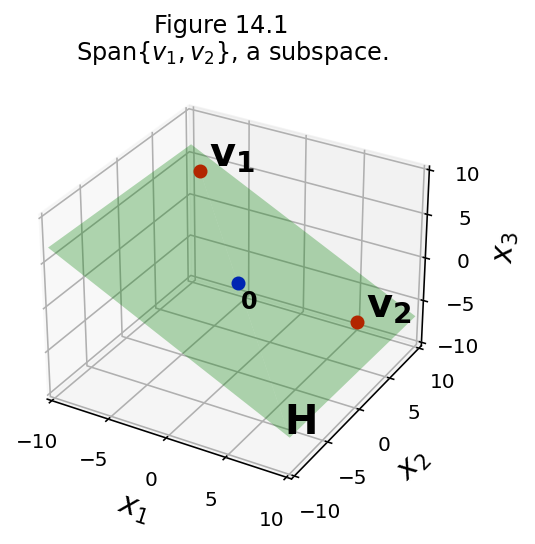
The Subspace Test applies not just to subsets of , but to more abstractly defined sets as well. One of the most important subspaces you'll encounter is the null space of a matrix , which is the set of all vectors that solve the homogeneous equation . This concept is central to understanding the solution structure of linear systems.
Let's walk through the proof that the null space is always a subspace.
This text provides a concise proof that the null space of any m x n matrix A is a subspace of R^n. This is a classic and important proof.
Find the definition of 'Null space' and read the 'Proof' that follows it. The proof directly applies the three-step Subspace Test, relying on the properties of matrix-vector multiplication we will cover in the next module.
The proof structure is identical to the video example, just applied to a more general setting:
- Check for : Is ? Yes. So, is in the null space.
- Check Closure under Addition: If and are in the null space (meaning and ), is in the null space? We check: . Yes.
- Check Closure under Scalar Multiplication: If is in the null space () and is a scalar, is in the null space? We check: . Yes.
Since all three conditions hold, the null space is a subspace.
Proving a Subset Is Not a Subspace
To prove that a subset is not a subspace, you only need to provide one specific counterexample that shows the failure of any one of the three conditions.
-
Easiest Check: Does the subset contain the zero vector? If not, you're done. For example, the set of vectors in where is not a subspace because is not in the set ().
-
Finding a Counterexample for Closure: If the zero vector is included, you must find a case where addition or scalar multiplication fails.
Let's watch a clear demonstration of this.
Linear Algebra 7 | Examples for Subspaces
Let's return to 'The Bright Side of Mathematics' for a counterexample. This will show you how to formally present a proof by counterexample.
Watch the segment from 8:21 to 10:26. The subset is defined by the non-linear equation x_1^2 = x_2. Notice how a specific vector and a specific scalar are chosen to demonstrate that closure under scalar multiplication fails.
Another Common Counterexample: Determinants
Consider the vector space of all 2x2 matrices. Let be the subset of matrices where the determinant is zero. Is a subspace?
-
Zero Vector: The zero vector in this space is the zero matrix . Its determinant is 0, so it's in .
-
Closure under Addition: Let's test this. Consider these two matrices in :
Their sum is:
The determinant of their sum is , which is not 0. Therefore, is not in .
Since we found a counterexample for closure under addition, is not a subspace.
Conclusion
In this lesson, we have developed the primary tool for identifying the fundamental building blocks of vector spaces.
Here are the key takeaways:
- A subspace is a non-empty subset of a vector space that is itself a vector space under the same operations.
- The Subspace Test is a three-condition check that provides an efficient way to prove or disprove that a subset is a subspace. The conditions are: containing the zero vector, closure under addition, and closure under scalar multiplication.
- To prove a set is a subspace, you must show that all three conditions hold for arbitrary elements.
- To disprove that a set is a subspace, you only need to provide a single, concrete counterexample demonstrating that one of the three conditions fails.
Preview of the next lesson:
We have seen that subspaces can be defined by equations (like planes or null spaces). An equally powerful way to define a subspace is by constructing it from a set of vectors. In the next lesson, we will explore the concept of span—the set of all possible linear combinations of a given set of vectors—and prove that the span of any set of vectors is always a subspace.