Welcome back! In our previous lesson, we explored the Nernst equation, which allows us to calculate reduction potentials under the non-standard conditions found inside a living cell. You saw how the cell ingeniously maintains separate pools of NAD⁺/NADH and NADP⁺/NADPH at different effective potentials, dedicating them to catabolism and anabolism, respectively.
This lesson is the capstone of our module on bioenergetics. Here, we will synthesize everything we've learned about free energy and reduction potentials to address a central question in metabolism: what determines the direction of electron flow in a biochemical pathway? You will learn to apply thermodynamic principles to predict the sequence of reactions in complex redox systems, using the mitochondrial electron transport chain as our primary case study. This will bridge the abstract concepts of electrochemistry with the concrete reality of cellular energy conversion.
1. The Guiding Principle: Electron Flow and Reduction Potential
In any redox reaction, electrons move from an electron donor to an electron acceptor. The spontaneous direction of this movement is governed by the difference in reduction potential () between the two redox pairs. The fundamental rule is simple: electrons spontaneously flow from a redox pair with a lower (more negative) reduction potential to a redox pair with a higher (more positive) reduction potential.
Think of it as electrons rolling "downhill" in an energetic landscape, where the reduction potential represents the altitude. The video below provides an excellent conceptual explanation of reduction potentials and this directional principle.
Electron Transport Chain (Part 1 of 3) - Introduction and Reduction Potentials
This video from Moof University clearly defines reduction potential and explains how it predicts the direction of electron transfer.
Please watch the segment from this explanation. Focus on these key points: A low or negative reduction potential signifies a species that does not want to be reduced; it would rather give away electrons, making it a good electron donor (reductant). A high or positive reduction potential signifies a species that wants to be reduced; it readily accepts electrons, making it a good electron acceptor (oxidant). Crucially, electrons will always flow from the species with the lower reduction potential to the species with the higher reduction potential.
This principle allows us to use a table of standard reduction potentials () to predict the behavior of different biological molecules. A species with a highly negative , like NADH, is a strong reductant. A species with a highly positive , like molecular oxygen, is a strong oxidant.
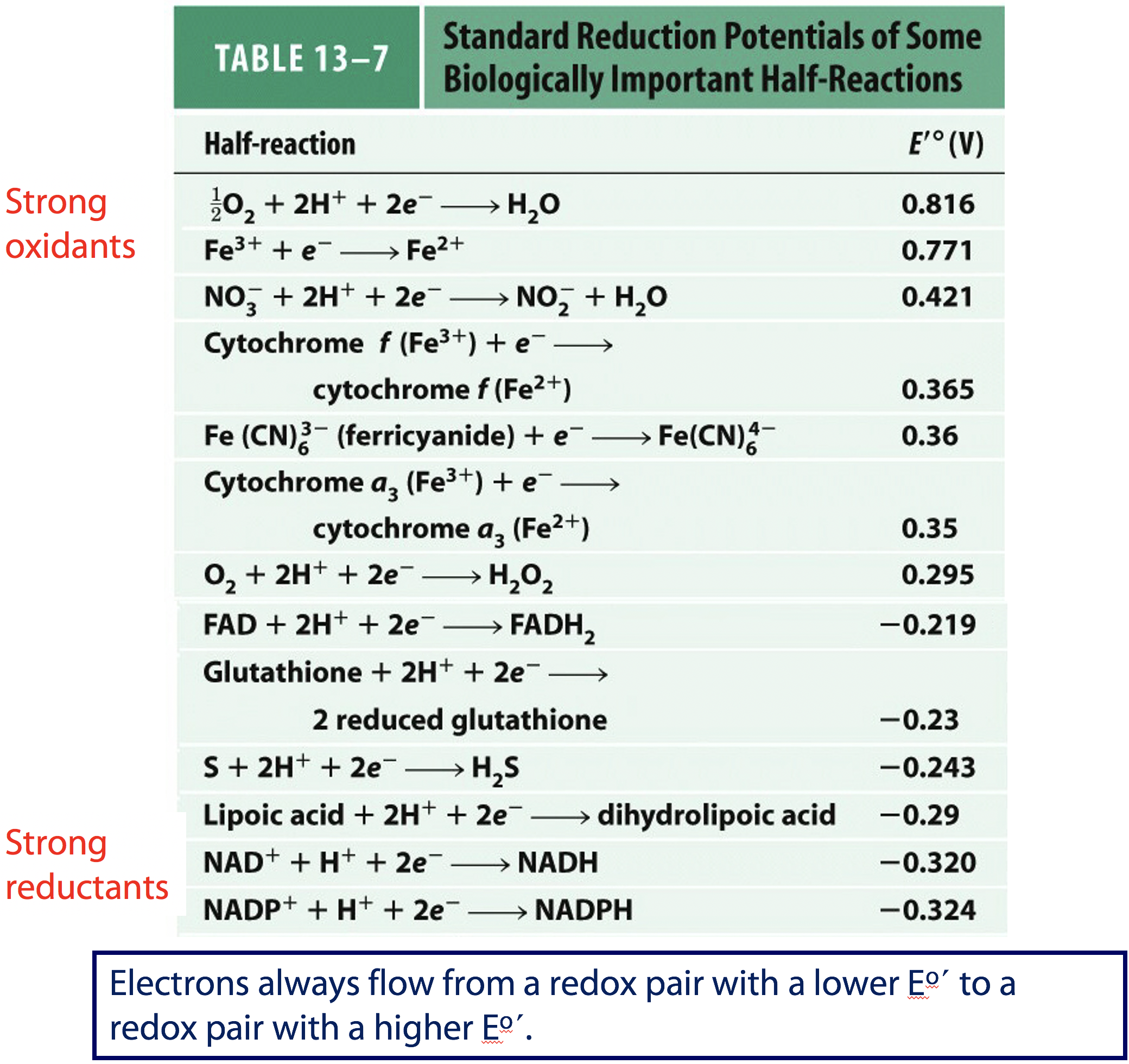
This table will be our guide for the rest of the lesson. Notice the positions of NADH () near the bottom and O₂ () at the very top. This vast difference in reduction potential is the primary driving force for cellular respiration.
2. Predicting the Path: A Case Study of the Electron Transport Chain
The mitochondrial electron transport chain (ETC) is a series of protein complexes and mobile carriers that transfer electrons from fuel molecules (carried by NADH and FADH₂) to oxygen. Given your biology background, you are likely familiar with the components: Complex I, II, III, IV, coenzyme Q, and cytochrome c. Now, we can use thermodynamics to understand why they are arranged in that specific sequence.
Let's use the table of reduction potentials to predict the path.
- Starting Point: Electrons are delivered by NADH, which has a very low reduction potential of -0.320 V. It is an excellent electron donor.
- Next Step: Looking at the table, we need to find a carrier with a slightly higher (less negative or positive) . The FAD/FADH₂ couple has an of -0.219 V. Components within Complex I, such as flavin mononucleotide (FMN), have similar potentials and act as the first acceptors from NADH.
- Mobile Carrier: Electrons are then passed to a mobile pool of lipid-soluble molecules called ubiquinone (also known as coenzyme Q). The oxidized/reduced ubiquinone couple (Q/QH₂) has a standard reduction potential of approximately +0.045 V (a value from Lehninger that lies between FAD and the cytochromes).
- The Cytochromes: From ubiquinone, electrons move to a series of proteins called cytochromes, which contain iron-heme groups. The table shows a clear progression to more positive potentials:
- Cytochrome a₃:
- Cytochrome f (a plant cytochrome, but representative of the b-c₁ complex):
(Note: The specific order in the complexes is cyt b -> cyt c1 -> cyt c -> cyt a -> cyt a3, with potentials generally increasing along the way.)
- Final Destination: The final electron acceptor must have the highest reduction potential of all. As seen in the table, the O₂/H₂O couple has an of +0.816 V, making it a powerful oxidant and the ultimate sink for electrons.
The path that we just predicted thermodynamically matches the known biological sequence of the ETC. Electrons flow from NADH, through the complexes and mobile carriers, in an order of increasing reduction potential, until they are finally accepted by oxygen.
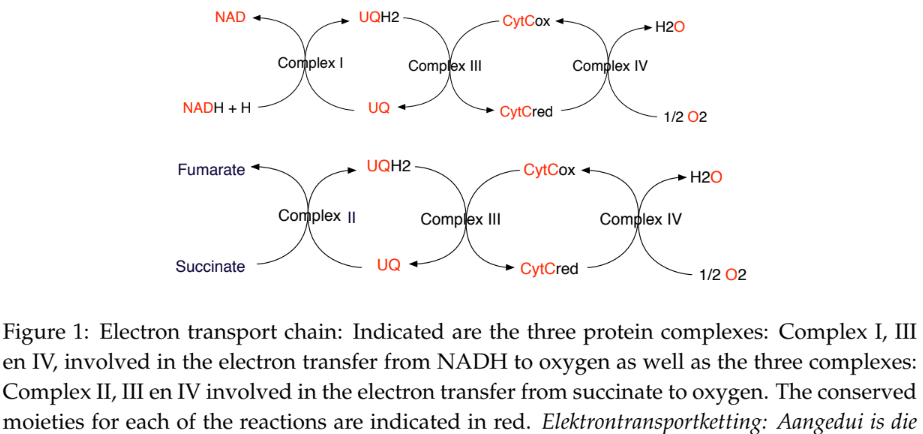
Notice the second pathway starting from succinate. Succinate dehydrogenase (Complex II) generates FADH₂, which has an of -0.219 V. This potential is higher than NADH's (-0.320 V), which is why FADH₂ donates its electrons "downstream" of NADH, entering the chain at the ubiquinone pool.
3. Quantifying the Energy Release
The "downhill" flow of electrons at each step releases a small amount of free energy. By summing the entire potential drop from the initial donor (NADH) to the final acceptor (O₂), we can calculate the total energy released and made available to do work—in this case, pumping protons.
The overall reaction for the transfer of two electrons from NADH to O₂ is:
To find the standard free energy change () for this process, we first calculate the change in standard reduction potential ().
The following reading explains this calculation and connects it back to the free energy change.
This excerpt from an MIT OpenCourseWare lecture transcript walks through the thermodynamic calculation for the total energy released by oxidizing NADH with oxygen.
Please read "Panel D" of the transcript. You can find it by searching for the heading "Panel D". Pay close attention to how the overall reaction is split into two half-reactions, and how their respective E'° values are used to find the overall \Delta E'°. Then, follow the application of the equation \Delta G'° = -nF\Delta E'° to determine the final free energy value.
As the text explains, we can perform the calculation as follows:
- Donor half-reaction (oxidation): NADH → NAD⁺ + H⁺ + 2e⁻
- Acceptor half-reaction (reduction): ½O₂ + 2H⁺ + 2e⁻ → H₂O
Using the potentials from our table:
The total potential difference is:
Now, we can find the standard free energy change using the equation you learned in a previous lesson. Here, because two electrons are transferred.
This is a massive release of free energy! It is this energy, liberated by the thermodynamically favorable "downhill" flow of electrons, that powers the pumping of protons across the mitochondrial membrane, creating the gradient that ultimately drives ATP synthesis.
If we were to repeat the calculation for FADH₂ (), the would be smaller (), yielding less energy (). This perfectly explains the biological observation that FADH₂ oxidation leads to the synthesis of fewer ATP molecules than NADH oxidation.
Conclusion
You have now completed the journey through biochemical energetics. Today, we tied all the principles together to show that the flow of electrons in metabolic pathways is not random but is dictated by the laws of thermodynamics.
Key Takeaways:
- Electrons spontaneously flow from a redox carrier with a lower reduction potential to one with a higher reduction potential.
- This principle allows us to predict the sequence of electron carriers in complex biological systems like the electron transport chain by simply arranging them in order of increasing .
- The total change in reduction potential () across a pathway determines the total standard free energy change (), quantifying the energy made available for cellular work.
- The substantial potential drop from NADH to O₂ () explains why cellular respiration is such a powerful energy-releasing process.
Having established the energetic principles that drive metabolism, we will shift our focus in the next module to the molecules that carry out these reactions: proteins. Our first lesson will go back to the fundamentals, examining the chemical properties of their building blocks, the amino acids, and how to quantify their behavior in solution.