Hello! Welcome to your first lesson in the History of Barcelona.
Introduction
This lesson begins our journey by exploring the very origins of the city. We will trace its story from a small Roman military outpost to the burgeoning medieval capital that laid the groundwork for the metropolis we know today.
Our learning outcome is to: Describe the founding of Roman Barcino and its development into the medieval city centered on the Gothic Quarter.
To achieve this, we will cover three main areas:
- The historical context and founding of the Roman colony of Barcino.
- The structure, life, and key features of this Roman city.
- The crucial transition from the Roman era, through the Visigothic period, to the establishment of the County of Barcelona, which formed the nucleus of the medieval city.
This first lesson provides the essential foundation for the entire course, as the decisions made and structures built over 2,000 years ago still physically and culturally resonate in Barcelona today.
1. From Iberian Settlement to Roman Colony
Before the Romans arrived, the area of modern-day Barcelona was inhabited by an Iberian people called the Laietani, who had a settlement named Barkeno. While history is sometimes embellished with founding myths, the historical record points to a clear Roman origin for the city we now call Barcelona.
To understand this origin, let's separate the legends from the archaeological and historical evidence.
Please read the following sections from the Wikipedia article 'History of Barcelona'. This will provide a solid overview of the pre-Roman inhabitants, the popular (but likely inaccurate) founding myths, and the actual Roman establishment of the city.
Please read the sections titled 'Origins', 'Legends about the foundation', and 'Roman Barcino'. Focus on the distinction between the Iberian settlement of Barkeno, the myths involving Hercules and Hamilcar Barca, and the historical facts surrounding the founding of Barcino by Emperor Augustus.
As you've read, while the tales of Hercules or the Carthaginian general Hamilcar Barca are evocative, the name Barcino is now understood to derive from the earlier Iberian name, Barkeno.
The Romans founded Colonia Faventia Julia Augusta Pia Barcino around 15-10 BC under Emperor Augustus. Its primary purpose was strategic: to be a colonia, a settlement for retired legionaries, which helped to Romanize and secure the newly conquered territory. It was situated on a branch of the Via Augusta, the great Roman road that connected Hispania to Rome, giving the small colony a strategic value that would eventually allow it to eclipse its more prominent neighbors, Tarraco (Tarragona) and Caesaraugusta (Zaragoza).
2. The Urban Plan of Roman Barcino
Roman cities were not accidental collections of buildings; they were meticulously planned systems. Barcino was built as a castrum—a fortified military camp—with a characteristic grid layout that is still discernible today.
This urban plan was defined by two main axes:
- Cardus Maximus: The main north-south street (today's Carrer de la Llibreteria and Carrer del Call).
- Decumanus Maximus: The main east-west street (today's Carrer del Bisbe).
These streets intersected at the city's highest point, a small hill named Mons Taber (16.9 meters above sea level), where the Forum—the center of civic and religious life—was located.

The entire city was enclosed by a formidable wall, initially built in the 1st and 2nd centuries AD and massively reinforced in the 3rd century in response to Germanic raids. This wall, nearly 1.5 km long and featuring 78 towers, was so effective that it defined the city's perimeter for centuries and became a key reason for Barcino's growing importance.
To see what remains of this Roman city today, let's take a short virtual tour.
Barcelona’s Gothic Quarter | 10-STOP WALKING TOUR
The 'Spain Revealed' video provides an excellent visual walkthrough of the Gothic Quarter, pointing out the surviving Roman structures. It helps connect the historical facts to the physical city.
Please watch the following three clips: Introduction to Roman Barcino (01:27 - 02:29): This shows the entrance to the old Roman city and explains how the Gothic Quarter is built on the Roman plan. Remnants of the Roman Wall and Temple (02:29 - 03:56): Here you'll see a section of the Roman wall and the impressive columns of the Temple of Augustus, hidden inside a medieval courtyard. The Sea Gate (15:28 - 16:12): This clip shows the location of the old Roman sea gate, giving a sense of the original, compact scale of Barcino.
The video highlights some of the most impressive Roman remnants. To get a more systematic list of where to find these traces, the following resource is very helpful.
Roman Barcelona ~ Discover the Colony of Barcino
The 'Roman Barcelona' guide from Barcelona Navigator offers a location-by-location look at the surviving Roman ruins. It's a practical guide that complements the historical narrative.
Skim through this guide, paying attention to the numbered locations like Plaça Nova (the main gate), Carrer del Paradís (Temple of Augustus), and the mention of the underground ruins at MUHBA in Plaça del Rei. You don't need to memorize the street names, but appreciate the quantity and distribution of Roman remains within the Gothic Quarter.
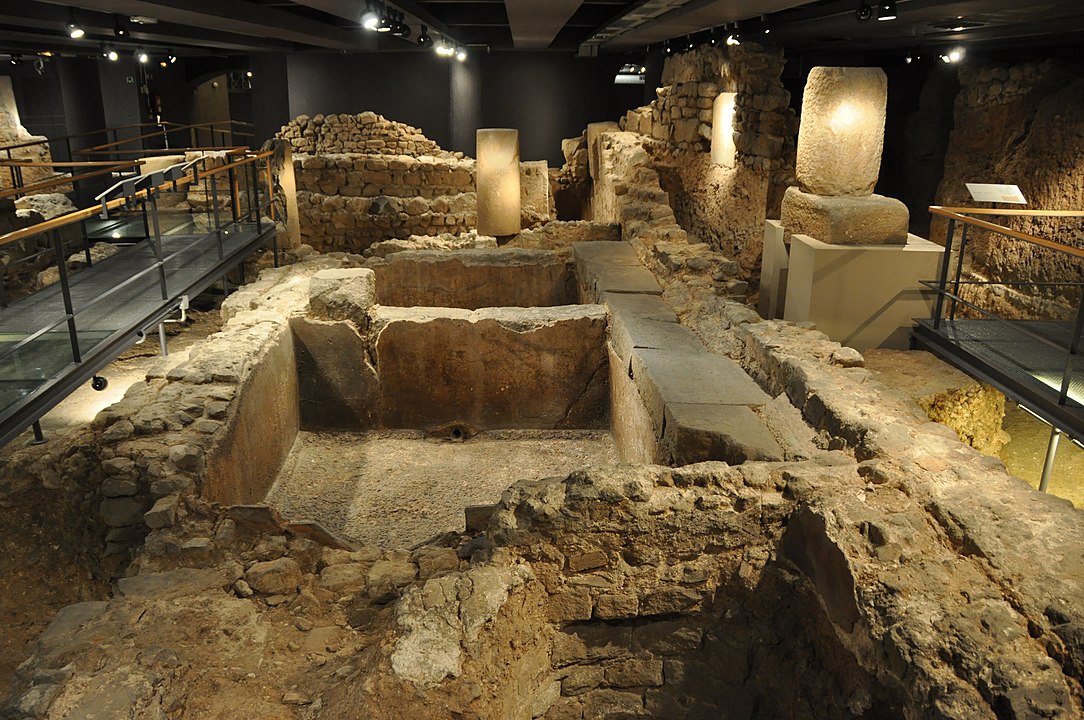
The physical remains—from the aqueducts and city walls to the temple columns and burial grounds—paint a picture of a small but well-established Roman town. Its economy was based on the cultivation of the surrounding land, with its wine being a notable export. While it lacked the grand amphitheaters of other Roman cities, its strategic location and strong fortifications laid the groundwork for its future prominence.
3. The Transition to a Medieval Capital
The fall of the Western Roman Empire did not mean the end of Barcino. The city's robust walls and strategic position ensured its continued importance through the turbulent centuries that followed. This period marks the city's evolution from a Roman outpost to a nascent Catalan power center.
Let's return to the Wikipedia article to trace this transition. These sections cover the arrival of Christianity, the Visigothic period where Barcelona briefly served as a capital, and the formation of the County of Barcelona under Frankish rule.
Please read the sections titled 'Paleochristian Barcino', 'Visigothic Barchinona', and 'The County of Barcelona'. Focus on the key events of each era: the establishment of a bishopric, the city's role as a Visigothic capital, and its capture by Louis the Pious, leading to the rise of Wilfred the Hairy.
This period of transition can be summarized in three key stages:
-
Christianization (4th Century): Barcino became an early Christian center with its own bishop. The first major church, the Basílica de la Santa Creu, was built on the site of the current Barcelona Cathedral, marking a shift in the city's religious landscape.
-
Visigothic Rule (5th-8th Centuries): After the collapse of Roman authority, the Visigoths took control. Barchinona, as it was then known, even served as the capital of the Visigothic kingdom for brief periods. Its Roman walls continued to provide essential security.
-
The County of Barcelona (9th Century): In 801, the city was conquered by the Franks under Louis the Pious, son of Charlemagne, and incorporated into the Marca Hispanica (Spanish March), a buffer zone against the Moors. Local counts were appointed to govern, but they gradually asserted their independence.
This brings us to a pivotal figure mentioned in the video you watched earlier.
Barcelona’s Gothic Quarter | 10-STOP WALKING TOUR
Let's revisit the 'Spain Revealed' video for its segment on the figure who is considered the founder of Catalonia.
Please re-watch the clip on Wilfrid the Hairy (04:23 - 05:20). This part explains his importance in uniting the Catalan counties and establishing Barcelona as his principal city.
Wilfred the Hairy (Guifré el Pelós) was the last count to be appointed by the Franks. By making his titles hereditary, he effectively founded the dynasty of the Counts of Barcelona in the late 9th century. He united several Catalan counties and established Barcelona as his de facto capital. This act marks the true beginning of Barcelona's medieval development and its emergence as the political heart of a new entity: Catalonia. The Gothic Quarter (Barri Gòtic), with its magnificent 13th-15th century buildings, was built directly upon the foundations—both literal and political—of Roman Barcino and the early medieval city of the Counts.
Conclusion
In this lesson, we have traced the origins of Barcelona from its founding as the Roman colony of Barcino to its establishment as the seat of the Counts of Barcelona.
Key Takeaways:
- Barcelona was founded as a Roman colony named Barcino around 15-10 BC for strategic purposes, notably to settle retired soldiers on the vital Via Augusta.
- The city was designed as a fortified castrum with a grid plan, strong walls, and a central Forum. This Roman layout forms the physical blueprint for today's Gothic Quarter.
- After the fall of Rome, Barcino's formidable walls ensured its survival and importance during the Visigothic period.
- The establishment of the hereditary County of Barcelona by Wilfred the Hairy in the 9th century marked the city's transition into a medieval capital and the political center of Catalonia.
This foundation is crucial for understanding everything that follows. The city's Roman heritage and its role as the cradle of Catalonia are recurring themes throughout its history.
Preview of the Next Lesson:
In our next lesson, we will explore Barcelona's "golden age." We will learn how the Counts of Barcelona unified with the Kingdom of Aragon, creating the powerful Crown of Aragon. We will then examine how Barcelona became the crown's maritime and commercial hub, dominating trade across the Mediterranean during the 13th to 15th centuries.