Introduction
In our previous lesson, we established the fundamental blueprint for a linked list: the self-referential struct. You learned how to define a node, allocate memory for it, and manually wire the pointers together to form a small chain. While this manual process is excellent for understanding the mechanics, it's not practical for managing a real inventory system in a game.
Today, we transition from manual construction to automated management. This lesson focuses on implementing the three most common insertion operations for a singly linked list. You will learn to write functions that can add a new item:
- At the head (beginning) of the list.
- At the tail (end) of the list.
- In its correct sorted position to maintain order.
Mastering these functions is the next crucial step in turning our conceptual linked list into a powerful and flexible data structure for our game project.
Inserting at the Head of the List
Inserting a node at the head, or front, of the list is the fastest and most fundamental insertion operation. The logic is straightforward:
- Create a new node.
- Set the new node's
nextpointer to point to the currentheadof the list. - Update the list's
headpointer to point to our newly created node.
It's crucial to perform these steps in the correct order. If you change the head pointer first, you lose the only link to the rest of the list! The following video provides an excellent, detailed walkthrough of this process.
2.5 Insertion of a Node in Linked List(at Beginning,End,Specified Position)with Code | DSA Tutorials
This video from Jenny's Lectures CS IT clearly explains the logic and pointer manipulation for inserting a node at the beginning of a list.
Please watch the section from insertion at beginning. Pay close attention to her explanation of why the pointer updates must happen in a specific order (the "why").
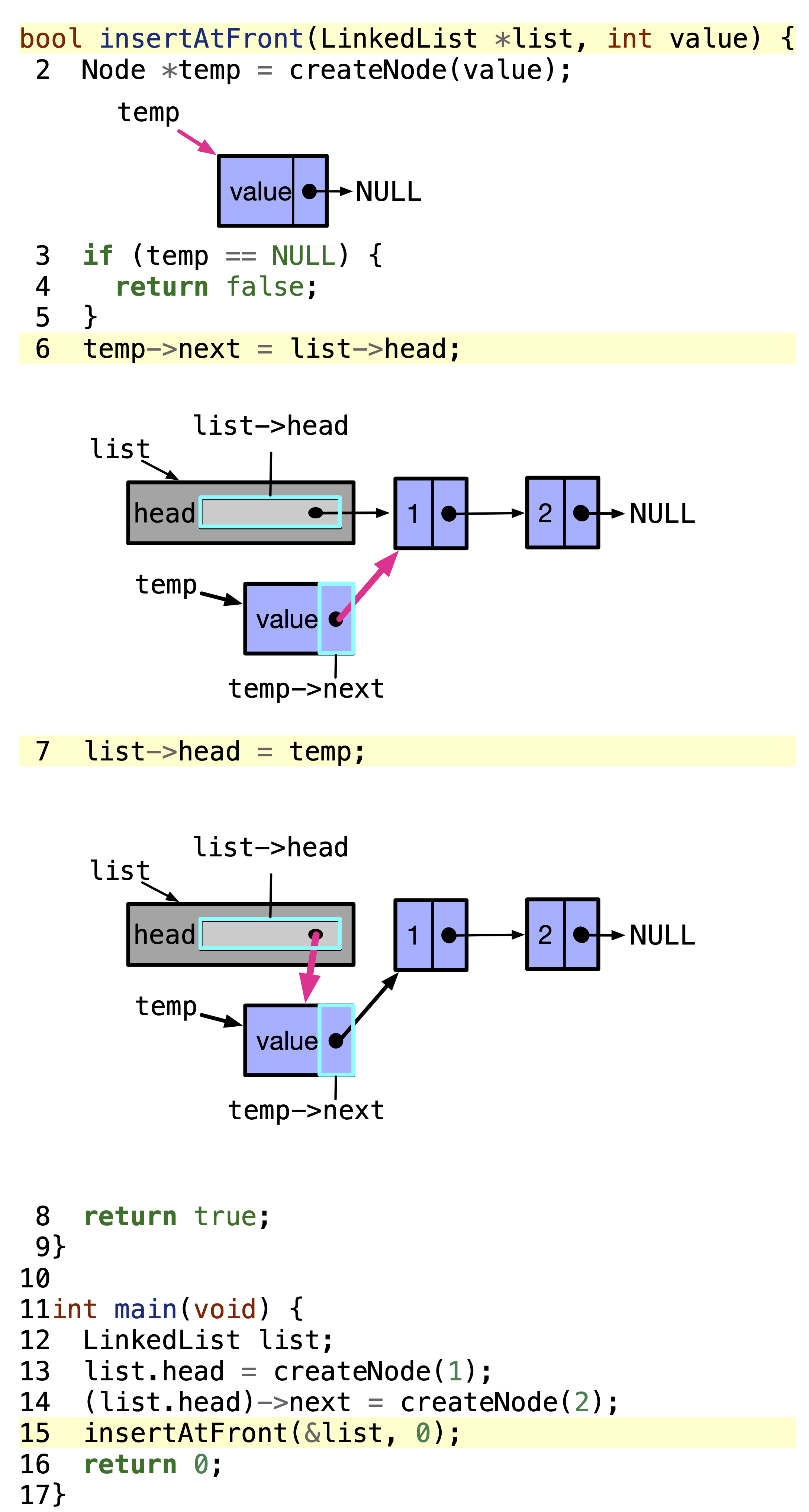
This diagram shows the steps for inserting a node at the front. A new node is created. Its next pointer is linked to the old head. Finally, the list's head pointer is updated to point to the new node, making it the new first element.
The Challenge: Modifying the Head Pointer
Now, let's consider how to write a function, say insertAtFront(), to do this. This function needs to be able to change the head pointer that exists back in our main() function. Given your experience with C from CS50, you might recall that function arguments are passed by value. If we pass head (which is a node_t *) to our function, we're only passing a copy of the pointer. Changing this copy inside the function will have no effect on the original head in main.
This is a classic C problem with a standard, elegant solution: passing a pointer to the pointer. Instead of passing node_t *head, we pass node_t **head_ptr. This gives our function the memory address of the original head pointer, allowing us to dereference it and modify it directly.
This is a significant concept. While we have a later lesson dedicated to double pointers, its most common use case is right here, and using it is the professional way to implement this function.
13.3. Insert nodes into a linked list
This article from learningc.org provides an excellent explanation of this exact problem and presents the double pointer solution.
Please read the section titled "Inserting a node at the beginning". Focus on understanding the "Issues with passing head by value" and then study "Solution 1: Pass pointer to head" to see how the Node** type solves the problem.
Here is a complete C function that correctly implements insertion at the front using a double pointer.
#include <stdio.h>
#include <stdlib.h>

typedef struct node {
    int data;
    struct node *next;
} node_t;

// Note the use of node_t **head_ref
void insertAtFront(node_t **head_ref, int new_data) {
    // 1. Allocate the new node
    node_t *new_node = malloc(sizeof(node_t));
    if (new_node == NULL) {
        // In a real game, you'd handle this more gracefully
        fprintf(stderr, "Unable to allocate memory for new node\n");
        exit(EXIT_FAILURE);
    }

    // 2. Put in the data
    new_node->data = new_data;

    // 3. Make next of new node as the old head
    //    We dereference head_ref to get the actual head pointer
    new_node->next = *head_ref;

    // 4. Move the head to point to the new node
    //    We change the value at the address of the head pointer
    *head_ref = new_node;
}

// Helper function to print the list
void printList(node_t *node) {
    while (node != NULL) {
        printf("%d -> ", node->data);
        node = node->next;
    }
    printf("NULL\n");
}

int main() {
    node_t *head = NULL; // Start with an empty list

    insertAtFront(&head, 10); // Pass the address of head
    insertAtFront(&head, 20);
    insertAtFront(&head, 30);

    printList(head); // Output: 30 -> 20 -> 10 -> NULL

    // Remember to free the list later! (We'll cover this in a future lesson)
    return 0;
}
Inserting at the Tail of the List
What if we want to add an item to the end of our inventory? This operation, insertAtEnd(), requires a different approach. Since we only have a head pointer, we can't jump directly to the end. We must traverse the list.
The algorithm is:
- Create the new node and set its
nextpointer toNULL, as it will be the new last node. - Special Case: If the list is empty (
head == NULL), the new node is both the first and last node. Simply setheadto the new node. - If the list is not empty, start a temporary pointer (
current) at thehead. - Loop through the list, advancing the pointer (
current = current->next) until you find the last node. The last node is the one whosenextpointer isNULL. - Once at the last node, update its
nextpointer to point to your new node.
The video from Jenny's Lectures also covers this case very well. Pay special attention to the loop condition she uses for traversal.
2.5 Insertion of a Node in Linked List(at Beginning,End,Specified Position)with Code | DSA Tutorials
Let's return to the same video to see how insertion at the end is implemented.
Watch the segment from insertion at end. The most important part to grasp is the traversal loop and the condition while (temp->next != NULL). Understand why this specific condition is used to find the last node, not to fall off the end of the list (why not temp != NULL).
Here is the corresponding C function. Notice that for this function, we don't necessarily need a double pointer. We only modify the head in the special case of an empty list, a change that we can handle by returning the new head pointer if we wanted, but the double-pointer approach remains consistent and robust.
void insertAtEnd(node_t **head_ref, int new_data) {
    // 1. Allocate and initialize the new node
    node_t *new_node = malloc(sizeof(node_t));
    if (new_node == NULL) { exit(EXIT_FAILURE); }
    new_node->data = new_data;
    new_node->next = NULL; // This will be the last node

    // 2. If the list is empty, make the new node the head
    if (*head_ref == NULL) {
        *head_ref = new_node;
        return;
    }

    // 3. Else, traverse till the last node
    node_t *last = *head_ref;
    while (last->next != NULL) {
        last = last->next;
    }

    // 4. Change the next of the current last node
    last->next = new_node;
}
Inserting into a Sorted List
For many game applications, like a high-score table or an inventory sorted by item value, we need to insert new elements while preserving the list's order. This is the most complex of the three insertion types because it involves finding the correct position before performing the insertion.

In a sorted list, inserting a new element (e.g., 12) requires finding the correct spot (between 9 and 19) to maintain the ascending order.
The algorithm for insertInOrder() has several cases:
- The list is empty, or the new node's value is smaller than the head's value. In this case, the new node becomes the new head. We can simply reuse our
insertAtFront()logic. - The new node's value belongs somewhere in the middle of the list or at the end. We must traverse the list to find the correct insertion point. We need to stop at the node before the insertion point.
The traversal logic is key: we need a current pointer and we loop as long as current->next is not NULL and current->next->data is less than our new data. This "look-ahead" technique lets us stop at the perfect spot to insert our new node.
Sorted Singly Linked List (Inserting a New Element)
The video "Sorted Singly Linked List" from Neso Academy is dedicated to this specific problem and explains the logic very effectively.
First, watch the problem introduction from the question. Next, carefully study the main traversal algorithm from the main logic. This covers inserting in the middle or at the end. Finally, see how the special case for inserting at the beginning is handled separately from the beginning case.
To solidify your understanding with a textual reference that covers all edge cases in detail, review the following reading.
13.3. Insert nodes into a linked list
This section of the learningc.org article provides a thorough breakdown of inserting into an ordered list, explicitly addressing all special cases.
Read the entire section "Insert a node into an ordered linked list". Pay particular attention to how it handles an empty list, inserting at the end, and inserting at the front. The C code provided there is a robust implementation.
Here is a complete function that combines these cases:
void insertInOrder(node_t **head_ref, int new_data) {
    node_t *current = *head_ref;

    // Special case: list is empty or new node goes at the front
    if (current == NULL || current->data >= new_data) {
        insertAtFront(head_ref, new_data);
        return;
    }

    // Locate the node before the point of insertion
    while (current->next != NULL && current->next->data < new_data) {
        current = current->next;
    }

    // Now, 'current' is the node after which we need to insert.
    // Let's create the new node.
    node_t *new_node = malloc(sizeof(node_t));
    if (new_node == NULL) { exit(EXIT_FAILURE); }
    new_node->data = new_data;

    // Perform the insertion
    new_node->next = current->next;
    current->next = new_node;
}
Conclusion
In this lesson, you've built the essential toolkit for populating a linked list. You now have functions to add nodes in the three most critical ways, moving far beyond the manual pointer manipulation of our last session.
Key Takeaways:
- Insertion at the Head: The fastest method. It requires updating the
headpointer itself, making the use of a double pointer (node_t **) the most robust C implementation. - Insertion at the Tail: Requires traversing the entire list to find the last node. You must handle the special case of an empty list. The correct traversal condition is
while (current->next != NULL). - Sorted Insertion: The most complex case. It involves a "look-ahead" traversal (
current->next->data < value) to find the node before the insertion point, and requires special handling for insertion at the very beginning of the list.
With the ability to add nodes, our list is no longer static. In the upcoming lesson, we will complete the core functionality by learning how to search for and delete nodes. This will give us a fully functional dynamic data structure, ready to be integrated into our game inventory system.