Introduction
In our last lesson, we explored the power of double pointers for modifying a linked list's structure, enabling functions to alter the head pointer directly. This was a crucial step in mastering list manipulation. Now, we'll address the other end of the data lifecycle: destruction. A program that allocates memory but never releases it is destined to fail, especially in long-running applications like games.
This lesson focuses on the final core competency for linked list management: traversing a list for the specific purpose of deallocating every node, one by one. You will learn the correct algorithm to do this safely, avoiding common pitfalls that lead to memory leaks or crashes. Mastering this ensures that your programs are clean, efficient, and robust, leaving no trace of their memory usage after they're done. This is a non-negotiable skill for any serious C programmer.
The Problem: Orphaned Nodes and Memory Leaks
As we established in Module 7, linked list nodes are allocated on the heap. A head pointer, which typically resides on the stack, holds the address of the first node, and each subsequent node holds the address of the next.

This structure presents a unique challenge for deallocation. If you were to simply call free(head), you would only release the memory for the first node. The head pointer would become invalid, and you would lose your only entry point to the rest of the list. All subsequent nodes would become "orphaned" — their memory would remain allocated on the heap, but your program would have no way to access or free them. This is a classic memory leak.
A slow memory leak might go unnoticed in a short program, but in a game that runs for hours, constantly creating and destroying objects (like enemies, projectiles, or inventory items), the cumulative effect is disastrous. The program's memory footprint will grow relentlessly until it consumes all available system resources and crashes.
To see a dramatic example of this, let's watch a short demonstration of what happens when a program allocates memory in a loop without ever freeing it.
Dynamic Memory Allocation | C Programming Tutorial
This video from Portfolio Courses provides a practical demonstration of a memory leak in action.
Watch the segment from the memory leak example. The instructor writes a simple program that calls malloc in an infinite loop without calling free. Observe how the program's memory consumption, shown in the system's Activity Monitor, balloons until the operating system is forced to kill the process.
The Algorithm: Safe Traversal and Deallocation
To avoid memory leaks, we must traverse the entire list and call free() on every single node. However, the order of operations is critical. Consider this incorrect approach:
// DO NOT DO THIS
struct Node* current = head;
while (current != NULL) {
    free(current);
    current = current->next; // CRASH! 'current' was just freed.
}
The moment you call free(current), the memory current points to becomes invalid. Attempting to access current->next is undefined behavior and will almost certainly lead to a program crash.
The correct approach requires a temporary pointer to "save" the location of the next node before you free the current one.
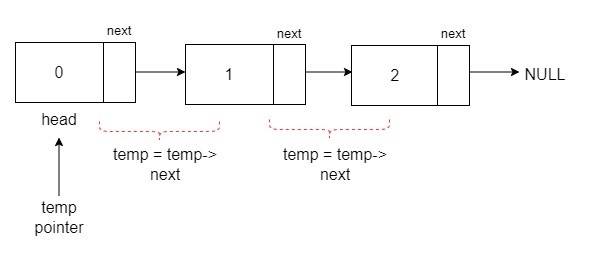
The safe deallocation algorithm builds on this traversal pattern:
- Initialize a
currentpointer to theheadof the list. - Loop as long as
currentis notNULL. - Inside the loop:
a. Create anext_nodepointer and store the address fromcurrent->next.
b. Now that you have a safe reference to the rest of the list, you can free the current node:free(current).
c. Advance to the next node for the next iteration:current = next_node.
The following resource provides an excellent walkthrough of this exact logic, complete with code and diagrams.
Security-Oriented C Tutorial 0x21 - Linked Lists - Null Byte
This section of the Null Byte tutorial explains and implements a freeList function.
Read the section beginning just after the first set of images, starting from "freeList function". Pay close attention to the diagram illustrating why you need a temporary pointer and how the freeList code implements the safe deallocation algorithm we just discussed.
An Elegant Alternative with Double Pointers
In our previous lesson, we saw how using a double pointer (struct Node**) could create more robust functions for modifying the list. We can apply the same principle to our deallocation function for a very clean and powerful implementation.
Consider this function signature: void destroy_list(struct Node** head_ref). By taking a pointer to the head pointer, we can not only free every node but also set the original head pointer in the calling function back to NULL. This is excellent practice, as it leaves the list in a valid, defined "empty" state, preventing any future use of a dangling pointer.
Here is how such a function works:
void destroy_list(struct Node** head_ref) {
    while (*head_ref != NULL) {
        // 1. Save the current head node in a temporary pointer.
        struct Node* temp = *head_ref;

        // 2. Advance the original head pointer to the next node.
        *head_ref = (*head_ref)->next;

        // 3. Free the saved (old) head node.
        free(temp);
    }
}

// In main:
// destroy_list(&inventory_head);
// After this call, inventory_head is now NULL.
This approach iteratively "chops" the node off the front of the list, advances the real head pointer, and frees the chopped node. It continues until the head pointer itself becomes NULL. This is a concise and common C idiom. You can see a similar implementation in the following Stack Overflow answer, labeled as a clear function.
How to properly allocate memory for linked list in C inside ...
This Stack Overflow answer provides a clear function that demonstrates the double-pointer deallocation technique.
Focus on the second half of the top answer. The author first presents a corrected init_ll function, and then refactors the cleanup logic into its own function. Study the implementation of the clear function and compare its logic to the destroy_list example above.
Verification with Valgrind
How can you be certain your destroy_list function worked correctly and didn't miss any nodes? As we learned in Module 7, the Valgrind memory debugger is the definitive tool for this. By running your program under valgrind, you can get a detailed report on heap usage. A clean run will show that all allocated blocks were eventually freed.
# Compile with debug symbols
gcc -g -Wall your_program.c -o your_program


# Run with Valgrind's memory checker
valgrind --leak-check=full ./your_program
If the "HEAP SUMMARY" reports that all heap blocks were freed -- no leaks are possible, you have succeeded. This practice of verifying your memory management is a professional discipline that separates reliable C code from brittle, unpredictable code.
Conclusion
You have now covered the complete lifecycle of a fundamental dynamic data structure. You can create nodes, insert them, search for them, delete them, and, as of today, safely dismantle an entire list, ensuring you return all borrowed memory to the system.
Key Takeaways:
- Failing to
freeevery node in a linked list causes a memory leak, which is catastrophic for long-running programs. - The safe deallocation algorithm requires a temporary pointer to store the address of the next node before freeing the current node.
- A more elegant implementation uses a double pointer (
struct Node**) to not only free each node but also to set the originalheadpointer back toNULL, leaving the list in a valid empty state. Valgrindis the essential tool for verifying that your deallocation logic is correct and that no memory has been leaked.
With these skills in hand, you are fully prepared for our next lesson. We will refactor the dynamic array-based inventory from our game project into a more flexible linked list, applying everything we've learned about insertion, deletion, and destruction.