Introduction
In our last lesson, we crafted a professional-grade debugging macro, a powerful tool that leverages the C preprocessor to give us deep insight into our program's state with minimal effort. This completed our initial tour of the preprocessor. However, our game project still has a fundamental limitation: the player's inventory is a fixed-size array. This is inflexible and unrealistic for a growing game. What if the player needs to carry more items than we anticipated?
To solve this, we must learn to manage memory ourselves. This brings us to a topic at the very core of C's power and reputation: manual memory management. This lesson marks the beginning of Module 7, where we will transition from memory that is managed automatically by the compiler to memory that you control. Today, we will explore the conceptual foundation for this skill by explaining the difference between the two primary memory regions your program uses: the stack and the heap. Understanding their distinct roles and characteristics is the first and most critical step toward writing dynamic, flexible C programs.
The Memory Landscape of a C Program
When you run your compiled C program, the operating system doesn't just throw it into a random part of memory. Instead, it allocates a dedicated, private block of virtual memory for your process. This memory is neatly organized into several distinct segments, each with a specific purpose.
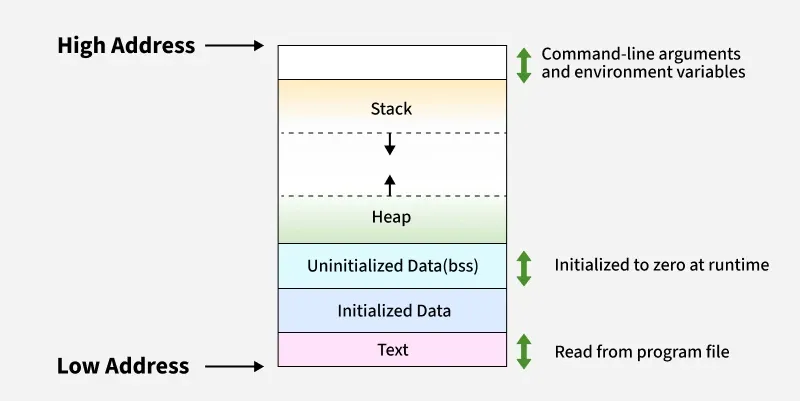
Let's briefly survey the main segments shown in the diagram above:
- Text Segment: This contains your compiled machine code instructions. It's typically read-only to prevent a program from accidentally modifying its own code.
- Data Segments (Initialized & Uninitialized): These hold your global and static variables. The key feature of these variables is that their lifetime is the entire duration of the program's execution.
- Stack: This region manages data for active function calls. It stores local variables, function parameters, and return addresses. It is highly structured and managed automatically by the compiler.
- Heap: This is a large, unstructured region of memory available for your program to use for long-lived or dynamically-sized data. It is managed manually by you, the programmer.
Today, our focus is squarely on the stack and the heap, as this is where the most dynamic activity occurs and where you'll make crucial design decisions.
For a quick animated overview of how these memory segments work together, the following video provides an excellent introduction.
Pointers and dynamic memory - stack vs heap
This video from mycodeschool provides a concise visual breakdown of a program's main memory segments.
Watch the segment from this point. It introduces the four key areas of memory—text, global/static, stack, and heap—and briefly explains the purpose of each, setting the stage for our deeper dive.
The Stack: Fast, Automatic, and Temporary
The stack is the primary workhorse for managing the flow of your program. Every time you call a function, a new block of memory, called a stack frame, is "pushed" onto the top of the stack. This frame contains all the information needed for that specific function call, including its local variables and parameters. When the function returns, its stack frame is "popped" off, and the memory is automatically reclaimed.
This leads to the key characteristics of the stack:
- Automatic Management: The compiler generates the code to manage stack memory. You don't write any code to allocate or deallocate it.
- LIFO Structure: It operates on a "Last-In, First-Out" (LIFO) principle. The last function called is the first one to finish and have its memory freed.
- Scoped Lifetime: A variable stored on the stack (like any local variable you declare) exists only as long as its containing function is executing. Once the function returns, the variable is gone forever.
- High Speed: Allocating and deallocating memory on the stack is extremely fast, typically involving only the adjustment of a single CPU register called the stack pointer.
The following video demonstrates this process in detail, showing how function calls and local variables are managed on the call stack.
Your Third Day in C (Understanding stack and heap memory) - Crash Course in C Programming
This video by Mike Shah provides a detailed, code-driven explanation of how the stack works.
Watch the portion from this segment. The instructor explains the concept of block scope and then visually illustrates how local variables for a function are pushed onto the stack when the function is called and automatically removed when it exits.
Limitations of the Stack
The stack's automatic nature and speed are wonderful, but they come with two significant limitations that make it unsuitable for all tasks.
-
Limited Size: The stack is a finite resource, typically only a few megabytes. If you try to allocate a very large variable (like a massive array) on the stack, you can exhaust this space. This condition is called a stack overflow, which will crash your program.
-
Fixed Lifetime: This is the most important limitation to understand. Since stack data is destroyed when a function returns, a function can never create and return data that is intended to outlive it.
This second point is so crucial that it leads to a golden rule of C programming: never return a pointer to a local variable. The memory it points to will be invalid as soon as the function returns, and using that pointer leads to undefined behavior—one of the most dangerous kinds of bugs.
The following reading from a Cornell University CS course provides a perfect, practical example of this bug.
The Stack, The Heap, and Dynamic Memory Allocation
This article provides a crystal-clear example of why stack memory's limited lifetime is a problem.
Read the section titled "Limitations of the Stack". Pay close attention to the rule "never return a pointer..." and study the buggy create_exp code example that follows. This demonstrates that a pointer to a local array becomes a "dangling pointer" after the function returns, making it unsafe to use.
The Heap: Flexible, Manual, and Long-Lived
So, if the stack can't be used for data that needs to persist or is very large, what's the alternative? The answer is the heap. The heap is a large pool of memory that you, the programmer, can use as needed.
The heap's characteristics are essentially the inverse of the stack's:
- Manual Management: You are in complete control. You must explicitly request a block of memory from the heap (using a function like
malloc) and you must explicitly release it when you're done (usingfree). - Persistent Lifetime: Memory allocated on the heap remains available for your program to use for as long as you want it, regardless of which function allocated it. It only goes away when you explicitly
freeit. - Large Size: The heap is much larger than the stack. Its size is effectively limited only by the amount of virtual memory your system can provide.
- Slower Allocation: Requesting memory from the heap is a more complex operation than simply adjusting the stack pointer. The system has to find a free block of the right size, which takes more time.
The Cornell article continues by introducing the heap and showing how to fix the buggy create_exp function using manual memory management.
The Stack, The Heap, and Dynamic Memory Allocation
Now, let's see the correct way to solve the problem using the heap.
Read the sections titled "The Heap" and the following explanation of malloc and free. Start with the introduction to the heap and continue through the explanation of the malloc and free functions. Then, study the corrected create_exp function. This demonstrates how malloc allows a function to create and return a pointer to data that safely persists after the function returns.
Choosing the Right Tool for the Job
You now have two different memory regions at your disposal. The choice between them is a fundamental design decision in C. Here is a summary of the trade-offs:
| Feature | Stack | Heap |
|---|---|---|
| Management | Automatic by compiler | Manual by programmer (malloc, free) |
| Lifetime | Temporary, tied to function scope | Persistent, until explicitly freed |
| Size | Small and fixed (e.g., ~8MB on Linux) | Large, limited by system memory |
| Speed | Very fast allocation/deallocation | Slower allocation/deallocation |
| Primary Use | Local variables, function parameters | Dynamic data structures, large objects, data that must outlive its creator function |
| Key Risk | Stack Overflow | Memory Leaks & Dangling Pointers |
This concise guide provides a clear checklist for making the decision.
Stack vs Heap Allocation in C: Pros and Cons
This article provides an excellent summary of when to choose one allocation method over the other.
Read the section "Choosing the Right Approach". It gives you a clear, concise checklist for when to use stack allocation and when to use heap allocation. Find it by searching for that title, starting with the text "When deciding between...".
To see a final, concrete demonstration of these two memory regions being distinct, watch this clip where the programmer prints the addresses of a stack variable and a heap-allocated block of memory.
Your Third Day in C (Understanding stack and heap memory) - Crash Course in C Programming
Let's see a practical demonstration of how stack and heap memory addresses differ.
Watch this clip from this point in Mike Shah's tutorial. He writes a small program to allocate memory on both the stack and the heap and then prints their addresses. Notice how the addresses are in vastly different ranges, providing concrete evidence that they occupy different regions of memory, just as shown in our initial layout diagram.
Conclusion
You have now explored the two most important memory regions in a C program. Understanding their fundamental differences is non-negotiable for any serious C programmer.
Key Takeaways:
- The Stack is for fast, temporary, automatically-managed data. It's the default for local variables and function calls. Its defining features are speed and a strict, scope-based lifetime.
- The Heap is for large, long-lived, manually-managed data. It provides the flexibility to create data structures whose size is unknown at compile time or whose lifetime must extend beyond the function that created them.
- This choice comes with a trade-off: the stack is simple and safe but rigid; the heap is flexible and powerful but requires careful manual management to avoid serious bugs like memory leaks.
This foundational knowledge is the "why" behind dynamic memory allocation. You now know why we can't just return a local array from a function and when you would need to reach for a tool that gives you more control.
In our next lesson, we will put this theory into practice. We'll dive deep into the mechanics of malloc() and free(), learning the exact syntax, how to handle potential errors, and finally write code to create our first dynamically-sized array on the heap.