Welcome to your first lesson in our course on ceramics. Your goal is to gain a deep understanding of these materials, from their fundamental composition to their advanced applications. We'll start this journey at the atomic level, because the unique properties of ceramics—their hardness, heat resistance, and electrical behavior—are all direct consequences of the chemical bonds holding their atoms together.
In this lesson, you will learn to quantify the nature of these bonds. We will explore how chemical bonds exist on a spectrum between purely covalent and purely ionic. Your objective is to learn how to calculate the percent ionic character of a bond using the concept of electronegativity. This foundational skill will be crucial as we later connect bonding to crystal structure and material properties.
The Spectrum of Chemical Bonding
You might recall from chemistry that we often categorize bonds into two neat boxes: ionic (electron transfer) and covalent (electron sharing). In reality, bonding is a continuum. With the exception of bonds between identical atoms (like O₂ or N₂), no bond is 100% covalent. Similarly, even in compounds we consider "ionic," like sodium chloride (NaCl), the electron transfer is not entirely complete.
Most chemical bonds, and particularly those in many ceramic materials, are polar covalent bonds. This means the electrons are shared unequally, creating a partial positive charge () on one atom and a partial negative charge () on the other.
To understand this concept more formally, please read the introductory section from the Chemistry LibreTexts page on electronegativity.
5.4: Electronegativity and Dipole Moment - Chemistry LibreTexts
This reading introduces the idea of a bonding continuum, from nonpolar covalent to ionic, and sets the stage for using electronegativity to quantify where a bond falls on this spectrum.
Please read the first few paragraphs, starting from the beginning of the text. Pay attention to the description of polar covalent bonds and the use of δ⁺ and δ⁻ to denote partial charges.
Electronegativity: The Power to Attract Electrons
The key to predicting where a bond lies on this spectrum is electronegativity (), a concept developed by Linus Pauling. He defined it as "the power of an atom in a molecule to attract electrons to itself." When two atoms with different electronegativity values form a bond, the atom with the higher value will pull the bonding electrons more strongly, gaining a partial negative charge.
The difference in electronegativity, , between two bonded atoms is what allows us to quantify the bond's character.
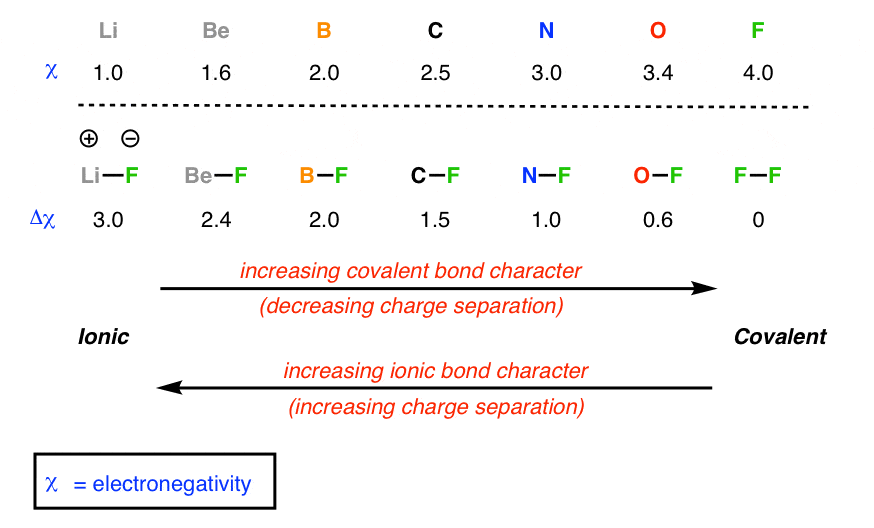
As you can see, a large (like in Li-F) leads to a highly ionic bond, while a small leads to a more covalent character. A of zero results in a completely nonpolar covalent bond.
Calculating Percent Ionic Character
While gives us a qualitative idea, we can use an empirical formula developed by Pauling to calculate a quantitative value for the percent ionic character. This formula provides a direct link between the electronegativity difference and the degree of electron transfer.
The formula is:
or, written slightly differently:
To see how this is applied, let's walk through a calculation. The following resource provides a very clear, step-by-step guide.
How to Calculate Percent Ionic Character [SOLVED] - Edubrain
This guide provides a concise, step-by-step breakdown of how to use Pauling's formula.
Please read the section titled Method 1. Follow the worked example for sodium chloride (NaCl) to see the formula in action.
Let's Practice
Now, let's apply this to a classic ceramic material: silicon carbide (SiC). This material is known for its extreme hardness and is used in applications like car brakes, abrasives, and bulletproof vests.
- The electronegativity of Silicon (Si) is .
- The electronegativity of Carbon (C) is .
-
Calculate the electronegativity difference, .
-
Apply Pauling's formula.
The bond in SiC has about 10% ionic character, meaning it is predominantly covalent. This strong, directional covalent bonding is a primary reason for its high hardness and stability.
The following graph plots this relationship for many different compounds, providing a useful visual reference. You can see how our SiC calculation would fall on the low end of the curve.

An Alternative View: The Dipole Moment
Given your background in physics, you'll appreciate another method for determining ionic character that is rooted in experimental measurement. A polar bond creates an electric dipole moment (), which is a vector quantity representing the separation of positive and negative charges.
It is defined as the magnitude of the charge () multiplied by the distance of separation ():
We can calculate a theoretical dipole moment () for a bond, assuming it were 100% ionic (i.e., is the elementary charge of one electron). We can then compare this to the experimentally measured dipole moment () for the actual molecule. The ratio gives a direct physical measure of the percent ionic character.
The following video provides an excellent walk-through of this calculation.
Dipole Moment, Molecular Polarity & Percent Ionic Character
This video from The Organic Chemistry Tutor demonstrates how to calculate percent ionic character using the dipole moment method.
Watch the section that explains the underlying formula. Then, follow the detailed worked example for the C-O bond. If you'd like more practice, the video continues with an example for the O-H bond.
Comparing the two methods, Pauling's formula is a quick and useful empirical estimate based only on electronegativity values. The dipole moment method is a more direct physical measurement, but it requires experimental data (the measured dipole moment and bond length) that may not always be available. For our purposes in this course, we will primarily rely on the Pauling method.
Conclusion
In this lesson, we established that chemical bonding is a continuum from covalent to ionic. The key takeaways are:
- Electronegativity () measures an atom's ability to attract electrons in a bond.
- The electronegativity difference () between two atoms determines the polarity and character of their bond.
- The percent ionic character can be calculated using Pauling's empirical formula, which relies on . A value greater than 50% generally signifies a predominantly ionic bond, which is common in many ceramic materials like oxides and halides.
Understanding the degree of ionic vs. covalent character in a ceramic is the first step toward predicting its structure and properties. Strong ionic and covalent bonds are what give ceramics their characteristic high melting points and hardness.
In the next lesson, we will build directly on this foundation. We will explore how the sizes and charges of ions determine how they pack together to form ordered, three-dimensional crystal structures, a defining feature of most ceramic materials.