Welcome back. In Book 6, Odysseus gained Nausicaa’s help by approaching her as an unknown stranger rather than claiming the authority of his name. At the Phaeacian court, he still has not told his hosts who he is. Book 8 brings that concealment under pressure: the bard Demodocus sings about Troy, and Odysseus cannot hear the story as the other guests do. This lesson follows the crucial sequence from song to tears to King Alcinous’s request for his name.
A guest who knows more than his hosts
The Phaeacians know their visitor has suffered, but they do not know that the man sitting among them is Odysseus. The poem’s audience does know. That difference makes Demodocus’s first performance especially tense: he sings of a quarrel between Odysseus and Achilles during the Trojan War, without realizing that one of those men is listening.
Book 8 Essays | Dickinson College Commentaries
Read Dickinson College Commentaries’ discussion of Demodocus’s first song to see how Odysseus’s concealed reaction prepares for the later scene.
In subsection “8.83–120,” begin with the paragraph describing Odysseus covering his face. Read the discussion through its comparison with the later horse song. The passage includes a brief comparison with Telemachus in Book 4; focus especially on what Alcinous notices and why noticing does not yet produce a name.
Odysseus pulls his cloak over his face and weeps. Most of the company misses it, but Alcinous, seated nearby, hears him groan. The king stops the performance and turns the gathering toward athletic games. He responds to his guest’s distress without demanding an explanation in public.
This is the first near-disclosure, not the disclosure itself. Hearing his own name in a song does not make Odysseus announce himself, and tears alone do not tell Alcinous exactly who his guest is. Yet the scene establishes a pattern: a public account of Troy reaches someone who experienced it privately; Odysseus tries to hide his response; his host sees enough to recognize that the song matters to him.
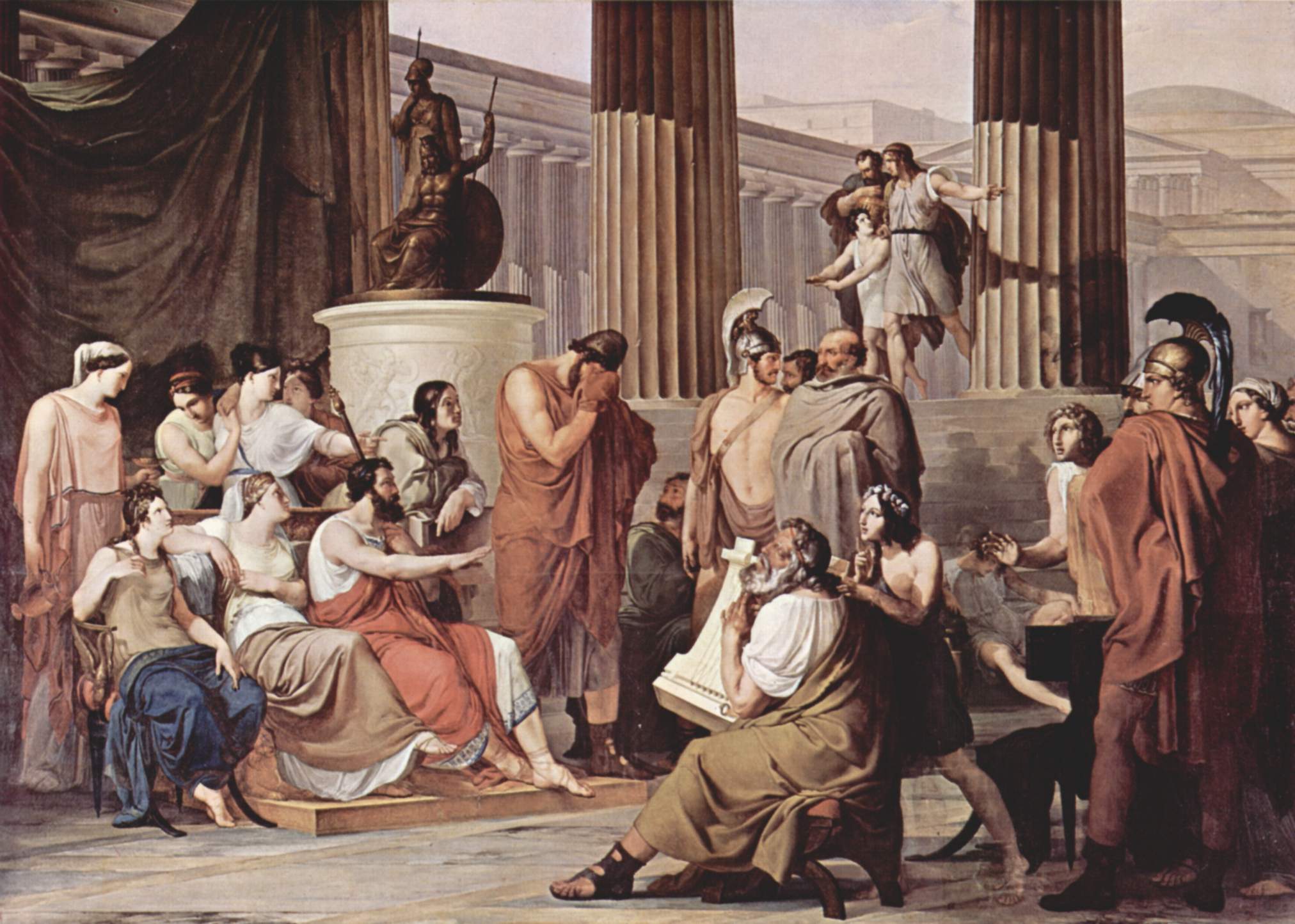
Odysseus asks to hear the horse song
After the games and further entertainment, the guests return to feasting. Odysseus then requests a song about the wooden horse and the fall of Troy. This detail matters. The final song is not simply another unwelcome reminder imposed on him: he invites Demodocus to tell the story and praises his ability to sing of events as though he had witnessed them.
Book 8 Essays | Dickinson College Commentaries
Return to the same commentary for the place of the Trojan Horse song within Book 8’s performances.
In subsection “8.469–520,” start at the opening description of Demodocus’s final song. Read the opening analysis, stopping after the paragraph that describes Odysseus’s defining strength. Attend to the contrast between the celebratory subject of the song and the listener’s coming reaction.
The horse is a victory won through concealment and calculation, not a straightforward clash of armies. Greek fighters hide inside it; the Trojans debate what to do with it; the city falls when the concealed men emerge. Demodocus’s song places Odysseus at the center of the exploit. For the Phaeacians, it is an impressive tale about a famous hero. For Odysseus, it is a tale in which his own actions have become public song.
His request need not mean that he expects to enjoy hearing it. He praises the singer’s skill and asks for this particular episode, but his response shows that neither the story nor his part in it is emotionally simple. Book 8 lets two versions of Odysseus occupy the same room: the celebrated strategist inside the song and the unnamed, visibly distressed guest listening to it.
What the tears add to the victory
Demodocus sings, and Odysseus weeps again. This time the poet does more than report tears. He compares Odysseus to a woman holding her dying husband after he has fought to defend their city and children. Enemy soldiers strike her and drag her away into slavery.
Book 8 Essays | Dickinson College Commentaries
Read the translated simile in the commentary to examine the emotional response that Alcinous observes.
In subsection “8.521–549,” start where the commentary introduces the third song’s effect on Odysseus. Read the passage and translation, ending with the English rendering of lines 8.521–31. Focus on the change from the horse’s successful deception to the woman’s experience after a city falls; you can pass over the Greek if you are reading only in translation.
The comparison is startling because the song has just celebrated the tactic that helped destroy Troy. We might expect the victor to be compared with another triumphant warrior. Instead, Odysseus’s grief is measured against the grief of someone left defenseless by war. The woman in the simile is not identified as a particular Trojan woman, and the poem does not state a single cause for Odysseus’s tears. The imagery does, however, make the human consequences of a conquered city impossible to set aside.
This does not cancel Odysseus’s ingenuity or turn his victory into a simple confession of regret. The point is that heroic success and suffering are heard together. Demodocus can sing an exploit worthy of fame, while its central participant reacts in a way that the celebratory account cannot contain. His tears reveal something about his relation to Troy, though they still do not reveal his name.
Alcinous brings the hidden identity into speech
The second bout of weeping changes Alcinous’s response. Earlier, he had stopped the song and moved to the games. Now, after Odysseus has specifically requested the horse song and again been overcome by it, the king stops Demodocus and addresses the unresolved question of his guest’s identity.
ODYSSEY BOOK 8 SUMMARY (Homer)
Watch the closing Book 8 summary from MoAn Inc. for the immediate sequence connecting Odysseus’s song request, his tears, and Alcinous’s response.
Watch the closing sequence. Use it for the order of events and the king’s request, rather than treating its proposed explanation of Odysseus’s feelings as something the poem explicitly confirms. The poem also credits the making of the horse to Epeius with Athena’s help; Odysseus’s role is central to the stratagem without making him its sole maker.
Alcinous asks the stranger to tell them his name and homeland, information his hosts need if they are to convey him home. He also presses him to explain why songs of Troy bring him such grief. The king does not deduce “This must be Odysseus” from the tears. Rather, the tears give him a reason to ask directly what hospitality has so far allowed his guest to withhold.
That distinction marks the boundary between Books 8 and 9. Book 8 ends with Alcinous’s request; at the beginning of Book 9, Odysseus names himself and begins telling the Phaeacians where he has been. His identity is disclosed in his own voice, not uncovered by a clever guess from the court.
The sequence also changes the kind of story we are about to hear. Demodocus has sung of Odysseus from outside, as a figure of heroic tradition. Odysseus’s tears interrupt that public account. When he finally speaks, the famous name belongs to the stranger who has needed food, shelter, and passage home. Recognition of the hero does not erase the vulnerable guest we have come to know.
Looking ahead
Demodocus’s horse song brings Odysseus’s celebrated cunning into the Phaeacian hall; his tears expose the distance between a victorious tale and the experience of someone who lived through Troy. Alcinous notices the repeated distress, stops the singer, and asks his guest to identify himself. Odysseus answers as Book 9 begins.
His answer opens the account of his wanderings. The next lesson turns to the Cyclops episode, where Odysseus’s ability to conceal a name—and his desire to make that name known—will have consequences of its own.