Welcome to the first lesson of your journey to master digital marketing. Your current role as an SEO analyst, particularly with your expertise in backlinks, gives you a fantastic foundation. This course is designed to build on that foundation, broadening your perspective to encompass the full digital marketing landscape and guiding you toward your goal of specializing in performance marketing.
In this introductory lesson, we will place your SEO knowledge into the broader context of the digital marketing ecosystem. The goal is to analyze how SEO interacts and creates synergies with other essential channels like paid advertising, social media, and email marketing. Understanding these relationships is the first step toward developing integrated strategies, which are at the heart of effective performance marketing.
The Digital Marketing Landscape
To begin, let's establish a shared understanding of what "digital marketing" means and what the major channels are. While you're an expert in one of these channels, you've mentioned wanting a beginner's introduction to the others, so we'll start there.
Digital marketing is simply marketing that utilizes digital channels to reach customers. The video below by Adam Erhart provides a clear and concise overview of these channels and some fundamental concepts that will be crucial throughout this course.
Digital Marketing 101 (A Beginner’s Guide To Marketing)
This video offers a great introduction to the world of digital marketing. As you watch, pay close attention to how the different channels are categorized.
Please watch the following three segments: The introduction, which outlines the primary digital channels and their advantages over traditional marketing. The section on organic vs. paid marketing. This distinction is fundamental to understanding how different strategies operate. The explanation of search vs. discovery marketing. This highlights the critical difference in user intent across platforms like Google versus Facebook.
The video introduces several key concepts. SEO falls squarely into organic and search-based marketing. Users on Google have high intent; they are actively searching for answers, products, or solutions. Your job in SEO is to ensure your website appears as the best possible answer. In contrast, channels like social media are often discovery-based, where users are browsing more casually, and marketing messages need to capture their attention.
A Framework for Channels: Paid, Owned, and Earned Media
A helpful way to visualize the digital marketing ecosystem is through the "Paid, Owned, and Earned" (POE) media framework. It categorizes channels based on how you leverage them.
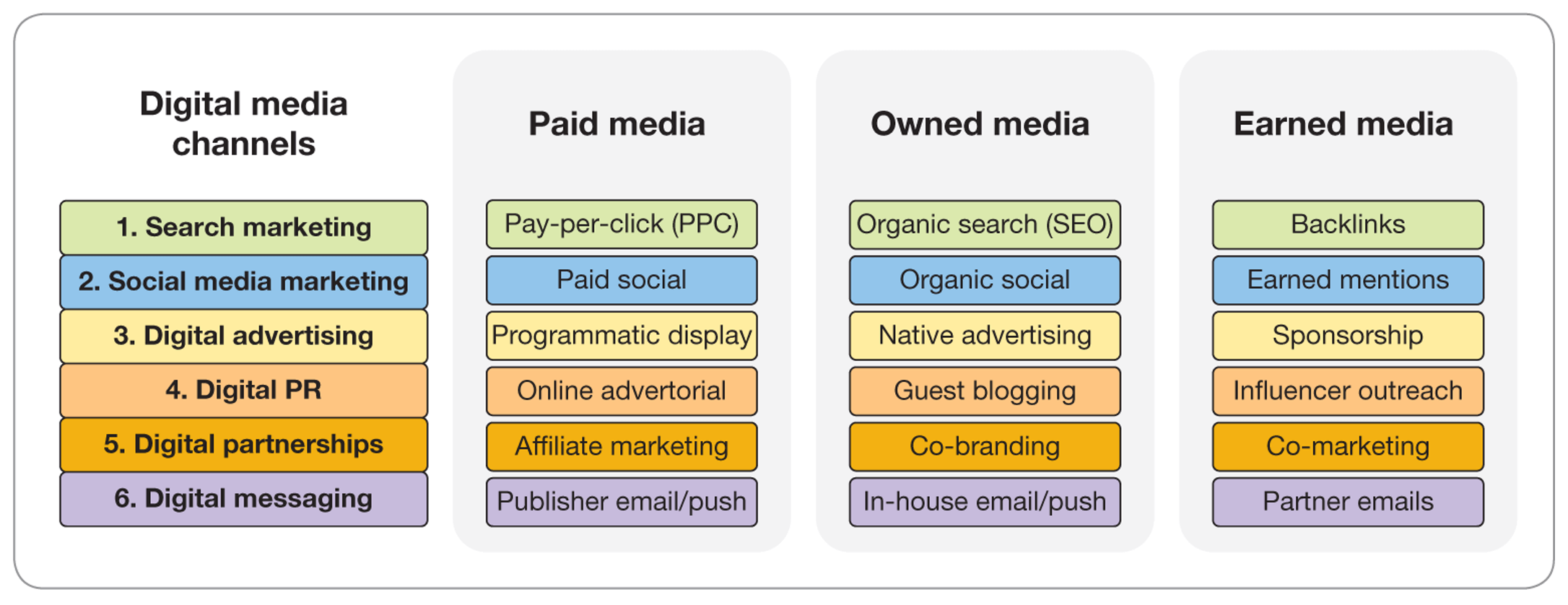
- Owned Media: These are the channels your company completely controls. This includes your website, blog, and organic social media profiles. Your on-page and technical SEO efforts are focused on optimizing these owned assets.
- Paid Media: This refers to any marketing where you pay for placement or visibility. This includes Pay-Per-Click (PPC) ads on Google, paid social media ads on Facebook or Instagram, and display advertising. This is a core component of performance marketing.
- Earned Media: This is the organic exposure you get from others. It's the digital equivalent of word-of-mouth. Your expertise in backlinks is a perfect example of cultivating earned media. Other examples include press mentions, customer reviews, and shares of your content on social media.
The true power of digital marketing lies not in using these in isolation, but in using them together. A well-optimized blog post (Owned) can be promoted with paid ads (Paid) to reach a wider audience, which in turn can lead to more shares and backlinks (Earned).
How SEO Integrates with Other Channels
Your expertise in SEO is not a silo; it's a central pillar that supports and is supported by every other marketing channel. Let's explore these synergistic relationships. The following reading from Online Optimism provides a great overview of these integrations.
Integrating SEO & Other Marketing Channels | Online Optimism
This article details how SEO can be woven into your social media, email, and paid advertising strategies for a more unified approach.
Please read the following sections: Start with How SEO and Social Media Can Work Together. Note how SEO content can be distributed via social media and how social signals can indirectly benefit SEO. Next, read Integrating SEO with Email Marketing. Focus on how SEO data can inform email content and how email can drive valuable engagement signals back to your site. Finally, read Paid Advertising and SEO: A Powerful Combination. Pay close attention to the idea of using PPC to test keywords for your organic strategy.
As the article highlights, treating these channels as separate functions leads to missed opportunities. A truly integrated strategy creates a cycle where each channel feeds the others. The article from tiptop SEO Agency reinforces this idea and explains why a "siloed approach" is problematic.
Integrating SEO with Paid, Social, and Email for a Unified Marketing Strategy - tiptop SEO Agency
This piece reinforces the importance of an integrated strategy and provides tactical examples of how SEO powers other channels.
Read these two parts: Begin with the introduction, from The power of an integrated SEO strategy, which frames SEO as a core component that enhances other channels. Then, jump to the section Tactical integration to see specific examples of how SEO works with paid search, social media, and email marketing.
Let's summarize the key relationships:
-
SEO + Paid Search (PPC): These two channels are natural partners on the search engine results page (SERP).
- Data Sharing: PPC campaigns generate data quickly. You can test the conversion potential of keywords with a small ad budget before investing months into ranking for them organically. Conversely, high-performing organic keywords can be added to PPC campaigns to completely dominate the SERP for valuable search terms.
- Remarketing: You can use paid ads to retarget users who initially found your site through organic search, guiding them further toward a conversion.
- Efficiency: A strong organic presence builds brand trust and can increase the click-through rate (CTR) of your paid ads. It can also reduce your reliance on expensive paid campaigns for terms you rank for organically.
-
SEO + Social Media:
- Content Amplification: Your SEO-driven content, like blog posts and pillar pages, needs an audience. Social media is the perfect channel to distribute and promote that content, driving initial traffic and creating opportunities for it to be shared and linked to (which helps your SEO).
- Brand Visibility: Social profiles often rank for branded searches. A consistent and active presence reinforces your brand's authority and controls the narrative on the SERP.
-
SEO + Email Marketing:
- Content for Nurturing: SEO content isn't just for attracting new users; it's also perfect for nurturing existing leads. A well-written article that answers a customer's question can be included in an email sequence to build trust and guide them toward a purchase.
- Driving Engagement: Sending an email to your subscribers that links to a new blog post drives a surge of high-intent traffic to your site. This engagement (time on page, low bounce rate) can send positive signals to search engines.
-
SEO + Content Marketing:
This is the most fundamental relationship. Content is the substance of SEO. Without high-quality, relevant content, there is nothing for search engines to rank. Content marketing is the strategic approach to creating and distributing this content, and SEO is the practice of optimizing it for search visibility. They are two sides of the same coin.

A Practical, Integrated Workflow
To make this tangible, let's look at a simple, integrated process. The following video demonstrates a five-step workflow that combines SEO, PPC, and social media. This is a great example of the kind of thinking you'll develop as you move toward performance marketing.
5 Step Process To Combine PPC, SEO, and Social Media Strategies - SEO & Google Ads Technique
This video from Surfside PPC provides a straightforward, actionable process for integrating several marketing channels. You don't need to watch the whole video, as some parts get very specific to the Google Ads interface, which we will cover later.
Watch the final recap of the five-step process. The five steps are: Find Keywords: The starting point for both SEO and PPC. Create Content: Develop search-engine-friendly content around those keywords. Create Ad Groups: Target the keywords with paid ads pointing to your content. Share on Social Media: Distribute your content to drive more traffic. Use Remarketing: Recapture visitors who didn't convert. This loop demonstrates how insights and assets from one channel can be leveraged to boost performance in another.
Conclusion
In this lesson, we've contextualized your existing SEO expertise within the broader digital marketing ecosystem. You now have a framework for understanding how different channels relate to one another and why an integrated strategy is far more powerful than a siloed one.
Here are the key takeaways:
- Digital marketing is an ecosystem of interconnected channels, not a list of separate tactics.
- The Paid, Owned, and Earned media framework helps classify these channels and understand their roles.
- Your SEO work is a foundational layer that is amplified by and, in turn, amplifies paid search, social media, and email marketing efforts.
- An integrated strategy creates a virtuous cycle where channels work together to attract, engage, and convert customers more effectively.
In our next lesson, we will introduce the digital marketing funnel. This model will help you map the customer journey and understand which channels are most effective at each stage, from initial awareness to final conversion and retention.