Welcome to the final module. The previous lesson distinguished a plausible biological rationale from evidence that an intervention protects muscle and function. The same distinction matters for claims about addiction: GLP-1 signalling may influence reward pathways, but a change in drinking must be demonstrated in people, not inferred from a mechanism.
This lesson examines one randomized trial of semaglutide in adults with alcohol use disorder (AUD). You will assess what its drinking measures show, who took part, and how long they were followed—then draw a conclusion no broader than the evidence permits. Allow about 40 minutes, including the readings.
What the trial was designed to test
The trial compared weekly semaglutide injections with placebo over nine weeks. Random assignment and blinding make it more informative about a drug effect on the measured outcomes than an anecdote about drinking less while taking a GLP-1 medicine. But randomization does not make a small, selected sample representative of everyone with AUD.
Start with the study’s design and outcome definitions. In particular, keep its controlled laboratory drinking session separate from reports of drinking during ordinary weeks.
Once-Weekly Semaglutide in Adults With Alcohol Use Disorder
Read Hendershot and colleagues’ trial report in JAMA Psychiatry to see how participants were selected and how the researchers measured drinking.
In the Abstract, read from the “Design, Setting, and Participants” description beginning the trial summary through “Intervention.” In Methods, read Trial Design and Participant Sample. Then, under “Study Procedures,” read from the opening account of the visits through the “Intervention” and “Outcomes Assessment” subsections, ending after “Weekly Consumption and Craving”: procedures and measures. Note which outcomes came from a laboratory session, which came from weekly reports, and when each was assessed.
The researchers screened 504 potential participants and randomized 48: 24 to semaglutide and 24 to placebo. That large drop occurred before randomization; it is not the same as participants dropping out after treatment began. The diagram makes both stages visible.

The principal test was an alcohol self-administration session: participants could choose whether to delay drinking and then how much to consume under controlled conditions. The two co-primary measures were estimated grams of alcohol consumed and peak breath alcohol concentration. This is a useful way to observe drinking behavior under comparable conditions, but one session is not a direct measure of sustained recovery in daily life.
The researchers also tracked weekly consumption using calendar-based reports supplemented by daily logs. Drinks per calendar day averages across drinking and non-drinking days; drinks per drinking day measures quantity on days when drinking occurred. A medicine could affect one without clearly affecting the other. Heavy-drinking days, drinking days, and craving provide further, distinct views of the outcome.
What changed—and what did not clearly change
Read the results by outcome rather than collapsing them into “drinking improved.” The paper reports model coefficients, not percentage reductions: for example, its coefficient of must not be rewritten as “48% less alcohol.”
Once-Weekly Semaglutide in Adults With Alcohol Use Disorder
Return to the trial report for the laboratory and weekly drinking results. Focus on the contrasts between outcomes with evidence of a group difference and outcomes without it.
In Results, read the subsection “Laboratory Alcohol Self-Administration,” from laboratory findings. Then read “Weekly Outcomes,” starting at weekly findings; finish that craving sentence before stopping. Use the Figure 2 and Figure 3 captions to check how many participants contributed data to the displayed comparisons.
In the laboratory comparison, the semaglutide group had lower estimated alcohol consumption and lower peak breath alcohol concentration than the placebo group after accounting for pretreatment measurements. The reported confidence intervals for both co-primary comparisons excluded no difference. The trial did not find evidence that semaglutide changed whether participants drank at all in that session or how long they delayed drinking.
The weekly results were mixed. There was evidence of fewer drinks per drinking day and a greater reduction in heavy-drinking days over time with semaglutide. Weekly craving was also lower, although craving was an exploratory measure. By contrast, the registered secondary outcome of drinks per calendar day did not show a statistically clear group difference, and neither did the number of drinking versus abstinent days. “No clear difference” is not proof that the true effect is zero; it means this trial did not establish a difference on those measures.
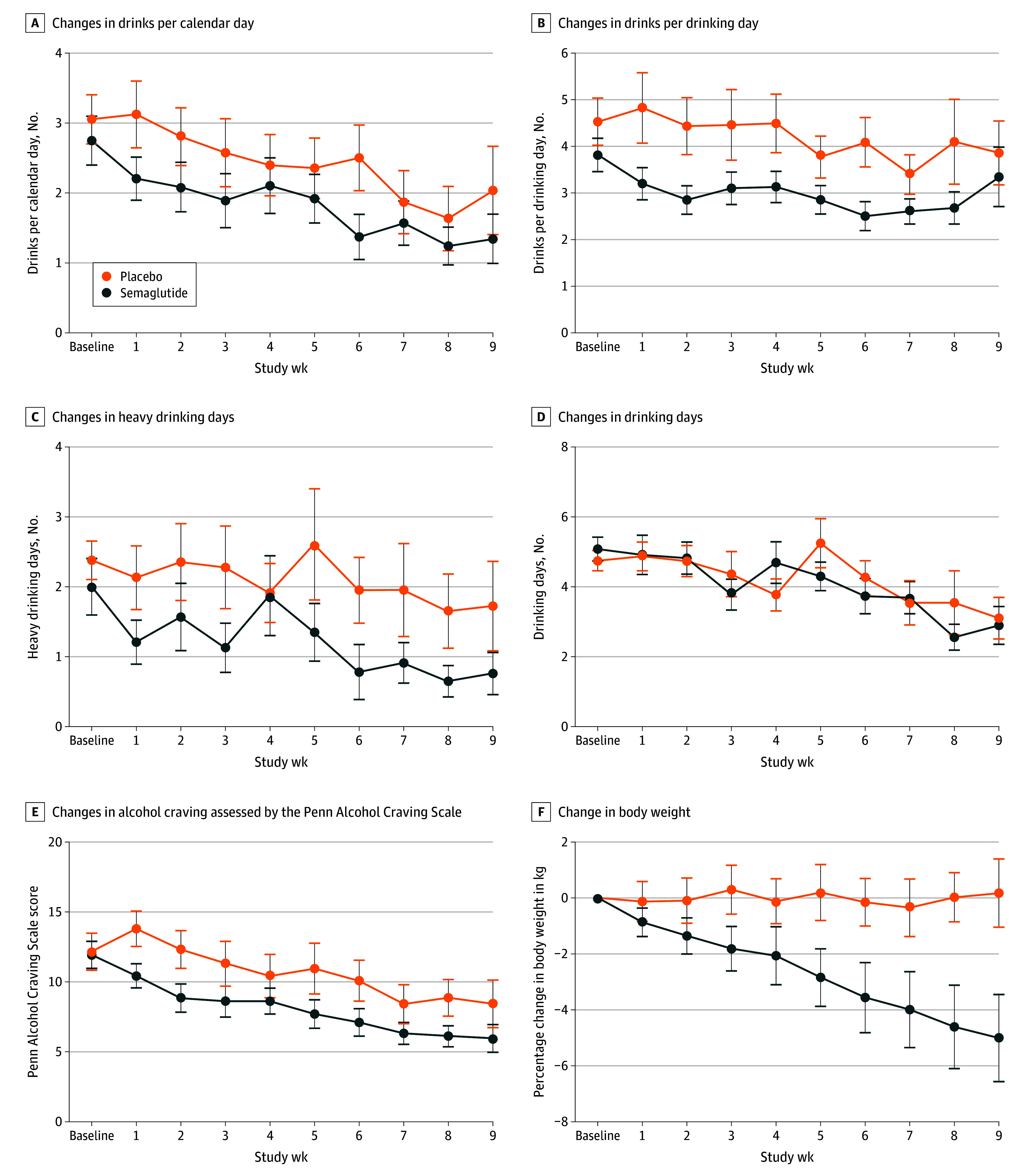
The panels help distinguish quantity from frequency. Semaglutide’s clearer weekly signal concerned how much participants drank when they drank and how often drinking was heavy—not an established increase in abstinent days. Likewise, reduced craving is relevant to AUD, but it is not interchangeable with a demonstrated long-term clinical benefit.
The body-weight panel shows a separate treatment effect. This trial cannot tell us whether any drinking change arose through reward signalling, altered appetite, unpleasant symptoms, another pathway, or some combination. Randomization can support an inference about semaglutide’s effect on the measured drinking outcomes under these conditions; it does not identify the mechanism.
The boundaries set by selection and follow-up
The participants were adults aged 21–65 who reported AUD and recent heavy drinking but were not seeking alcohol treatment or actively trying to reduce consumption. The study excluded, among others, people with diabetes, a body mass index below 23, and most other recent substance use disorders. The authors describe the sample’s AUD severity as moderate, with consumption below that of many treatment-seeking groups. These choices made the short trial feasible and safer to conduct, but they matter when applying its results elsewhere.
Follow-up is another boundary. The main laboratory assessment took place after week 8, when the treatment group had received four weeks at 0.25 mg weekly and four weeks at 0.5 mg weekly. A possible increase to 1.0 mg came after that primary assessment. The final visit was in week 10. Thus, the trial does not establish what happens after months of treatment, after stopping medication, or at a higher dose during the main outcome assessment.
Once-Weekly Semaglutide in Adults With Alcohol Use Disorder
Read the authors’ “Limitations” subsection to compare their stated boundaries with the claims the results might invite.
Under “Limitations,” begin at the limitations paragraph and read to the end of that subsection. Pay particular attention to sample size, AUD severity, treatment duration, and the need for larger trials with clinically useful endpoints.
All 48 randomized participants were included in the intention-to-treat analysis, but that does not mean every person supplied every measurement. The flow diagram shows that 22 semaglutide participants and 19 placebo participants completed the later alcohol self-administration session. The paper’s plotted comparison adjusted for pretreatment laboratory drinking uses an even smaller subset—25 people with the required non-missing data. With numbers this small, estimates are less precise and missing measurements deserve attention.
A secondary finding concerned cigarettes per day among participants who smoked. It is a reason to study smoking outcomes, not evidence that semaglutide treats tobacco use disorder—still less that it treats every addiction. Substances, patient populations, and clinically meaningful endpoints differ. Earlier lessons’ reward-pathway model provides a research hypothesis, not permission to transfer an AUD trial result to nicotine, opioids, or other conditions.
Conclusion
This randomized trial provides encouraging, short-term evidence that semaglutide reduced alcohol consumed in a controlled session and improved some weekly drinking measures in selected, non-treatment-seeking adults with AUD. It did not establish a reduction on every drinking measure, sustained benefit after treatment, an effect in heavier treatment-seeking populations, or efficacy across addictions. Larger and longer trials with clinically meaningful drinking outcomes are needed to resolve those questions.
The next lesson applies the same discipline to cognition: observational associations, biomarkers, and randomized treatment outcomes answer different questions, even when they concern the same medicine.