In our last lesson, we focused on using 有 (yǒu) and 没有 (méiyǒu) to talk about what you have and what exists. We also had a brief glimpse of measure words, like 个 (gè), when counting things. Today, we'll build directly on that foundation by learning how to point things out specifically. Instead of just saying "I have a book," you'll learn to say "This is my book" or ask "Who is that person?".
Our goal is to master the demonstrative pronouns 这 (zhè) for "this" and 那 (nà) for "that". These are fundamental for identifying and distinguishing objects and people in conversation and are essential for your HSK 1 exam. This lesson will also reinforce the critical role of measure words, preparing you for our next topic.
1. The Core Concept: 这 (zhè) and 那 (nà)
In Mandarin, pointing is elegantly simple. There are two primary words you need:
- 这 (zhè): "this" (used for things that are physically or conceptually close)
- 那 (nà): "that" (used for things that are physically or conceptually distant)
The most important rule to internalize—one that differs significantly from English—is that you almost never place 这 (zhè) or 那 (nà) directly before a noun. Just as you need a measure word when using a number with a noun (e.g., 一个人, yī ge rén), you also need one when using a demonstrative.
The structure is a fixed formula:
Demonstrative (这 / 那) + Measure Word + Noun
This infographic provides a helpful visual for this grammatical "bridge." You can see how 这 (zhè) and 那 (nà) connect to a noun via a measure word.
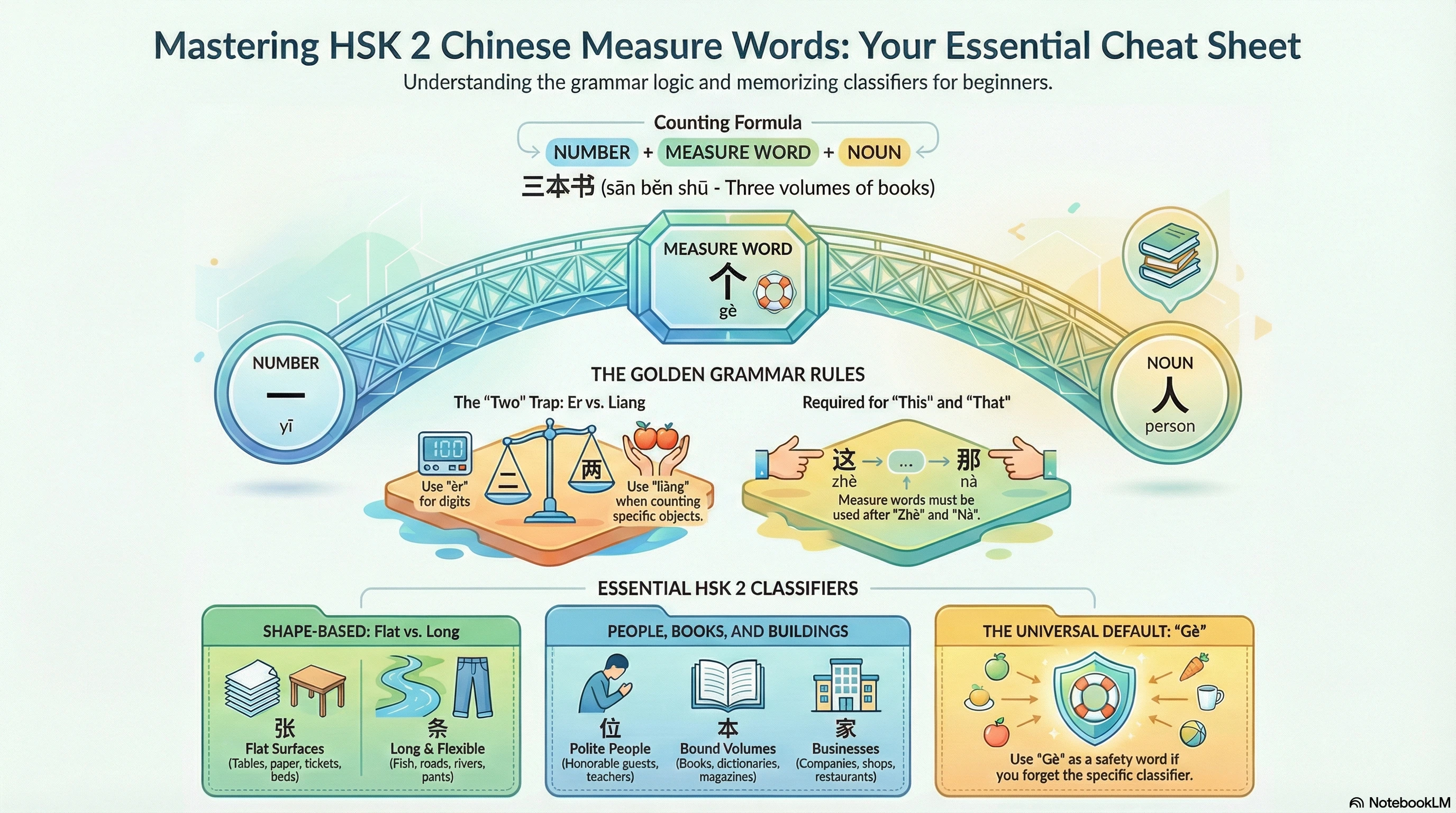
Let's look at this structure with some familiar vocabulary:
- 这个人 (zhè ge rén) - This person
- 那本书 (nà běn shū) - That book
2. The Golden Rule in Detail
Forgetting the measure word is one of the most common mistakes for beginners. Your background in mathematics and computing has trained you to appreciate strict rules and syntax; think of this as a syntactic requirement in the grammar of Chinese. The expression "这书" (zhè shū) is grammatically incomplete, much like a function call with a missing argument.
The following resources explain this rule very clearly.
Chinese grammar | Demonstrative Pronouns: 这 and 那 | Language Dove
This article from Language Dove provides a concise and direct explanation of the rule. I'd like you to read the sections on "这 (zhè) — 'This'" and "那 (nà) — 'That'".
First, read the brief explanation and examples under the heading “This”. Then, do the same for the section under the heading “That”. Finally, pay close attention to the first point listed under Common Mistakes, as it reinforces this core principle.
To see this explained from another perspective, let's look at a second resource.
A Comprehensive Guide to Chinese Pronouns
This guide from ChineseClass101 also emphasizes the essential role of measure words.
Please read the section titled "This & That + Measure Word + Noun." Focus on the paragraph that explains the structural requirement for using a measure word, and look at the examples that use the universal measure word 个 (gè).
To hear these words and structures in use, watch the following video. Listening to the native pronunciation will help solidify the tones and rhythm.
Learn Chinese for Beginners: 这 - This, 那 - That, 哪 - Which & More Common Usages in Chinese [HSK 1]
This video from Everyday Chinese provides clear examples of pronunciation and sentence structure for 这 and 那.
Watch the explanations for 这 (zhè) and see how it's combined with a noun. Then, do the same for 那 (nà) and its combination with a noun. Finally, listen to the example sentences to see how these are used in context.
You may notice in the video and in colloquial speech that 这 (zhè) and 那 (nà) are sometimes pronounced zhèi and nèi, respectively. Both pronunciations are correct. For now, you can stick to the standard zhè and nà, but it's valuable to recognize the colloquial variants for your listening comprehension.
3. Combining with Verbs: 是 (shì) and 有 (yǒu)
Now we can integrate 这 and 那 with the verbs you already know, like 是 (shì) and 有 (yǒu).
A. As the Subject of a Sentence
When used as the subject, 这 and 那 can stand alone to mean "this" or "that."
- 这是我的书。(Zhè shì wǒ de shū.) - This is my book.
- 那是什么?(Nà shì shénme?) - What is that?
- 这个是谁?(Zhè ge shì shéi?) - Who is this? (Here, 个 acts as a generic placeholder, like saying "this one".)
B. As Part of the Subject or Object
You can also use the Demonstrative + MW + Noun structure as either the subject or the object of a sentence.
- 这个人有三个女儿。(Zhè ge rén yǒu sān ge nǚ'ér.) - This person has three daughters. (Subject)
- 我没有那本书。(Wǒ méiyǒu nà běn shū.) - I don't have that book. (Object)
- 那个人是老师吗?(Nà ge rén shì lǎoshī ma?) - Is that person a teacher? (Subject)
4. Practice
Let's test your understanding by combining what we've learned today with previous lessons. Try to formulate the Chinese sentences for the following.
- This is a teacher.
- Who is that person?
- I have this book.
- He does not have that cup. (Use 杯 (bēi) for cup)
Take a moment to work through your answers.
Answers:
- 这是老师。(Zhè shì lǎoshī.)
- 那个人是谁?(Nà ge rén shì shéi?)
- 我有这本书。(Wǒ yǒu zhè běn shū.)
- 他没有那个杯子。(Tā méiyǒu nà ge bēizi.) (Note: 杯子 (bēizi) is the word for 'cup'. Using just 杯 (bēi) as the noun is less common).
Conclusion
In this lesson, you've added two crucial demonstrative pronouns to your toolkit, along with the fundamental grammatical rule that governs their use.
Here are the key takeaways:
- 这 (zhè) means "this" and 那 (nà) means "that."
- The mandatory structure when modifying a noun is
Demonstrative + Measure Word + Noun. For example,这个人(zhè ge rén) or那本书(nà běn shū). - 这 and 那 can act as the subject of a sentence, as in
这是我的老师(Zhè shì wǒ de lǎoshī - This is my teacher). - You can now combine these structures with verbs like 是 (shì) and 有 (yǒu) to create more specific and descriptive sentences.
We've emphasized the importance of measure words today. In our next lesson, we will dive deeper into this topic. You'll formally learn the most common HSK 1 measure words—个 (gè), 本 (běn), and 杯 (bēi)—and solidify your understanding of their function, ensuring you can count objects and point them out with precision.