Welcome to the final lesson of our module on numbers, dates, and time. In the last session, we focused on the subtle but important distinction between 几 (jǐ) and 多少 (duōshao) for asking "how many." You learned that the choice depends on the expected number size and the grammatical requirement for a measure word.
This lesson shifts our focus from grammar to the written form. The learning outcome is to recognize and associate the characters for all the new vocabulary in this module. We'll consolidate your knowledge of the characters for numbers (0-99), dates (年, 月, 日), time (点, 分), age (岁), and related time words like 今天 and 明天.
Given your background, it's useful to approach character learning not as rote memorization, but as a system of pattern recognition. We will explore how characters are constructed from smaller, meaningful components, turning the task of learning them into a process of logical deconstruction.
Deconstructing Characters: The Power of Radicals
A common misconception for beginners is that each of the thousands of Chinese characters is a unique, arbitrary drawing that must be memorized individually. This is not the case. The vast majority of characters are compounds, built from a smaller set of recurring components.
The most important of these components is the radical (部首, bùshǒu). Think of a radical as a semantic tag that gives a clue to the character's general meaning. For example, many characters related to water or liquids share the "water" radical. By learning to spot these radicals, you can make educated guesses about new characters and create powerful mnemonic links to remember them. This transforms character learning from a brute-force memory task into a more analytical process of parsing structures and identifying patterns.
To get a formal introduction to this crucial concept, please read the following sections from the HSKLord article, "Chinese Radicals: The Building Blocks of Characters."
Chinese Radicals: The Building Blocks of Characters (Complete Guide) | HSKLord
This article provides an excellent overview of why radicals are essential for efficient learning.
Please read the first three sections of the article: The introductory section explains the core idea of characters as logical combinations. The section What Are Chinese Radicals? provides a formal definition. The table under The 30 Most Important Radicals is your starting point. You don't need to memorize it now, but scan through it to see how radicals categorize concepts like 'person' (亻), 'mouth' (口), 'water' (氵), and 'sun' (日). We will be pointing these out in the characters we study today.
As you can see, this framework allows you to group and understand characters systematically. Let's now apply this approach to the vocabulary of this module.
The System of Numbers: Characters 0-99
The Chinese number system is remarkably logical and consistent, reflecting a clear mathematical structure in its written form. Once you learn the characters for 0-10, you can construct all numbers up to 99 with a simple, algorithmic rule set.
This table provides a clear view of the fundamental building blocks.

Now, let's explore how these simple characters are combined to form larger numbers. The article from ImproveMandarin provides a step-by-step breakdown of this system.
Chinese Numbers: The Complete Guide to Numbers in Mandarin - ImproveMandarin
This guide walks through the number system logically, from the basics to larger numbers and specific use cases.
Please focus on the following sections: In Basic Chinese Numbers, review the characters for 0-10, noting the simplicity of 一, 二, and 三. The section Chinese Numbers 1 to 20 explains the additive logic for 11-19 (e.g., 十一 is ten-one). The section Chinese Numbers 1 to 100 demonstrates the multiplicative and additive structure for numbers like 21 (二十一, two-ten-one) and 99 (九十九, nine-ten-nine). Finally, read the section Chinese for "Two" to solidify your understanding of when to use 二 versus 两. This is a critical distinction.
This compositional system, where 21 is literally written as 二十一 (two-ten-one), is highly efficient and a great example of the logic embedded in the language.
Characters for Dates and Time
Many characters related to dates and time are either pictorial in origin or are logical compounds that use the number characters you've just mastered.
Dates: 年, 月, 日/号, 星期
- 月 (yuè): Month. This character is a pictograph of the moon.
- 日 (rì): Day. This is a pictograph of the sun. It is also a very common radical.
- 年 (nián): Year.
- 号 (hào): Day number (colloquial). Note the 口 (mouth) radical; a number you say.
- 星期 (xīngqī): Week. Notice the 日 (sun/day) radical at the beginning of 期.
The structure for dates is highly logical: [Number] + 月 for the month and [Number] + 号/日 for the day. Let's watch a short video to see and hear these characters used in context.
Expressing Dates (Months and Days) in Mandarin Chinese | Beginner Lesson 9 | HSK 1
This video from Harbin Mandarin clearly demonstrates how to form dates using the characters you're learning.
Please watch the following segments: Saying the months: This section shows how the numbers 1-12 combine with the character 月. Saying the days: Here, you'll see the numbers 1-31 combine with the character 号. Stating full dates: This part puts the month and day characters together in the correct sequence.
Time: 点, 半, 分 and Time-of-Day Words
- 点 (diǎn): O'clock. The radical at the bottom is
灬, a variant of火(fire). It's a semantic clue, originally related to lighting a lamp or marking a point. - 半 (bàn): Half. The character visually suggests something being split in two down the middle.
- 分 (fēn): Minute. The radical at the bottom is
刀(knife), suggesting division. - Time-of-day words:
- 上午 (shàngwǔ) - Morning
- 中午 (zhōngwǔ) - Noon
- 下午 (xiàwǔ) - Afternoon
- 晚上 (wǎnshang) - Evening. Notice the 日 (sun) radical on the left side of
晚.
Temporal Nouns: 今天, 昨天, 明天
These are excellent examples of character construction.
- 今天 (jīntiān): Today
- 昨天 (zuótiān): Yesterday. The character
昨contains the 日 (sun/day) radical. - 明天 (míngtiān): Tomorrow. The character
明is a compound of 日 (sun) and 月 (moon), creating the meaning of "bright" or "next day." It's a perfectly logical and memorable construction.
Remaining Vocabulary: Age
- 岁 (suì): Years of age.
- 多大 (duōdà): How old. These are two very common characters you will see frequently.
To see all these characters used in context with clear examples, you can refer back to the "ImproveMandarin" article. Their sections on Dates, Time, and Age are excellent references.
Consolidation and Review
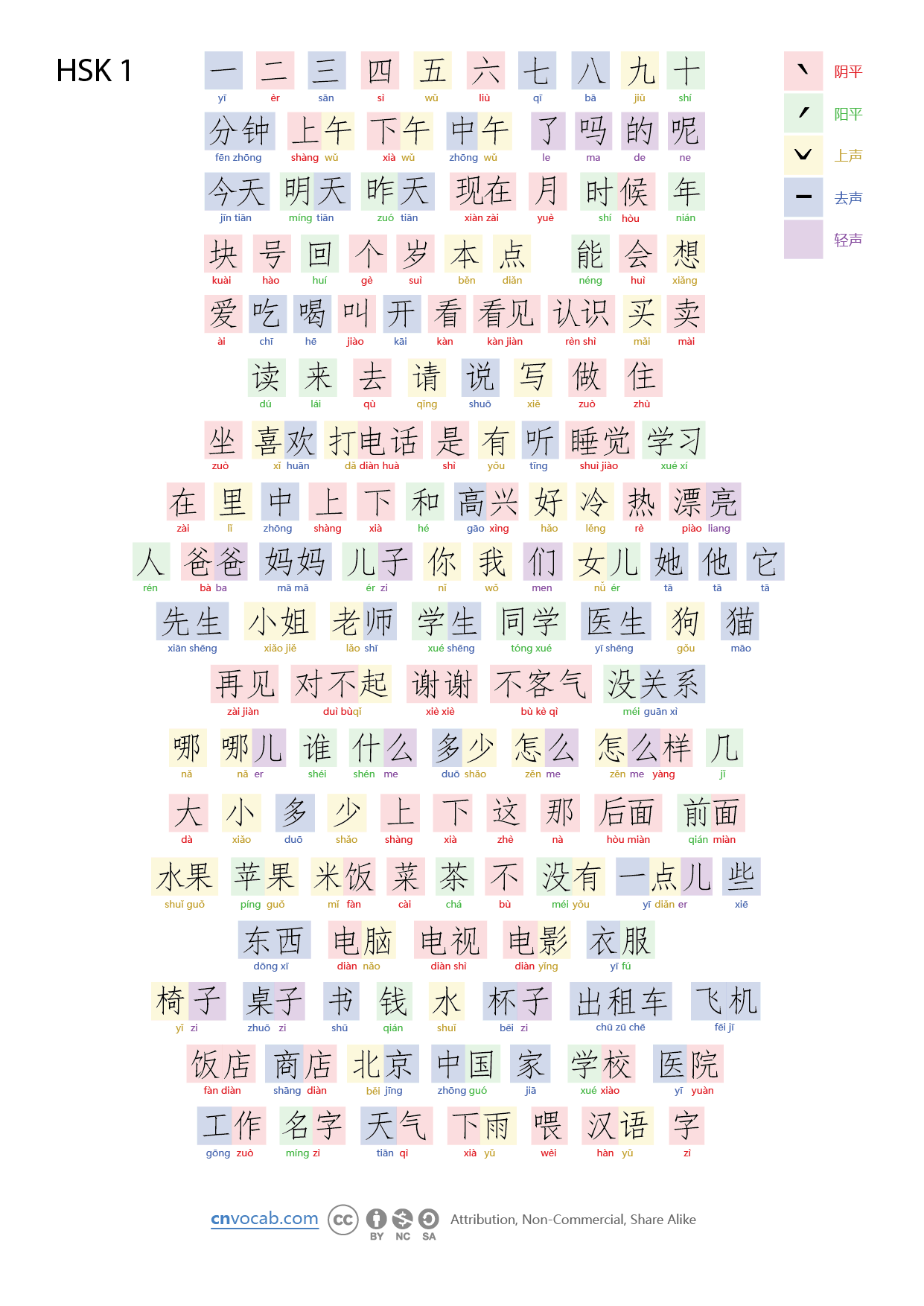
You have now been introduced to the characters for all the key vocabulary in this module. The image below contains the full HSK 1 vocabulary list. It's a useful tool for self-assessment.
Conclusion
In this lesson, we focused on decoding the written characters for the vocabulary in Module 5. You have seen that Chinese characters are not arbitrary but are often built on a logical system of components and radicals.
Key Takeaways:
- Systematic Construction: The Chinese number system is highly logical. Mastering the characters for 0-10 allows you to construct numbers up to 99 algorithmically.
- Radicals as Clues: Radicals like
日(sun),月(moon),口(mouth), and火(fire) provide semantic hints that make characters like明,晚,号, and点easier to understand and remember. - Component Logic: Many characters are logical compounds, such as
明(tomorrow/bright) being a combination of日(sun) and月(moon). - Recognition over Rote: By focusing on these patterns, you can develop your character recognition skills systematically, which is far more effective than rote memorization.
This lesson concludes Module 5. You are now equipped to read, understand, and use numbers, dates, and times in basic Mandarin.
Next Lesson Preview:
In our previous discussion of 二 (èr) versus 两 (liǎng), you saw that the use of 两 is tied to the presence of a "measure word." This concept is fundamental in Chinese grammar. In our next lesson, we will begin Module 6, "Existence, Possession, and Measure Words." We will explore this topic in depth, starting with the verb 有 (yǒu) to express "to have" and "there is/are," and learning how to use the most common measure words like 个 (gè), 本 (běn), and 杯 (bēi).