Introduction
In our last few lessons, we've built a solid foundation for introductions, covering names, nationalities, and family members. You can now form sentences to describe who people are and their relationship to you. Today, we shift from describing people to interacting with them by learning some of the most fundamental social expressions in any language.
This lesson focuses on mastering the essential phrases for giving and receiving thanks and apologies. By the end of our session, you will be able to correctly use 谢谢 (xièxie), 对不起 (duìbuqǐ), and their appropriate responses, 不客气 (bú kèqi) and 没关系 (méi guānxi). These fixed pairings are like simple social algorithms: a specific input (like an expression of gratitude) triggers a specific, polite output.
1. Expressing Gratitude: 谢谢 (xièxie)
The most common way to say "thank you" in Mandarin is 谢谢 (xièxie). It's a versatile phrase suitable for most situations.
An important pronunciation point is the tone. The first character is the 4th (falling) tone, xiè. The second character, though identical, is unstressed and pronounced with a neutral tone, making the whole phrase sound like xiè-xie.
Let's watch a short video that explains the pronunciation and also introduces a more formal way to say "thank you."
Learn to say Thank You, Please, Sorry, Excuse Me and More in Mandarin Chinese
This video from "Learn Mandarin Chinese with Weiwei" will cover the basics of 'thank you'.
Watch the section from the beginning of the explanation. Pay close attention to the neutral tone on the second syllable and the distinction between 谢谢你 (xièxie nǐ) and the more respectful 谢谢您 (xièxie nín), which builds on what we learned about the pronoun 您.
Responding to Thanks: 不客气 (bú kèqi)
When someone thanks you, the standard HSK 1 response is 不客气 (bú kèqi).
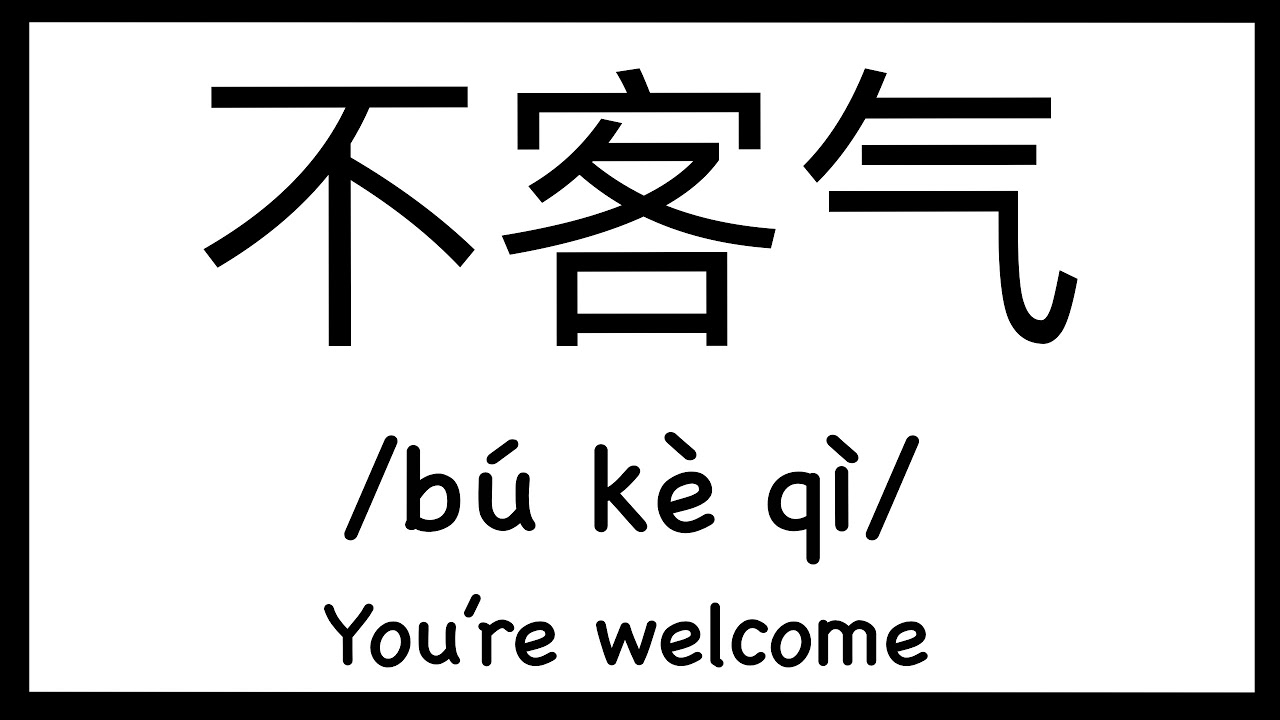
The phrase 不客气 (bú kèqi) is the standard way to say "You're welcome" in Mandarin.
Literally, 客气 (kèqi) means "polite" or "courteous." So, 不客气 (bú kèqi) translates to "don't be polite" or "no need for formalities." It's a friendly and common way to say "you're welcome."
Notice the tone change on 不 (bù). As we covered in Module 2, when 不 (originally 4th tone) is followed by another 4th tone syllable like 客 (kè), it changes to the 2nd (rising) tone: bú.
The following video segment explains 不客气 and also introduces another common response, 不用谢 (búyòng xiè), which literally means "no need to thank."
Learn to say Thank You, Please, Sorry, Excuse Me and More in Mandarin Chinese
Continuing with the same video, we will now look at the responses to 'thank you'.
Watch the segment from this section. Focus on understanding the meaning behind both 不用谢 (búyòng xiè) and 不客气 (bú kèqi). For the HSK 1 exam, 不客气 is the key phrase to master.
2. Making Apologies: 对不起 (duìbuqǐ)
For a formal or sincere apology, the phrase to use is 对不起 (duìbuqǐ). This is the equivalent of "I'm sorry."
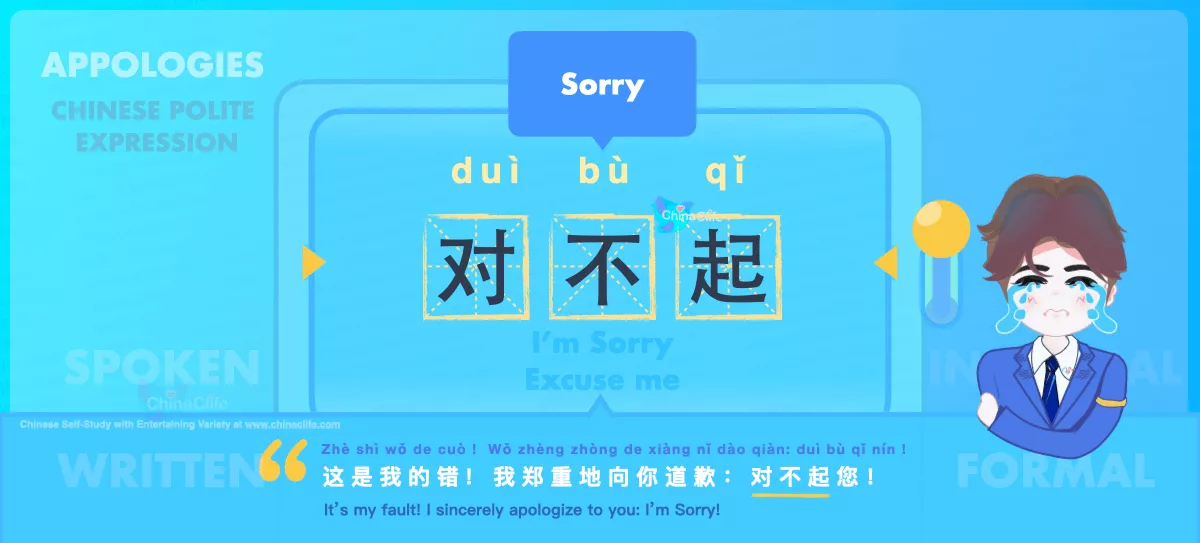
对不起 (duìbuqǐ) is used for sincere apologies. The three characters literally mean "to face/cannot/rise," which historically suggested being unable to face someone out of shame.
The pronunciation is duì (4th tone), bu (neutral tone), qǐ (3rd tone). Let's watch a video that breaks down the pronunciation of each syllable clearly.
This video from "Say Ninhao" provides a detailed breakdown of the apology phrase and its response.
Watch the first part of this clip from the explanation of 对不起 (duìbuqǐ). The instructor methodically goes through the Pinyin and tones for each character, which is excellent practice.
Responding to Apologies: 没关系 (méi guānxi)
The standard response to 对不起 (duìbuqǐ) is 没关系 (méi guānxi). This translates to "it doesn't matter," "no problem," or "it's okay."
Literally, 关系 (guānxi) means "relationship" or "connection," and 没 (méi) is a negative particle meaning "to not have." So, 没关系 suggests that the incident has no bearing on or consequence for your relationship.
Let's return to the same video to hear the pronunciation.
Now, let's learn the response to an apology from the same "Say Ninhao" video.
Watch the segment from this clip, which covers the pronunciation of 没关系 (méi guānxi) and shows the simple dialogue exchange: A: 对不起, B: 没关系.
While 对不起 and 没关系 are the core HSK 1 pair, in daily conversation, you might also hear 不好意思 (bù hǎo yìsi) for a milder apology (like "excuse me" or "my bad") and 没事 (méi shì) as a common response (literally "no thing" or "it's nothing"). For your exam, focus on mastering 对不起 and 没关系.
3. The Core Rule: Matching Pairs
In English, "it's okay" or "no problem" can sometimes be used to respond to both thanks and apologies. In Mandarin, the distinction is strict. This is a simple but non-negotiable rule.
- You respond to thanks (
谢谢) with不客气. - You respond to an apology (
对不起) with没关系.
Mixing these up is a common beginner mistake. To solidify this rule, let's look at a resource that directly compares these two responses.
HSK Quiz: Méi guān xi (没关系) VS Bú kè qi (不客气)
This article from eChineseLearning presents two simple dialogues to test your understanding of when to use each phrase.
Read the two quiz questions under the heading Choose the best option. Try to answer them yourself first. Then, read the Analysis section below, which explains the correct pairing for each dialogue. This will reinforce the rule we just discussed.
As you can see, the logic is straightforward. If the input is 谢谢, the output is 不客气. If the input is 对不起 (or a similar apology like 抱歉), the output is 没关系.
Conclusion
In this lesson, we've added four of the most crucial phrases for polite conversation to your HSK 1 toolkit. Mastering their use and, just as importantly, their correct pairings, is a significant step toward sounding natural and respectful in Mandarin.
Key Takeaways:
- To express thanks, use
谢谢 (xièxie). The standard response is不客气 (bú kèqi). - To make a sincere apology, use
对不起 (duìbuqǐ). The standard response is没关系 (méi guānxi). - The rule for responding is strict:
不客气is for thanks, and没关系is for apologies. They are not interchangeable. - Remember the tone changes: the second syllable of
谢谢is neutral, and不in不客气becomes 2nd tone.
This lesson concludes the new vocabulary for Module 4. In our next session, we will focus on reviewing and consolidating all the characters you've learned throughout this module, from greetings and family to the polite expressions we covered today, ensuring you are ready to recognize them in your HSK exam.