Welcome back. Over the past few lessons in this module, we've assembled the fundamental toolkit for building basic Chinese sentences. We've explored the personal pronouns that act as the subjects and objects, the essential verb 是 (shì) for making identifications, and the question words that allow us to inquire about the world around us. You've learned the logical "in-situ" grammar for asking questions and the symmetric "fill-in-the-blank" method for answering them.
This final lesson of the module is dedicated to consolidation. Our goal is to ensure that you can instantly and accurately recognize the written characters for all the vocabulary we've covered, and associate them with their correct Pinyin and meaning. For a pragmatic learner like yourself, you can think of this as populating and verifying your mental "symbol table" — ensuring every character (the key) maps correctly to its pronunciation and definition (the values). Mastering this is non-negotiable for passing the HSK 1 reading section.
The Vocabulary of Module 3: A Systematic Review
Let's break down the vocabulary into logical groups and review each one.
1. The "Actors": Personal Pronouns
These are the words for people and entities that perform or receive actions in your sentences. Chinese personal pronouns are systematic. You have singular base forms, and a simple suffix 们 (men) to create plurals.
Chinese pronouns – forms, usage, pronoun drop, and examples
This article provides a very clear and structured overview of Chinese personal pronouns. It's an efficient way to review them all in one place.
Please start at the heading "Chinese personal pronoun forms". Study the main table, which lays out the singular and plural forms. Then, read the short explanatory sections for the first person, second person, and third person forms. As you read, pay close attention to these patterns: The use of 们 (men) to form plurals. The distinction between 你 (nǐ) and the polite form 您 (nín). Notice the radical 心 (xīn - heart) at the bottom of 您, implying respect. The identical pronunciation of 他 (tā), 她 (tā), and 它 (tā). In writing, the radical indicates the meaning: 亻 (person) for 'he', 女 (woman) for 'she', and 宀 (roof) for 'it' (often related to animals or objects). This is a direct application of the radical concepts we discussed in Module 1.
The image below provides a great visual summary of these pronouns, similar to a set of flashcards.
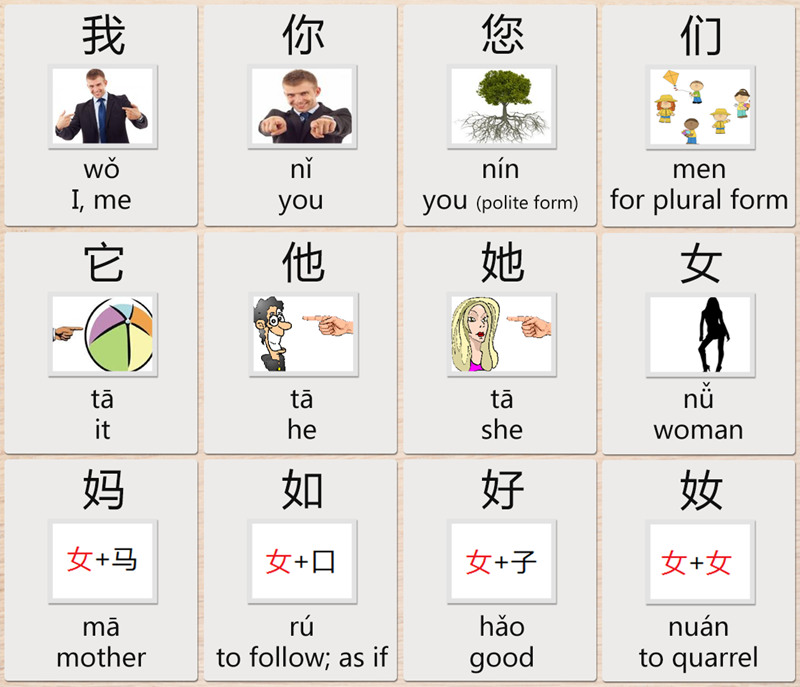
This chart displays the core personal pronouns, their Pinyin and meanings, and also shows how the 女 radical is used in other characters like 妈 (mā - mother) and 好 (hǎo - good).
2. The Core Verb and Yes/No Particle
With the pronouns established, we need the verb 是 (shì) to link them to an identity or description. To turn a statement into a simple yes/no question, we use the particle 吗 (ma).
- 是 (shì): The verb "to be", used in A-是-B structures like
我是学生(Wǒ shì xuésheng - I am a student). - 不是 (bú shì): The negation. This is a good moment to recall the tone change rule for
不 (bù), which becomesbúbefore a 4th tone syllable likeshì. - 吗 (ma): The yes/no question particle. It has no meaning on its own but transforms a statement into a question when placed at the end. For example,
你是学生(Nǐ shì xuésheng - You are a student) becomes你是学生吗?(Nǐ shì xuésheng ma? - Are you a student?).
The following resource provides clear examples of how 吗 (ma) works in practice.
Major Question Words in Chinese
This article from DigMandarin explains the function of the most common question words and particles.
Please read the section under the heading "1. 吗". Focus on the examples in the table, observing how adding 吗 to the end of a declarative sentence converts it into a yes-no question without any other changes.
3. The "Information-Seekers": Interrogative Pronouns
Finally, let's review the question words we learned, which allow us to ask for specific information. Remember the "in-situ" principle: these words stand in the exact spot in the sentence where the answer will go.
- 什么 (shénme): "what"
- 谁 (shéi): "who"
- 哪儿 (nǎr): "where"
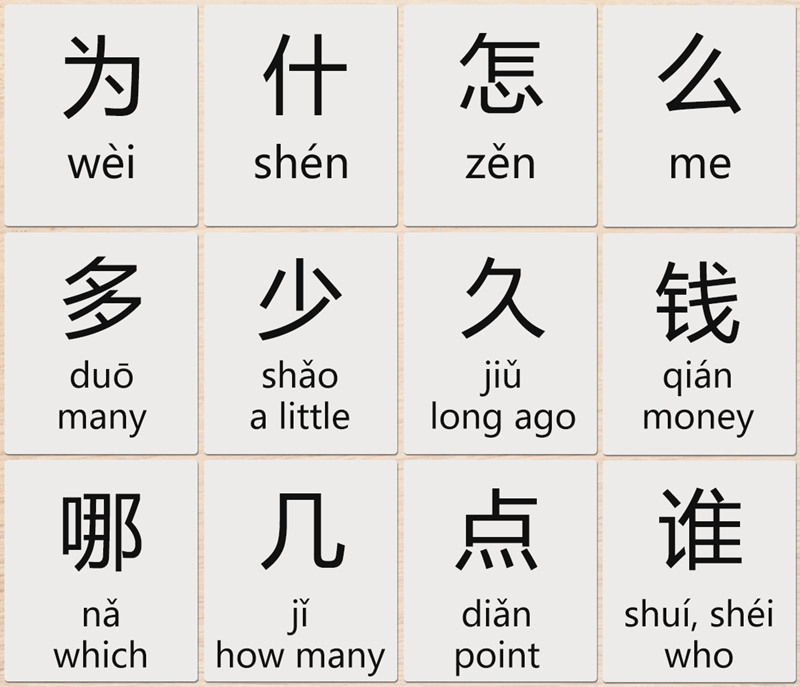
This flashcard grid shows characters used in common question words. You can see 什 (shén), 谁 (shuí/shéi), and 哪 (nǎ), which are the key components of the question words you've learned in this module.
To see these words used in full questions, you can refer back to the same article from DigMandarin.
Major Question Words in Chinese
This reading will show you contextual examples for the question words.
In the article, find and read the sections for "1. 什么 – what", "2. 谁 – who/whom", and "3. 哪儿/哪里 & 什么地方 – where/what place". For each one, look at the "Wh- Question" column to see how the question word is integrated into a sentence.
Active Recall and Consolidation
Reading and reviewing is the first step. The next, more crucial step is active recall.
Video Flashcard Drill
The following video from Mandarin Corner functions as an excellent digital flashcard drill. It will show you a character, pronounce it clearly, and give you its meaning. This will help you solidify the link between the visual character and its sound.
HSK 1 Course - Complete Chinese Vocabulary Course - HSK 1 Full Course - Pronouns/Numerals (3/5)
This video covers a large portion of the HSK 1 vocabulary. We will use it to drill the specific words from this module.
Watch the following short segments. For each one, try to recall the meaning and Pinyin before the video provides it. 你 (nǐ) 你们 (nǐmen) 什么 (shénme) 谁 (shéi) 他 (tā) 她 (tā) 他们 (tāmen) 她们 (tāmen) 我 (wǒ) 我们 (wǒmen) 哪儿 (nǎr) 是 (shì) Note: The yes/no particle 吗 (ma) is not covered in this particular video segment.
Practice Exercise
Now, test your recognition by filling in the blanks. Choose the correct pronoun for each sentence.
- _____ 是学生。 (_____ shì xuésheng. - I am a student.)
- _____ 是老师吗? (_____ shì lǎoshī ma? - Are you a teacher?)
- _____ 是中国人。 (_____ shì Zhōngguó rén. - She is Chinese.)
- _____ 都不是学生。 (_____ dōu bú shì xuésheng. - We are all not students.)
Answers
- 我 (wǒ)
- 你 (nǐ)
- 她 (tā)
- 我们 (wǒmen)
Conclusion
This lesson concludes our work in Module 3. You have now established the grammatical and lexical foundation for forming core sentences in Mandarin. You can identify people, form statements and negations with 是, and ask fundamental "who," "what," "where," and "yes/no" questions. Most importantly, you are building the crucial skill of character recognition for all this vocabulary.
Key Takeaways:
- Pronouns: 我, 你, 您, 他, 她, and their plural forms with 们 (我们, 你们, 他们). Remember that 他 and 她 are written differently but pronounced identically (tā).
- The Verb "to be": 是 (shì) for identification and its negation 不是 (bú shì).
- Question Forms: The particle
吗 (ma)for yes/no questions, and the in-situ question words 什么 (shénme), 谁 (shéi), and 哪儿 (nǎr).
As we move into Module 4, we will immediately put this entire vocabulary set to use. Our next topic is Introductions, Family, and Possession. You will learn how to state your name with 我叫... and ask for others' names using the 你叫什么名字? pattern, directly applying what you've just mastered.