Hello! Welcome to your second lesson.
Introduction
In our last session, we established that the radio frequency (RF) spectrum is a regulated resource, licensed to operators and shared among users through various multiple access techniques. We ended with a brief introduction to duplexing—the method for handling two-way communication.
Today, we'll dive deep into that topic. This lesson directly addresses the learning outcome: Explain the difference between FDD and TDD duplexing methods. We will explore how Frequency Division Duplex (FDD) and Time Division Duplex (TDD) work, their respective advantages and disadvantages, and in which technologies you're likely to find them.
For your goal of telecommunication hacking, this is not just abstract theory. The duplexing method is a fundamental parameter of a cellular network. When you begin scanning for signals with your RTL-SDR, knowing whether a target network uses FDD or TDD is essential for knowing where and how to listen.
Duplexing: Enabling a Two-Way Conversation
At its core, "duplexing" refers to how a communication system enables two-way (bi-directional) conversation. In cellular networks, this means managing the uplink (your phone transmitting to the base station) and the downlink (the base station transmitting to your phone).
There are two main approaches:
- Half-Duplex: Communication can only happen in one direction at a time. Think of a walkie-talkie where you have to press a button to talk and release it to listen.
- Full-Duplex: Communication can happen in both directions simultaneously, like a natural phone conversation.
Cellular networks need to provide a full-duplex experience. FDD and TDD are the two primary strategies they use to achieve this.
Let's watch a short video that introduces these concepts.
What are FDD and TDD in mobile networks?
This video from Commsbrief Limited provides a clear and concise introduction to FDD and TDD, starting with the basic principles of duplexing.
Watch the first segment of the video (00:00 - 01:16). Focus on how it defines full-duplex and half-duplex systems and maps them to FDD and TDD, respectively.
As the video explains, FDD is a true full-duplex system, while TDD is a half-duplex system that operates so quickly it emulates a full-duplex experience. Let's break down how each one works.
Frequency Division Duplex (FDD)
In FDD, the uplink and downlink are given two separate, dedicated frequency bands. Imagine two separate highways, one for northbound traffic and one for southbound. They are physically separate, so traffic can flow in both directions continuously and simultaneously without collision.
To prevent the powerful outbound signal from your phone's transmitter from deafening its own sensitive receiver, these two frequency bands are separated by an unused block of spectrum called a guard band.
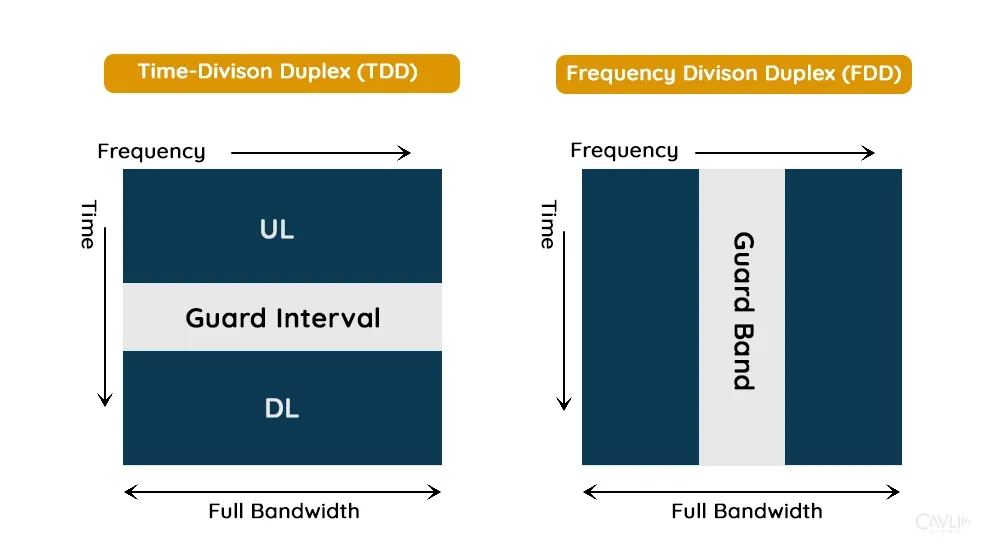
Key characteristics of FDD:
- Paired Spectrum: It requires two separate blocks of spectrum, which are licensed by regulators as a pair (e.g., one band for UL, one for DL).
- Simultaneous Transmission: True full-duplex communication.
- Hardware Requirement: Requires a special filter in the phone called a duplexer to handle the simultaneous transmission and reception on the same antenna. This adds cost and complexity.
- Common Use: FDD is the most common scheme for 2G (GSM), 3G (UMTS), and the majority of global 4G (LTE) deployments, especially in lower frequency bands used for wide-area coverage.
Time Division Duplex (TDD)
In TDD, the uplink and downlink share the same frequency band. Instead of being separated by frequency, they are separated by time. Imagine a single-lane road on which traffic flow is controlled by a traffic light at each end. For a short period, traffic flows north; then the lights switch, and for another short period, traffic flows south.
This switching happens so fast—thousands of times per second—that it's imperceptible to the user. To prevent uplink and downlink transmissions from colliding due to propagation delays, a small amount of dead time, known as a guard period, is inserted between the switch-overs.
Looking back at the "TDD and FDD Comparison" image, you can see how the TDD model uses the same frequency but alternates between UL and DL time slots.
Key characteristics of TDD:
- Unpaired Spectrum: It operates on a single frequency band, making it more spectrally efficient.
- Asymmetric Traffic: TDD offers great flexibility. Since internet usage is typically download-heavy, an operator can dynamically allocate more time slots to the downlink than the uplink to match demand. FDD's capacity is fixed and symmetric.
- Synchronization: TDD networks require very precise time synchronization between all base stations. If adjacent cells are not perfectly synchronized, a base station trying to receive an uplink signal could be deafened by a neighboring base station transmitting a powerful downlink signal on the same frequency. This synchronization is a major operational challenge.
- Common Use: TDD is used for some 4G LTE networks (often marketed as TD-LTE) and is very common in 5G, particularly in mid-band and high-band spectrum where large, unpaired channel blocks are available.
Comparing FDD and TDD: The Trade-offs
Now that you understand the mechanics, let's synthesize this knowledge and look at the pros and cons that an operator considers when designing a network. Your background in security will help you appreciate that system design is always about trade-offs, and these choices can have security implications.
What are FDD and TDD in mobile networks?
Let's return to the Commsbrief video to see a direct comparison of these two methods.
Please watch the rest of the video, focusing on these two parts: 01:16 - 03:04: This section visually explains the FDD guard band and the TDD guard time. 03:52 - 06:36: This is the most important part. It details the pros and cons of each method, covering spectrum efficiency, capacity allocation, coverage, and hardware.
The video provides a great overview of the trade-offs. The table below, which draws from the video and the detailed article from CableFree, summarizes the key points of comparison.
| Feature | FDD (Frequency Division Duplex) | TDD (Time Division Duplex) |
|---|---|---|
| Spectrum | Requires paired frequency bands. | Uses a single, unpaired frequency band. |
| Spectral Efficiency | Less efficient due to guard bands. | More efficient as there are no guard bands. |
| Traffic Symmetry | Symmetric (fixed UL/DL capacity). Inefficient for asymmetric data traffic. | Asymmetric (dynamic UL/DL capacity). Highly efficient for internet traffic. |
| Coverage / Range | Better for wide-area coverage. Range is not limited by timing. | Range is limited by the guard period, which must be long enough to account for propagation delay. |
| Hardware (Device) | Requires an expensive duplexer to isolate transmitter and receiver. | Does not require a duplexer, leading to lower device cost and complexity. |
| Latency | Lower inherent latency due to continuous transmission. | Slightly higher latency due to the time required to switch between UL and DL. |
| Interference | Interference is managed by frequency planning and filtering. | Requires precise time synchronization across the network to avoid cross-slot interference between cells. |
From a security perspective, the TDD network's reliance on precise timing (often from GPS) introduces a dependency that could be targeted. An attack that disrupts timing synchronization could cause significant interference and service disruption across a TDD network.
Conclusion
You now have a detailed understanding of the two fundamental duplexing methods that underpin all modern cellular networks.
Key Takeaways:
- FDD achieves two-way communication by using two separate frequency bands for uplink and downlink, separated by a guard band. It is a true full-duplex system.
- TDD achieves two-way communication by using a single frequency band and rapidly alternating between uplink and downlink in time, separated by a guard period.
- The choice between FDD and TDD involves critical trade-offs in spectrum efficiency, traffic flexibility, coverage, and network complexity.
- Generally, FDD excels in providing wide-area coverage, while TDD excels in providing flexible, high-capacity data service in more densely populated areas.
In the next lesson, we will outline the evolution of cellular networks from 2G (GSM) to 5G (NR). You'll see how these duplexing schemes fit into the broader story and how each generation of technology built upon, and sometimes replaced, the architecture of its predecessor. This historical context is vital for understanding why certain vulnerabilities exist and how security has evolved over time.