Welcome to the final lesson of your course on telecommunication hacking.
Throughout this journey, we have covered a vast amount of ground. We started with the foundational principles of cellular networks, moved to passive reconnaissance with your RTL-SDR, and dove deep into the architecture of 4G/LTE. You then learned how to build and operate your own 4G test lab, a crucial step for safely practicing the attack vectors we explored. Finally, we looked at how 5G's architecture aims to mitigate many of these legacy threats.
With all this powerful knowledge and practical skill, our final topic is perhaps the most important: the legal and ethical framework that governs security research. Applying your skills responsibly is not just a matter of principle; it's a critical step in protecting yourself and contributing positively to the security of our communications infrastructure. This lesson will equip you to navigate the complex landscape of security research, ensuring your work is both impactful and legitimate.
1. The Legal Landscape for Security Researchers
Security research often exists in a legal gray area. Laws written to prosecute malicious attackers can sometimes be interpreted in ways that create risk for individuals acting in good faith. Your background in cybersecurity means you are likely aware of some of these challenges, particularly regarding web applications. Here, we'll focus on the laws most relevant to cellular security research in the United States.
To get a comprehensive overview of the legal risks, we will rely on a guide created by the Cyberlaw Clinic at Harvard Law School.
[PDF] A Researcher's Guide to Some Legal Risks of Security Research
Please start by reading the introduction to this guide. It defines what legal risk means for a researcher and distinguishes between civil and criminal liability, which is a fundamental concept.
Read the section titled '2 What do we mean by legal risk?'. Focus on the difference between civil and criminal liability and the guide's note about the current ambiguity in the law.
Now, let's examine the three main areas of U.S. law that you must be aware of.
The Computer Fraud and Abuse Act (CFAA)
The CFAA is the primary federal anti-hacking statute. Its broad language makes it a central concern for any security researcher. The act prohibits "intentionally access[ing] a computer without authorization or exceed[ing] authorized access."
- What does this mean for cellular research? The terms "computer," "access," and "authorization" can be interpreted very broadly. Does a base station count as a computer? Does receiving a broadcast signal count as "access"? If you use your own SIM card and SDR to interact with a public network, have you "exceeded authorized access"? The answers are often not clear-cut.
- Key Takeaway: The safest path is to conduct research on equipment you own, within a lab environment you control (like the srsRAN/Open5GS lab you learned to build). Interacting with public networks carries inherent risk under the CFAA.
The Digital Millennium Copyright Act (DMCA)
The DMCA includes anti-circumvention provisions (Section 1201) that prohibit bypassing "technological measures" that control access to copyrighted works.
- What does this mean for cellular research? Software and firmware in phones, SIM cards, and base stations are copyrighted. Reverse-engineering them or bypassing security checks (like code signing or encryption) to analyze their function could be considered a violation of the DMCA. This is a significant barrier to understanding how systems truly work.
- Good Faith Exemptions: Fortunately, the law contains specific, though narrow, exemptions for good-faith security and encryption research. These exemptions are crucial legal protections. To qualify, your research must be for the purpose of promoting security, conducted in a way that avoids harm, and must not violate other laws (like the CFAA).
The Electronic Communications Privacy Act (ECPA)
The ECPA prohibits the unauthorized interception of "electronic communications."
- What does this mean for cellular research? This law is directly relevant to using an SDR to monitor radio signals. While capturing broadcast control channels (like MIB/SIB) is generally considered safe, capturing traffic directed at specific users could be a violation.
- One-Party Consent: The ECPA operates on a "one-party consent" rule. You can legally intercept a communication if you are a party to it or if at least one of the parties has given you permission. This is why it is legal to capture traffic between your own phone and the network in your test lab, but capturing traffic from other people's phones without their consent is illegal.
[PDF] A Researcher's Guide to Some Legal Risks of Security Research
To understand these three laws in more detail, please read the relevant sections of the researcher's guide. Pay close attention to the examples and the specific exemptions mentioned for the DMCA.
Read the following sections from the guide: Start with the overview table in section '3 What kinds of security research raise legal risk?'. Read '3.1 CFAA (Computer Fraud and Abuse Act)'. Read '3.3 DMCA §1201', focusing on both the prohibitions and the 'Permanent security research exemptions' and 'Temporary security research exemptions'. Read '3.6 ECPA (Electronic Communications Privacy Act)'.
2. The Ethical Framework: Coordinated Vulnerability Disclosure (CVD)
Beyond staying within the law, ethical conduct is about acting responsibly. If you discover a security vulnerability, what should you do? The industry best practice is Coordinated Vulnerability Disclosure (CVD).
CVD is a process where researchers report vulnerabilities to the affected organization privately, allowing them a reasonable amount of time to develop and deploy a fix before the vulnerability is publicly disclosed. This approach minimizes the risk to the public while still ensuring that vulnerabilities are eventually made known and fixed.
For vulnerabilities that affect the mobile ecosystem at an industry level (e.g., a flaw in an LTE or 5G standard), the GSMA—the trade body representing mobile network operators worldwide—runs a CVD program to act as a central coordinator.
GSMA Coordinated Vulnerability Disclosure programme
Let's look at how the GSMA describes its CVD program. Understanding its purpose and scope is key to knowing when and how to engage with it.
On the GSMA's CVD page, please read the sections under the headings: 'The aim of the CVD programme'. 'GSMA Member CVD programme' (to understand the scope). 'CVD programme assets' (note the explicit statement that this is not a bug bounty program).
The process for submitting a vulnerability to the GSMA follows a clear, structured path designed to validate the finding and coordinate with affected parties.
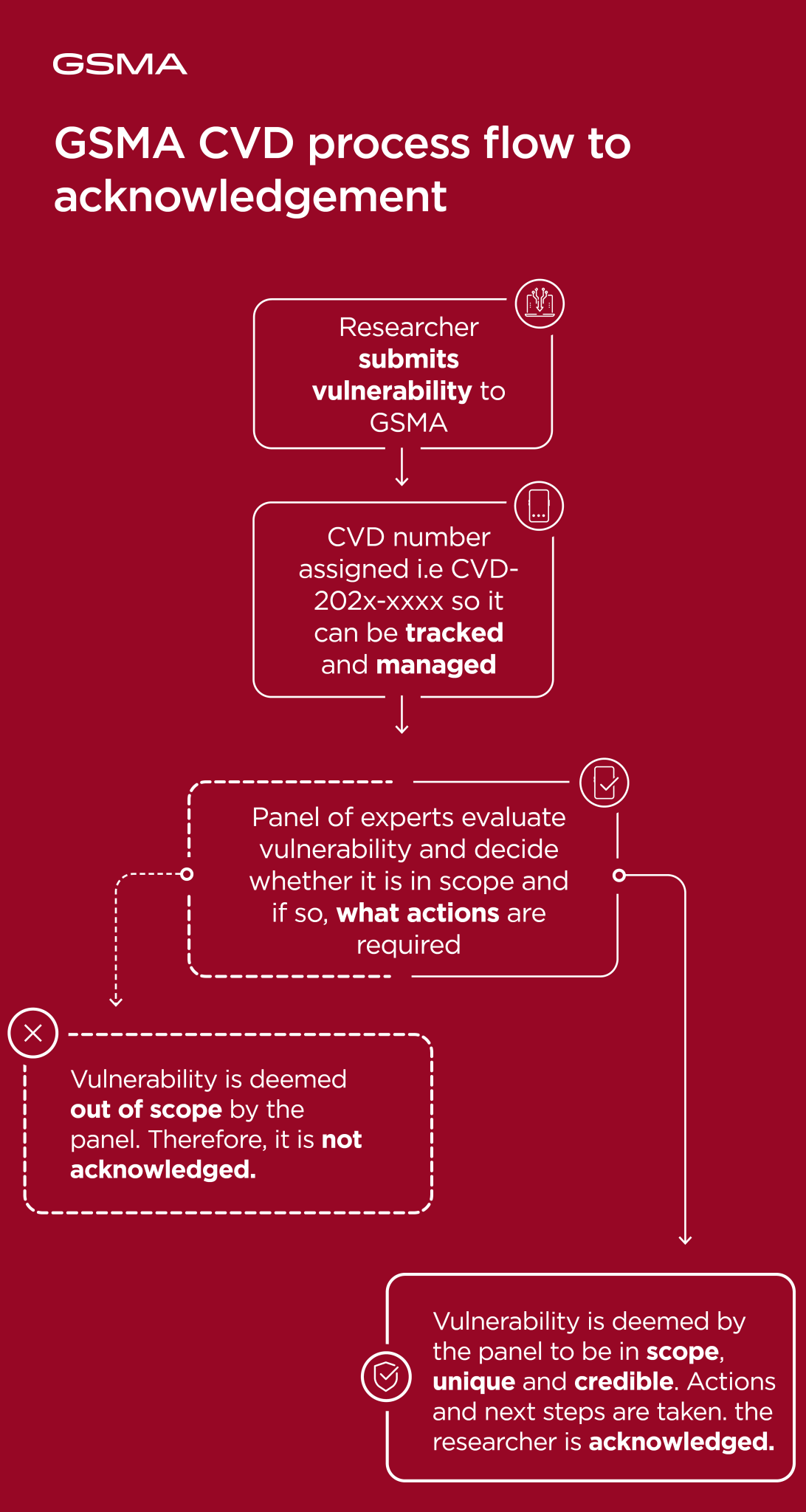
Engaging in CVD has two major benefits:
- It protects the public: By allowing vendors and operators to patch systems before an attack is widely known, it prevents malicious actors from exploiting the flaw.
- It protects you: Following an established, good-faith disclosure process demonstrates responsible intent, which can be a significant factor in mitigating legal risk. Organizations are far less likely to pursue legal action against researchers who report issues responsibly.
3. A Practical Guide to Responsible Research
So, how do you put all this together? Here is a simple checklist for conducting cellular security research responsibly.
Before You Begin:
- Know the Law: Be familiar with the CFAA, DMCA, and ECPA in your jurisdiction.
- Use a Lab: Conduct your research on hardware you own, in a controlled lab environment (e.g., your srsRAN/Open5GS setup). This is the single most effective way to minimize legal risk.
- Get Permission: If you must test on a system you don't own, get explicit, written authorization from the owner. Define the scope of your testing clearly.
During Your Research:
- Act in Good Faith: Your goal should be to find and help fix security flaws, not to cause damage, disrupt service, or access data you shouldn't.
- Avoid Private Data: Do not intentionally access or store non-public user data. If you accidentally encounter it, do not record or share it, and purge it immediately.
After Finding a Vulnerability:
- Follow CVD: Report the vulnerability privately to the responsible party (e.g., the software vendor, hardware manufacturer, or network operator).
- Use Coordinators: If the vulnerability affects an entire standard or multiple vendors, consider reporting it through a coordinator like the GSMA or CERT/CC.
- Be Patient: Allow the organization a reasonable time (typically 90 days) to fix the issue before you consider public disclosure. Maintain communication throughout the process.
If at any point you receive legal threats (like a "Cease and Desist" letter) or are unsure about the legality of your work, it is wise to stop and seek legal counsel from a lawyer experienced in this field.
[PDF] A Researcher's Guide to Some Legal Risks of Security Research
The researcher's guide has a helpful FAQ on what to expect when seeking legal advice. It's a good idea to be aware of your options.
To round out your understanding, please read sections '2.2 Cease and desist letters', '4 FAQ on getting and working with an attorney', and '5 Conclusion' from the guide. This provides practical advice for navigating difficult situations.
Conclusion
This lesson, and this course, have aimed to provide you with a comprehensive understanding of cellular security, from theory to practice. You now possess the knowledge to find and analyze vulnerabilities that affect the daily communications of millions of people.
Key Takeaways:
- Security research operates within a complex legal framework, primarily governed by the CFAA, DMCA, and ECPA.
- The most effective way to mitigate legal risk is to work in a controlled lab environment using equipment you own.
- Coordinated Vulnerability Disclosure (CVD) is the ethical standard for reporting security flaws. It protects the public and the researcher.
- Organizations like the GSMA provide formal channels for disclosing industry-wide vulnerabilities.
The power to hack is the power to build and to break. By choosing to act legally and ethically, you can use your skills to strengthen the systems we all rely on. This concludes our course. I hope this has been a stimulating and empowering journey, and I wish you the very best in your future explorations of telecommunication security.