Introduction
In our last lesson, we mastered the calculation of the Weighted Average Cost of Capital (WACC), which represents a firm's blended cost of financing. This naturally leads to a crucial strategic question: can a company actively manage its WACC by changing its mix of debt and equity? In other words, is there an optimal capital structure that minimizes the cost of capital and, by extension, maximizes the value of the firm?
This lesson delves into the foundational theory that addresses this question, as articulated by Nobel laureates Franco Modigliani and Merton Miller (MM). We will focus on achieving the learning outcome: Apply the Modigliani-Miller propositions to calculate the effect of leverage on firm value and WACC, with and without tax. We will first explore their propositions in a simplified, "perfect" world without taxes, and then see how their conclusions shift dramatically once we introduce the reality of corporate taxation. This theoretical journey is fundamental to understanding modern corporate finance and will rely heavily on the numerical application you prefer.
1. The Modigliani-Miller Propositions in a World Without Taxes
Modigliani and Miller began by imagining a perfect capital market with a set of simplifying assumptions, the most important for our initial analysis being the absence of taxes. Other assumptions include no transaction costs, no bankruptcy costs, and that individuals can borrow at the same rate as corporations. In this theoretical world, they developed two key propositions.
Proposition I (No Taxes): Capital Structure is Irrelevant to Firm Value
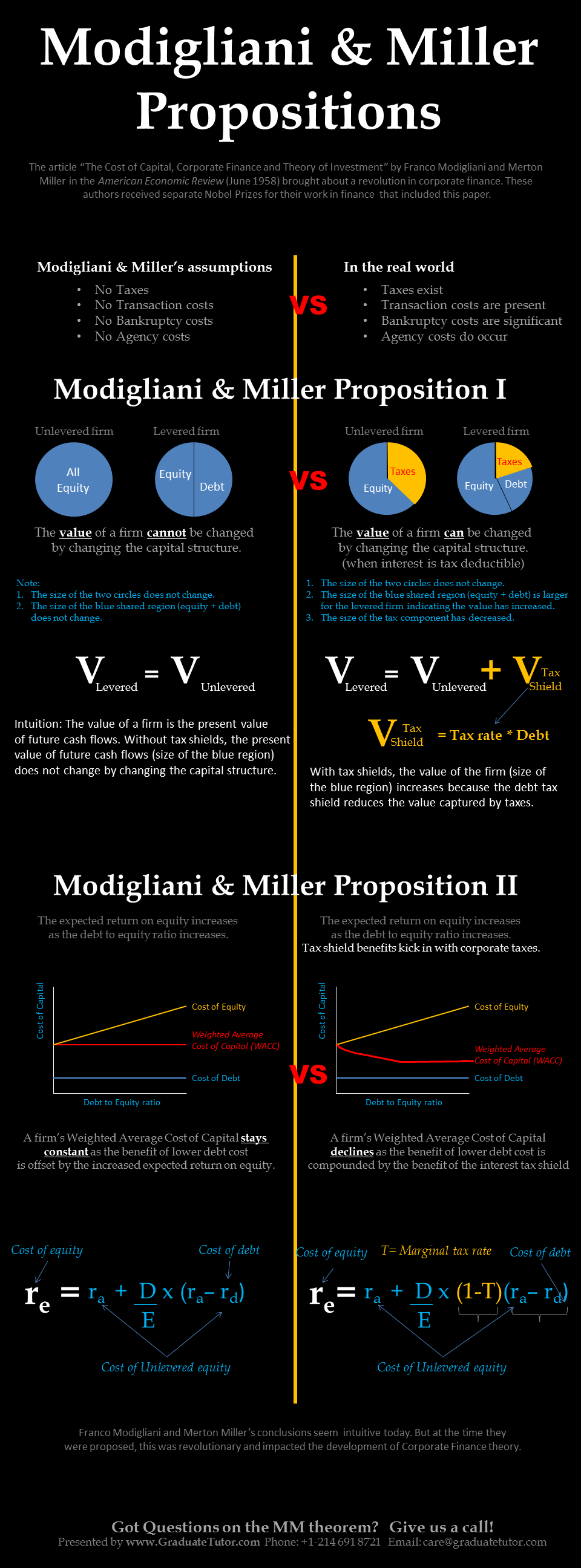
MM's first proposition is a powerful statement: in a world without taxes, a company's capital structure has no effect on its value. The value of a levered firm () is exactly equal to the value of an identical unlevered firm ().
The intuition is that the firm's value is determined by the earning power of its assets and its business risk, not by how the cash flows from those assets are divided between debtholders and equity holders. Think of the firm's value as a whole pizza. Proposition I states that the size of the pizza doesn't change whether you slice it into two pieces (debt and equity) or just leave it as one (all equity). Any attempt by the firm to create value by changing its financing mix would be undone by investors through "homemade leverage," where they can replicate the firm's capital structure on their own.
Proposition II (No Taxes): Cost of Equity and the WACC
If firm value doesn't change, what happens to the cost of capital? Proposition II states that as a firm increases its use of debt (leverage), its cost of equity increases in a precise, linear fashion. The risk to equity holders increases because debtholders have a priority claim on the firm's cash flows. To compensate for this higher financial risk, equity investors demand a higher return.
The formula for the cost of levered equity () is:
Where:
- is the cost of capital for an all-equity firm (the unlevered cost of equity).
- is the cost of debt.
- is the debt-to-equity ratio.
Crucially, this increase in the cost of equity exactly offsets the benefit of using cheaper debt. The result? The WACC remains constant regardless of the level of leverage and is always equal to the cost of capital of an unlevered firm ().
Let's see this in action with a numerical example.
Modigliani Miller | Capital Structure | Where there is Tax and Where there is no Tax | Kauserwise
This video from the Kauser Wise channel demonstrates the MM propositions in a world without corporate taxes. It provides a clear, step-by-step calculation that aligns with the exam-style problems you will encounter.
Please watch the section covering the no-tax model, from this part. Focus on: How the value of the unlevered firm is calculated first as the baseline. How the value of equity for the levered firm is derived by subtracting debt from the total firm value (which, according to Prop I, remains unchanged). The calculation of the leveraged cost of equity, and notice how it is higher than the initial cost of equity for the all-equity firm.
2. Introducing Reality: The MM Propositions with Corporate Taxes
The no-tax world provides a critical theoretical baseline, but its conclusions change once we relax the no-tax assumption and step into a more realistic scenario. In most countries, interest payments on corporate debt are tax-deductible. This creates a significant advantage for debt financing.
This tax-deductibility creates what is known as a debt tax shield—a reduction in a firm's tax bill that results from using debt. This tax shield has value.
Proposition I (With Taxes): Firm Value Increases with Leverage
Because the tax shield adds value, MM's first proposition is revised: the value of a levered firm is now the value of an unlevered firm plus the present value of the tax shield. Assuming the debt is perpetual, the value of the tax shield is the corporate tax rate () multiplied by the amount of debt ().
This implies that, all else being equal, adding debt increases the total value of the firm. The pizza gets bigger because the government takes a smaller slice from a levered firm.
Proposition II (With Taxes): WACC Decreases with Leverage
With taxes, the cost of equity still rises as leverage increases, but not as steeply as before. The tax shield partially mitigates the financial risk. The formula for the cost of levered equity becomes:
Since the cost of equity rises more slowly, the benefit of using cheaper, tax-advantaged debt is no longer fully offset. The result is that the WACC decreases as the firm adds more debt. This leads to the striking conclusion that, according to the MM model with taxes, the optimal capital structure is 100% debt, as this would minimize the WACC and maximize firm value.
The infographic below provides an excellent summary of the differences between the MM world without taxes and with taxes.
Now, let's return to the Kauser Wise video to see how these calculations work in practice when taxes are included.
Modigliani Miller | Capital Structure | Where there is Tax and Where there is no Tax | Kauserwise
This part of the video provides a numerical example for the MM propositions in a world with corporate taxes, demonstrating the impact of the tax shield.
Watch the first main section of the video from the beginning. Pay attention to: The formula for the value of the levered firm, which now adds the tax shield component (\text{Tax rate} \times \text{Debt}). How this directly increases the firm's total value compared to its unlevered counterpart.
3. Applying Proposition II: A Practical Toolkit
For your exam, a common task will be to calculate the cost of equity at different levels of gearing using the MM Proposition II formula. The following video provides a very clear, practical guide on how to use and rearrange the formula to solve typical problems.
ACCA AFM - NEW FORMULA in 2024/5! Modigliani and Miller (M&M) Proposition 2 Formula Sheet Update
This video by ACCA tutor Andrew Mower gives a practical guide to applying the MM Proposition II formula with taxes. It covers both calculating the levered cost of equity and the unlevered cost of equity, which are key skills.
Please watch the following segments carefully: Introduction and Context: This section explains the relationship between gearing, WACC, and the cost of equity, visualizing the core concepts of Proposition II. Calculating Geared Cost of Equity: This part walks through a numerical example of calculating the cost of equity for a levered firm (r_e) when you know the unlevered cost of equity (r_0). Calculating Ungeared Cost of Equity: This final part shows a rearranged version of the formula to solve for the unlevered cost of equity (r_0), a very common exam-style task.
To consolidate all the formulas and concepts, the following reading serves as an excellent summary and reference sheet.
Modigliani-Miller Capital Structure | CFA Level 1 - AnalystPrep
This article from AnalystPrep provides a concise summary of all four MM propositions, with and without taxes. It's a great reference to have the key formulas in one place.
Please review the following four sections, focusing on the formulas and the logic of the worked examples: Prop I Without Taxes: Reinforces that V_L = V_U. Prop II Without Taxes: Shows how the cost of equity increases with leverage. Prop I With Taxes: Introduces the tax shield and the formula V_L = V_U + tD. Prop II With Taxes: Presents the adjusted cost of equity formula and shows how WACC decreases as a result.
Conclusion
Today, we explored the groundbreaking Modigliani-Miller propositions, which provide the theoretical foundation for understanding capital structure. We saw how their conclusions pivot on the single assumption of corporate taxes.
Key Takeaways:
- Without Taxes: Capital structure is irrelevant. The value of a firm () and its WACC are constant regardless of leverage. The benefit of cheaper debt is perfectly offset by the rising cost of equity.
- With Taxes: Debt financing creates value through the tax shield (). As leverage increases, the WACC falls. The MM model with taxes suggests a firm's value is maximized with 100% debt.
This last point is clearly unrealistic—we do not see successful companies financed entirely by debt. Why not? Because the MM model ignores other real-world factors, most notably the costs associated with financial distress and bankruptcy. In our next lesson, we will introduce these costs and explore the trade-off and pecking order theories, which provide a more nuanced and realistic view of how firms decide their optimal capital structure.