Hello! Welcome back to our journey through query execution internals.
In our last lesson, you learned how to implement external merge sort, a crucial algorithm for handling ORDER BY clauses on datasets that don't fit in memory. We broke it down into its two main phases: creating initial sorted runs and performing a k-way merge on those runs using a min-heap.
Today, we'll build directly on that foundation. Our goal is to analyze the I/O cost of external merge sort and explore its use for projection with duplicate elimination. Understanding the I/O cost is fundamental to query optimization, as it allows the database to predict how expensive an operation will be. We'll also see how this powerful sorting primitive can be leveraged to efficiently implement the SELECT DISTINCT SQL clause.
1. Analyzing the I/O Cost of External Merge Sort
The performance of any external memory algorithm is dominated by the amount of data it reads from and writes to disk. In external merge sort, we make multiple passes over the data. In each full pass, we read every page of the file and write every page back out to a new file.
Therefore, the total I/O cost can be expressed as:
\text{Total I/O Cost} = 2 \times N \times (\text{# of passes})where N is the number of pages in the file. Our main goal in optimizing external sort is to minimize the number of passes.
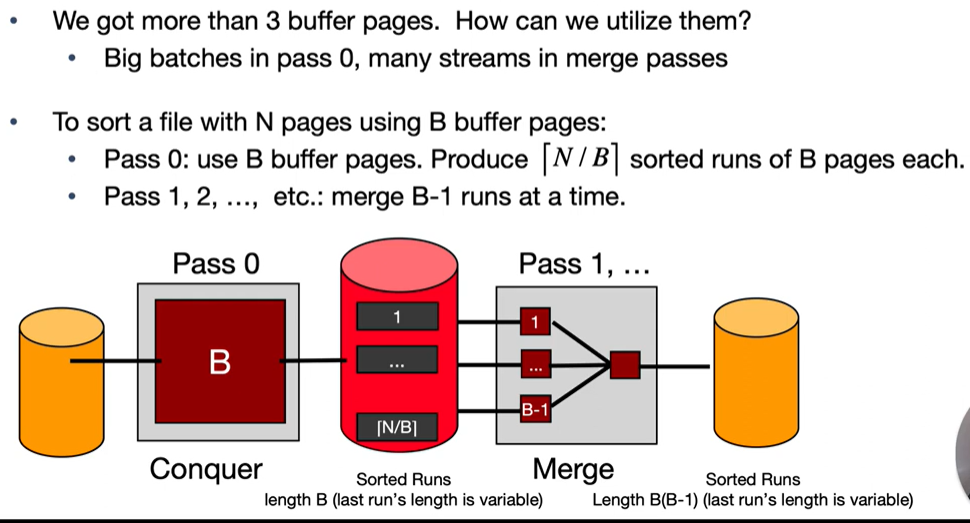
Let's assume we have B pages available in our buffer pool. How can we use them to reduce the number of passes? The strategy involves two key ideas:
- Make initial runs as long as possible: In Pass 0, we can read
Bpages into memory at once, sort them, and write out a single sorted run of sizeB. This "chops" the base of the conceptual merge tree, creating fewer, longer initial runs. - Merge as many runs as possible at once: In subsequent merge passes, we need one buffer page for the output. This leaves
B-1pages to be used as input buffers. Therefore, we can perform a(B-1)-way merge, which "widens" the merge tree.
This short video explains these two optimizations visually and intuitively.
F2023 #10 - Sorting & Aggregation Algorithms (CMU Intro to Database Systems)
Professor Pavlo from CMU explains how to generalize and optimize external merge sort by using all available buffer pool pages to create longer initial runs and perform wider merges, thus minimizing the number of passes.
Watch the segment from 33:15 to 39:40. Focus on the two core ideas for reducing passes: 'chopping the tree' by creating larger initial runs and 'widening the tree' by increasing the merge fan-in.
The General Cost Formula
As the video explained, these optimizations lead us to a general formula for the number of passes and the total I/O cost.
Sorting & Aggregations (Slides)
These slides from the same CMU course formalize the concepts we just saw. They present the formulas for the number of passes and total I/O cost, along with a concrete example.
Please review slides 32 and 33. Slide 32 provides the general formulas, and slide 33 works through an example calculation for sorting 108 pages with 5 buffer pages.
Let's summarize the key formulas from the slides:
- Pass 0: We use all
Bbuffer pages to create initial sorted runs of sizeB.- Number of initial runs =
- Merge Passes (1, 2, ...): We perform a
(B-1)-way merge in each subsequent pass.- Number of merge passes = \lceil \log_{B-1} (\text{# of initial runs}) \rceil
- Total Passes: \text{# of passes} = 1 + \lceil \log_{B-1} \lceil N/B \rceil \rceil
- Total I/O Cost:
Let's re-examine the example from the slides to solidify this:
N= 108 pagesB= 5 buffer pages
- Pass 0: Create runs, each 5 pages long (except the last).
- Pass 1 (Merge): We do a (5-1) = 4-way merge. We merge the 22 runs, producing longer runs.
- Pass 2 (Merge): We merge the 6 runs, producing even longer runs.
- Pass 3 (Merge): We merge the final 2 runs, producing sorted file.
Total passes = 1 (for run creation) + 3 (for merging) = 4 passes.
Total I/O Cost = I/Os.
Test your understanding!
Imagine you need to sort a 10 GB table. A page is 8 KB, and you have 129 MB of buffer pool memory available. How many I/Os will the sort take?
- 1 GB = 1,024 MB
- 1 MB = 1,024 KB
Show answer
First, let's find N and B in terms of pages.
-
N (pages in table):
pages. -
B (pages in buffer pool):
pages.
Now, we can calculate the number of passes.
-
Pass 0: We create initial runs of size
B.- Number of initial runs = runs.
-
Merge Passes: We perform a
(B-1)-way merge, so16512 - 1 = 16511.- Number of merge passes = .
- Since , the logarithm is less than 1. So, merge pass.
This is a two-pass sort: one pass to create sorted runs, and one pass to merge them. This is very common in practice when memory is reasonably large compared to the file size.
- Total Passes: 1 + 1 = 2.
- Total I/O Cost: I/Os.
2. Application: Projection with Duplicate Elimination
Sorting is not just for ORDER BY. It's a general-purpose tool that can be used to implement other relational operators. A classic example is projection with duplicate elimination, which is what the database does for a SELECT DISTINCT query.
The basic idea is simple: if you sort a list of values, all the duplicates will end up next to each other. Then, a single scan through the sorted list is enough to identify and discard them.
How can we implement this efficiently for a large table?
-
Scan and Project: In Pass 0 of the external sort, instead of just sorting, we first read the pages of the original table, extract only the columns needed for the
DISTINCTclause, and then sort these projected tuples to create the initial runs. This is a crucial first step, as the projected data is often much smaller than the original tuples, reducing the amount of data we have to sort and write to disk. -
Merge and Eliminate: In the subsequent merge passes, we can modify the merge logic. As we're picking the next smallest element to write to the output, we compare it to the very last element we wrote. If it's a duplicate, we simply discard it and move on. This "fuses" the duplicate elimination step directly into the merge logic.
This technique can significantly reduce I/O. By eliminating duplicates early, the intermediate runs written to disk in each merge pass become smaller and smaller, saving write and subsequent read costs.
Implementation of Relational Operations
This document from UC Berkeley's database course provides a concise explanation of using sorting for projection with duplicate elimination. It explicitly discusses the optimization of modifying the merge passes.
Please read the section titled 'The Projection Operation' on page 10 and the 'Discussion of Projection' on page 12. Notice the cost analysis and how the 'improved' external sort algorithm modifies both Pass 0 (to eliminate fields) and the merging passes (to eliminate duplicates).
To see this idea of fusing operations into the merge process in action, the following video provides an excellent and detailed visualization. It discusses it in the context of GROUP BY and aggregation, but duplicate elimination is just a special case of this (grouping by all projected columns and picking one from each group).
Database Systems: Query Processing, Join Algorithms, External Merge Sort, Early Aggregation
Professor Jens Dittrich provides a detailed walkthrough of how aggregation (and by extension, duplicate elimination) can be fused into the merge passes of an external merge sort, significantly saving I/O.
Watch from 1:19:28 to 1:28:10. Focus on the core concept: instead of first producing a large, sorted intermediate file and then aggregating, the aggregation logic is applied during the merge, producing smaller intermediate results and saving I/O.
Conclusion
In this lesson, we moved from implementing external merge sort to analyzing its performance and extending its use. This shift from "how it works" to "how much it costs" is central to database systems engineering.
Key Takeaways:
- The I/O cost of external merge sort is driven by the number of passes.
- We can minimize passes by using available memory (
B) to create long initial runs (sizeB) and perform wide merges (fan-in ofB-1). In many practical scenarios, this results in a simple two-pass sort. - The total I/O cost is approximately .
- External merge sort is a powerful primitive for more than just ordering. By sorting data, we can efficiently implement
SELECT DISTINCTbecause duplicates become adjacent. - A key optimization is to fuse the duplicate elimination logic directly into the merge passes, which reduces the size of intermediate data and saves I/O.
Preview of the Next Lesson
We've now covered scanning, filtering, and sorting—all operations on single tables. Next, we'll tackle one of the most important and complex operations in a relational database: the join. We will start by implementing and analyzing the cost of the simplest join algorithm: the block nested loop join.