Hello! Welcome to a new module focused on write-optimized storage systems.
In the last module, we explored storage layouts like column stores and the PAX model, which are highly optimized for fast data scanning and analytical queries (OLAP). We saw that their strength lies in minimizing I/O for read-heavy workloads. Today, we pivot to an entirely different design philosophy built for systems that need to handle a massive volume of incoming writes, such as logging systems, time-series databases, or many modern NoSQL key-value stores.
Your learning outcome for this lesson is to describe the architecture of a Log-Structured Merge-Tree (LSM-Tree) with its memtable and multiple on-disk levels. We will unpack how LSM-Trees turn slow, random disk writes into fast, sequential ones, forming the backbone of systems like RocksDB, Cassandra, and Google's Bigtable.
1. The Problem: The High Cost of In-Place Updates
Traditional database storage engines, often based on B+ Trees, perform in-place updates. When you update a record, the system finds the specific page on disk where the record lives and modifies it directly. While this is efficient for reads (since a record has one canonical location), it involves random I/O operations. On traditional Hard Disk Drives (HDDs), random seeks are extremely slow. On modern Solid-State Drives (SSDs), while much faster, random writes are still less efficient than sequential writes and contribute to "write wear," which can shorten the drive's lifespan.
LSM-Trees were designed to solve this very problem by avoiding in-place updates entirely. The core idea is simple: all modifications are buffered in memory and written to disk sequentially in batches.
2. The LSM-Tree Architecture: A Bird's-Eye View
At its heart, an LSM-Tree is a collection of data structures spread across main memory (RAM) and disk. Let's start with a high-level architectural diagram that we'll refer back to throughout this lesson.
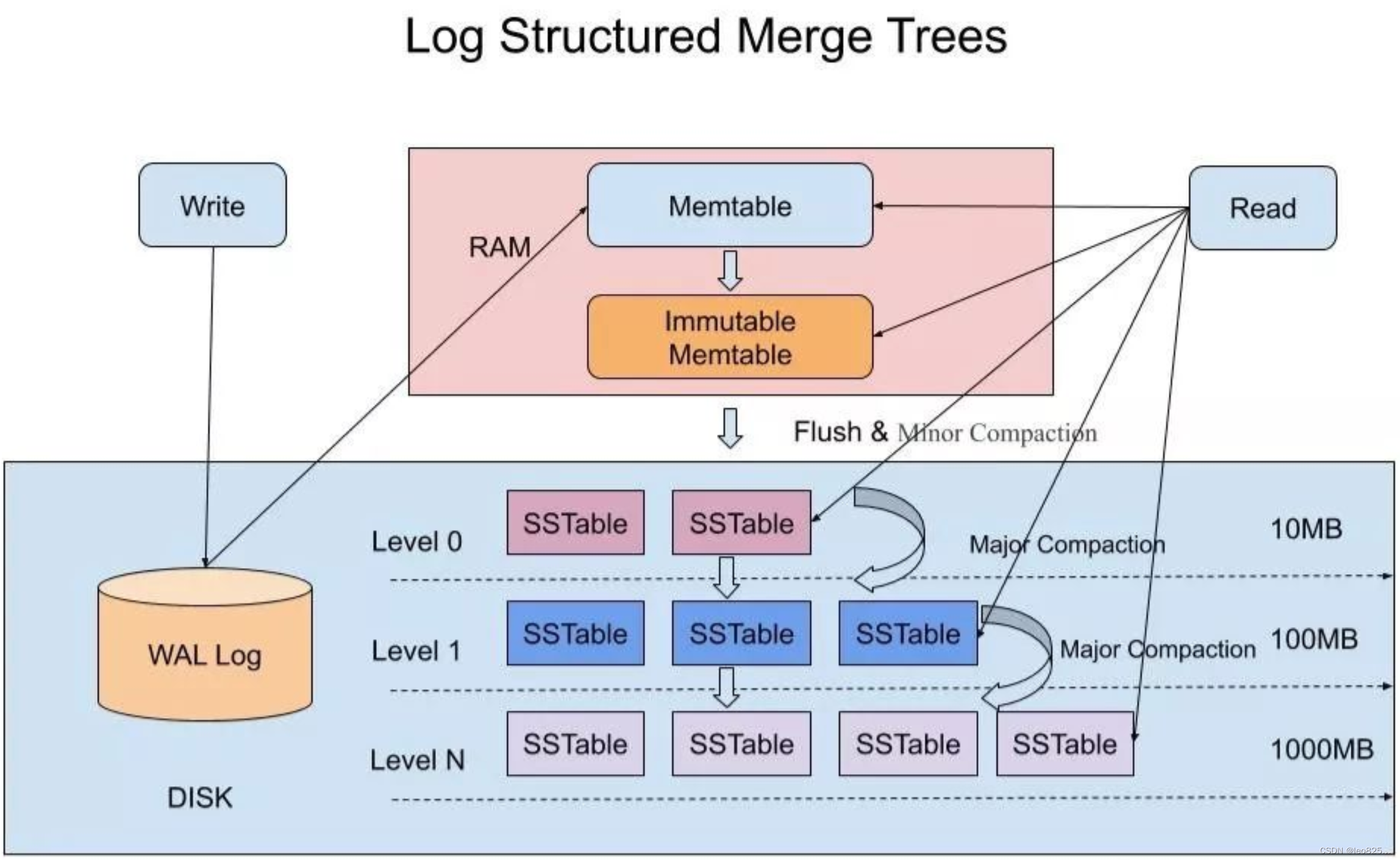
As you can see, the architecture has two main arenas: RAM and Disk. Data flows from RAM to disk as it ages. Let's break down each component.
3. In-Memory Component: The Memtable
All incoming write requests (inserts, updates, and even deletes) are first sent to an in-memory data structure called the Memtable.
Because the Memtable lives entirely in RAM, writing to it is extremely fast—it's just a memory operation. This is the key to the high write throughput of LSM-Trees.
Building an LSM-Tree from Scratch
This technical blog post, 'Building an LSM-Tree from Scratch,' provides a clear, practical explanation of the Memtable's role.
Please read the section titled 'Let’s begin with understanding Memtable' down to 'A brief into Skip List and WAL...'. Focus on what the Memtable does and why a sorted structure like a Skip List is a good choice for implementing it.
As the article explains, the Memtable isn't just a simple buffer. It's typically a sorted data structure (like a Skip List or a Red-Black Tree). Keeping the data sorted in memory is crucial for the next step of the process.
Durability and the Write-Ahead Log (WAL)
Since the Memtable is in volatile RAM, what happens if the system crashes? All the recent writes would be lost. To prevent this, LSM-Trees use a Write-Ahead Log (WAL).
Before a write operation is added to the Memtable, it is first appended to a log file on disk. This disk write is sequential and therefore very fast. If the system crashes, it can restore the contents of the Memtable by replaying the operations from the WAL.
The blog post you just looked at has another excellent section explaining this.
Building an LSM-Tree from Scratch
Let's continue with the same blog post to understand the critical role of the Write-Ahead Log.
Read the section titled 'Write-Ahead Log (WAL)' and the following section, 'What Happens During a Crash and Recovery?'. This explains how the WAL provides durability for the in-memory Memtable.
4. On-Disk Components: SSTables and Levels
The Memtable has a fixed size. Once it becomes full, the database needs to make room for new incoming writes. To do this, the current Memtable is "frozen" (made immutable), a new empty Memtable is created to accept new writes, and the contents of the full, immutable Memtable are flushed to disk.
The on-disk file created from this flush is called an SSTable (Sorted String Table). Because the data in the Memtable was already sorted by key, creating the SSTable is a highly efficient, single-pass sequential write to disk. These SSTables are immutable—once written, they are never modified.
The following video from CMU's Intro to Database Systems course explains this process visually.
#04 - Database Storage: Log-Structured Merge Trees & Tuples (CMU Intro to Database Systems)
Professor Andy Pavlo explains the core data structures of an LSM-Tree and how data moves from the in-memory Memtable to on-disk SSTables.
Watch the segment from 25:49 to 31:28. Pay close attention to how writes are buffered in the Memtable and then converted into a sorted SSTable on disk. The video also introduces the concept of multiple on-disk levels.
As the video illustrates, over time, the system will accumulate many SSTables on disk. If a read request comes in, the database would have to check the Memtable, and then potentially every single SSTable on disk to find the latest version of a key. This would be very slow.
To manage this, SSTables are organized into levels.
- Newly flushed SSTables from the Memtable are typically placed in
Level 0. - As a level fills up with too many SSTables, a background process called compaction kicks in.
- Compaction merges several SSTables from one level (e.g.,
Level i) into a new, larger SSTable in the next level (e.g.,Level i+1). This process also purges old or deleted data.
This hierarchical, leveled structure is the "Merge-Tree" part of the name. Each level is typically exponentially larger than the one before it. For example, Level 1 might be 10MB, Level 2 100MB, Level 3 1GB, and so on.
Let's watch another segment from the same video that focuses on the compaction process.
#04 - Database Storage: Log-Structured Merge Trees & Tuples (CMU Intro to Database Systems)
This segment explains the compaction process, which is fundamental to how an LSM-Tree organizes its on-disk levels.
Watch from 41:13 to 44:00. This part shows how a sort-merge algorithm is used to combine multiple SSTables, creating a new, compacted SSTable in a lower level.
Test your understanding!
Imagine you have an LSM-Tree. You issue the following three commands in order:
PUT(key="A", value="1")PUT(key="B", value="2")PUT(key="A", value="3")
Assume the Memtable is now full and gets flushed to an SSTable in Level 0. What will the contents of that SSTable look like? Remember that SSTables are sorted and compaction hasn't happened yet.
Show answer
The SSTable will contain the latest value for each unique key that was in the Memtable, sorted by key. So, the contents would be:
("A", "3")("B", "2")
The write PUT(key="A", value="1") is overwritten in the Memtable by the later write PUT(key="A", value="3") before the flush happens. The final SSTable only stores the most recent state from that batch of writes.
5. Summary of Operating Principles and Trade-offs
We can summarize the architecture of an LSM-Tree through a few key operating principles, as laid out in the research paper "Dissecting, Designing, and Optimizing LSM-based Data Stores":
- Batched Ingestion: Writes are buffered in the in-memory Memtable.
- Out-of-Place Updates: Updates and deletes are handled as new entries, not by modifying existing data on disk. A delete is often recorded as a special entry called a "tombstone."
- Immutable File Structure: SSTables on disk are never changed once written.
- Periodic Compaction: A background process merges SSTables across levels to bound read costs and reclaim space.
This design presents a fundamental trade-off.
- Writes are very fast (sequential I/O).
- Reads can be slower because the system might have to check the Memtable and multiple SSTables across several levels to find the latest version of a key.
A major engineering consideration is write amplification: a single logical update from the client can result in the same data being physically written to disk multiple times as it gets compacted down through the levels. This has cost implications for cloud storage and impacts the lifespan of SSDs.
Conclusion
In this lesson, we've dissected the fundamental architecture of the Log-Structured Merge-Tree. You now understand how it achieves high write throughput by transforming random writes into sequential ones.
Key Takeaways:
- LSM-Trees are optimized for write-heavy workloads by avoiding in-place updates.
- Writes are buffered in an in-memory sorted structure called the Memtable and made durable via a Write-Ahead Log (WAL).
- When the Memtable is full, it's flushed to disk as an immutable, sorted file called an SSTable.
- SSTables are organized into multiple on-disk levels, with each level being progressively larger.
- A background compaction process merges SSTables from upper levels into lower levels to control the number of files and clean up old data, which is crucial for maintaining read performance.
Preview of the Next Lesson
Now that you understand the high-level architecture, we will zoom in on the operational details. In the next lesson, we will focus on how to implement insertions and deletions (using tombstones) within this structure, laying the groundwork for understanding how queries are actually executed.