Welcome to our fifth lesson in the "Efficient Attention" module.
In our last session, we explored the core mechanics of Multi-head Latent Attention (MLA), focusing on its down-projection and on-the-fly up-projection steps. We saw how compressing the K/V heads into a shared latent space dramatically reduces the KV cache's memory footprint.
However, our previous explanation intentionally omitted a crucial detail: positional information. Models need to know not just what tokens are in a sequence, but also where they are. As we learned in a prior module, Rotary Positional Embeddings (RoPE) are the modern standard for this.
Today, we'll address a critical challenge: standard RoPE is incompatible with MLA's elegant compression. Our learning goal is to explain the decoupled RoPE strategy in MLA that separates content and positional components, a clever solution that allows MLA to have the best of both worlds.
1. The RoPE Paradox: When Efficiency and Position Collide
From our lesson on modern transformer components, we know that RoPE works by applying a position-dependent rotation to the Query and Key vectors. This is highly effective. However, it creates a major problem for the MLA architecture we just learned.
The efficiency of MLA relies on a mathematical "absorption trick," where the up-projection matrices for the query () and key () can be pre-combined. This allows the query to interact directly with the compressed latent cache, avoiding the need to reconstruct the full key vectors.
When we introduce standard RoPE, a position-dependent rotation matrix gets inserted between these two weight matrices, breaking the associative property that makes the absorption trick possible.
To see a detailed walkthrough of this conflict, please watch the following video segment.
How DeepSeek exactly implemented Latent Attention | MLA + RoPE
This video from Vizuara explains precisely why the position-dependent nature of RoPE prevents the weight absorption that makes latent attention efficient, creating a paradox.
Watch the segment from 07:34 to 15:02. Focus on understanding how the RoPE function, being position-dependent, gets 'stuck in the middle' and forces the recomputation of keys, thereby negating MLA's main benefit.
As the video explains, applying RoPE in the standard way forces us to reconstruct the full key vectors at every step, completely defeating the purpose of the latent cache. We've solved the memory problem only to find our solution is incompatible with knowing word order.
2. The Solution: Decoupling Content and Position
The root of the paradox is that a single Key/Query vector is trying to do two jobs: encode semantic content ("what") and encode position ("where"). The DeepSeek team's brilliant solution was to stop trying to do two jobs with one tool.
This is the "decoupled RoPE" strategy. Instead of one tangled vector, the model creates two separate, specialized vectors for both the Query and the Key:
- A Content Vector (): This vector is responsible only for the semantic meaning of the token. It is generated using the efficient latent compression we learned about last time. No RoPE is applied here.
- A Positional Vector (): This is a new, smaller vector whose only job is to handle positional information. RoPE is applied exclusively to this vector.
The final Query and Key are then formed by simply concatenating (stitching together) these two separate parts.
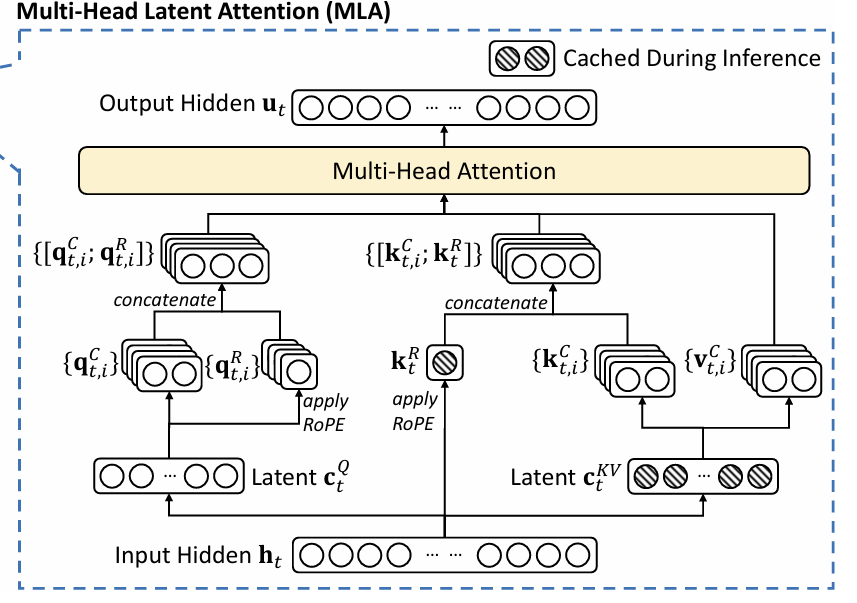
By separating these concerns, the "tangled knot" is undone. The efficient weight absorption trick can proceed on the content path, while RoPE is applied independently to the positional path.
3. Deep Dive: The Mechanics of Decoupled RoPE
Now let's trace the data flow through this complete architecture. The following video provides an excellent, detailed whiteboard explanation of how the content and positional vectors are generated and combined. We will break it into a few segments.
Step 1: The Content Path (No RoPE)
First, let's see how the content vectors () are generated. This path is essentially what we learned in the previous lesson, with a small refinement to the query generation.
How DeepSeek exactly implemented Latent Attention | MLA + RoPE
This segment revisits the latent attention mechanism, now framed as the 'no RoPE' or 'content' path. It details the generation of the content-only vectors KC, VC, and QC.
Watch from 20:20 to 26:57. Focus on how the input is processed to create the latent CKV vector (which is cached) and then used to generate KC and VC. Also, note the down- and up-projection used to generate QC.
Step 2: The Positional Path (With RoPE)
While the content path is creating the "what," a parallel path creates the "where." This is where RoPE is applied.
How DeepSeek exactly implemented Latent Attention | MLA + RoPE
Now, let's examine the new, parallel path that handles positional information. This segment explains how the dedicated positional vectors, KR and QR, are constructed and rotated.
Watch from 26:57 to 34:31. Pay close attention to two key details: How the positional key, KR, is derived and why it uses shared weights across heads. How the positional query, QR, is derived from the down-projected CQ and uses separate weights for each head.
At the end of these two steps, we have successfully created our separated components:
- Content vectors:
- Positional vectors:
Step 3: Assembly and Inference
The final steps are to assemble these components, calculate attention, and see how the caching works during inference.
How DeepSeek exactly implemented Latent Attention | MLA + RoPE
This final segment shows how everything comes together. It explains how the content and positional vectors are concatenated and how the cache is used during inference when a new token arrives.
Watch from 34:31 to 55:35. This is the longest and most detailed part. Focus on: How QC and QR are concatenated into the final Query, and KC and KR into the final Key. The two components that are cached during inference: the latent CKV matrix and the KR matrix. The step-by-step walkthrough of what happens when a new token ('bright') arrives.
This walkthrough shows the complete, end-to-end mechanism. By caching only the small latent content vector CKV and the small positional key vector KR, the system maintains massive memory efficiency while still performing the full attention calculation with positional awareness.
Conclusion
Today, we confronted the "RoPE Paradox" and dissected DeepSeek's ingenious solution.
Key Takeaways:
- The Paradox: Standard RoPE applies a position-dependent rotation that breaks the "weight absorption" trick, making it incompatible with the efficiency gains of latent compression.
- The Solution: The decoupled RoPE strategy separates a token's representation into two parts:
- A content vector, which is handled by the efficient latent compression pipeline and is never touched by RoPE.
- A positional vector, a new, smaller vector whose sole purpose is to be rotated by RoPE.
- The Mechanism: The final Query and Key are formed by concatenating their respective content and positional parts. During inference, only two small matrices are cached: the latent content representation () and the positional key representation ().
- The Payoff: This allows MLA to achieve the best of both worlds: the dramatic memory reduction of a compressed cache and the powerful positional awareness of RoPE, leading to an architecture that is both more efficient and more performant than standard Multi-Head Attention.
Preview of the Next Lesson:
We have now examined the mechanisms of Multi-Head Attention (MHA), Grouped Query Attention (GQA), and the complete Multi-head Latent Attention (MLA) with decoupled RoPE. In our final lesson of this module, we will compare these three architectures directly, evaluating their trade-offs in memory, compute, and model quality to synthesize everything we've learned about efficient attention.