In the previous lesson, we implemented a coarse-grained pthread_rwlock_t to protect our HNSW graph, allowing multiple readers to search concurrently while ensuring writers have exclusive access. While this is a huge improvement over a simple mutex, in the world of high-frequency trading and other latency-sensitive systems, even the overhead of a read-write lock can be too much. Any lock, no matter how clever, introduces the risk of blocking, scheduler intervention, and unpredictable latency "fat tails" — where 99% of operations are fast, but a few are orders of magnitude slower, which is unacceptable when millions are on the line.
This lesson takes the next step into modern high-performance concurrency. We will move beyond locks to explore lock-free programming using C11 atomic operations. You will learn how the hardware itself can guarantee the integrity of certain operations, allowing us to build data structures that are immune to many of the pitfalls of traditional locking. Our goal is to refactor parts of our HNSW graph to use these atomic primitives, reducing lock contention and paving the way for even greater concurrency.
The Problem with Locks and the Promise of Atomics
A lock, fundamentally, protects a critical section of code. An atomic operation, in contrast, protects a single piece of data. It guarantees that a modification to a variable (like an integer or a pointer) is indivisible. While one thread is performing an atomic read-modify-write operation, no other thread can see the data in a half-modified state.
To see why this matters, consider a classic race condition when inserting a node into a linked list, a structure analogous to our graph connections.
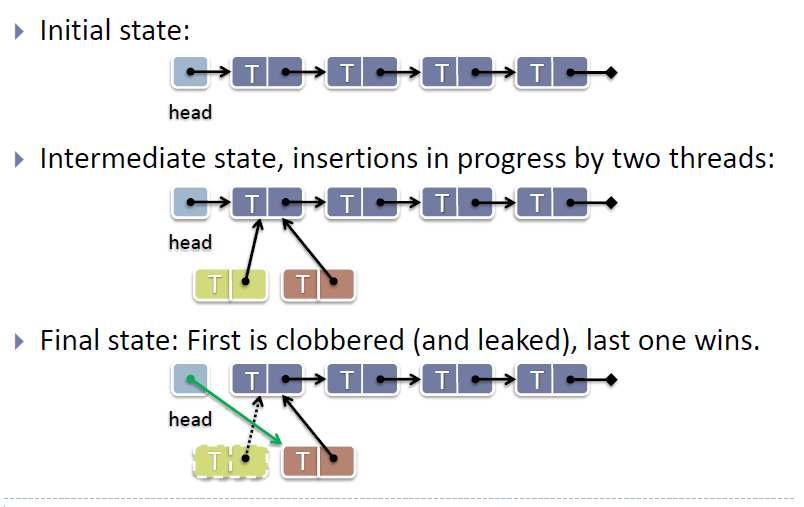
Atomic operations provide a way to perform these updates safely without a lock.
User API & C++ Implementation of a Multi Producer, Multi Consumer, Lock Free, Atomic Queue - CppCon
To understand the motivation from a high-performance domain, watch the beginning of this CppCon talk on designing a lock-free queue for high-frequency trading.
Focus on the section from the introduction to fat tails. The speaker explains why average-case performance is insufficient and why controlling worst-case latency by avoiding system calls and blocking is critical. This is the core reason we are now moving towards atomics.
Introducing C11 Atomics
The C11 standard introduced the <stdatomic.h> header, which provides a portable way to access these powerful hardware features. Let's explore the fundamentals with a clear, practical guide.
"Beej's Guide" offers an excellent and very readable introduction to C11 atomics.
Please read the following sections: Atomic Variables: This introduces the _Atomic keyword (and aliases like atomic_int) and the "all-or-nothing" property of atomic writes. Synchronization: This is a crucial section. It explains that atomics aren't just about indivisible writes; they are also about ensuring that memory changes made in one thread become visible to other threads in a predictable order. Atomic Type Specifier, Qualifier: This section provides a quick reference for the available atomic types and how to define your own.
As you've just read, an atomic variable guarantees two things:
- Atomicity: Read and write operations are indivisible. For a simple
_Atomic int x;, another thread will see the value ofxeither before or after a write, never a partially-written value. - Synchronization: An atomic write in one thread synchronizes with a subsequent atomic read of the same variable in another thread. This forces memory visibility. All memory writes (even to non-atomic variables) that happened before the atomic write in thread 1 become visible to thread 2 after its atomic read.
Key Atomic Operations
While simple assignment (x = 5;) to an atomic variable is atomic, compound operations like x = x + 1; are not, as they involve a separate read and a write. <stdatomic.h> provides atomic versions of these common patterns.
[PDF] Synchronization and memory consistency review
This slide deck from Stanford provides a more formal overview of the C11 atomic API.
Please read the section C11 Atomics: Basics. This covers the syntax for declaration, initialization, and lists the key functions.
The most important operations you'll use are:
- Atomic Read-Modify-Write Operators: For built-in types, operators like
+=,-=,++,--,|=,&=are overloaded to be atomic. So,atomic_counter++is a safe, single atomic operation. atomic_fetch_add(obj, arg): Atomically addsargto*objand returns the value*objheld before the addition. There are also_sub,_or,_and, etc.atomic_load(obj): Atomically reads and returns the value of*obj.atomic_store(obj, desired): Atomically writesdesiredinto*obj.atomic_compare_exchange_strong(obj, expected, desired): This is the workhorse of most lock-free algorithms. It works like this, as a single, indivisible hardware operation:- Atomically, it reads the current value at
*obj. - It compares this value to what's in
*expected. - If they are equal, it means the value hasn't changed since we last looked. It then atomically writes
desiredinto*objand returnstrue. - If they are not equal, it means another thread modified
*obj. The write does not happen. Instead, the current value of*objis written into*expected, and the function returnsfalse. This conveniently gives you the new value so you can retry your operation.
- Atomically, it reads the current value at
This "compare-and-swap" (CAS) pattern is fundamental. A typical usage is a loop:
// Attempt to atomically change 'ptr' from 'old_val' to 'new_val'
_Atomic some_ptr_t ptr;
some_ptr_t old_val = atomic_load(&ptr);
some_ptr_t new_val = /* calculate new value */;

// Keep trying until the CAS succeeds.
// If another thread changes ptr, the CAS will fail,
// old_val will be updated with the new current value, and we loop.
while (!atomic_compare_exchange_strong(&ptr, &old_val, new_val)) {
    // The value changed. Recalculate new_val based on the updated old_val.
    new_val = /* recalculate based on new old_val */;
}
A Quick Word on Memory Ordering
As Beej's Guide noted, atomic operations also define memory ordering. By default, C11 atomics provide sequential consistency (memory_order_seq_cst). This is the most intuitive model: it guarantees that all threads agree on a single global timeline of operations. For performance-critical code, you can use "weaker" memory orders like memory_order_acquire and memory_order_release (or even memory_order_relaxed) to give the compiler and CPU more freedom to reorder instructions.
This is an advanced topic, but the core idea is:
- An acquire operation (like a load) prevents subsequent memory operations from being moved before it.
- A release operation (like a store) prevents preceding memory operations from being moved after it.
For now, we will stick with the default sequential consistency, which is always safe.
Applying Atomics to the HNSW Graph
Now, let's refactor our hnsw_index_t structure. Previously, any change to graph metadata required a full write lock. Let's identify candidates for atomic variables.
// Original structure
typedef struct {
    // ...
    pthread_rwlock_t lock;

    hnsw_node_id_t entry_point;
    int max_layer;
    size_t count; // Total number of vectors

    memory_arena_t node_pool;
} hnsw_index_t;

// Refactored structure


#include <stdatomic.h>

typedef struct {
    // ...
    pthread_rwlock_t lock; // Still needed for complex structural changes

    _Atomic hnsw_node_id_t entry_point;
    _Atomic int max_layer;
    _Atomic size_t count; // Total number of vectors

    memory_arena_t node_pool;
} hnsw_index_t;
By making entry_point, max_layer, and count atomic, we can now update them without acquiring the main rwlock.
Updating the element count:
- Before:
pthread_rwlock_wrlock(&graph->lock); graph->count++; pthread_rwlock_unlock(&graph->lock); - After:
// This is an atomic read-modify-write operation.
// memory_order_relaxed is often sufficient for a simple counter
// if no other memory operations depend on its ordering.
// However, the default sequential consistency is always safe to start with.
atomic_fetch_add(&graph->count, 1);
Updating the entry point:
The entry point only changes if a new node is inserted at a layer higher than any existing node. This is a more complex operation, but the final pointer swap can be made atomic.
- Before:
pthread_rwlock_wrlock(&graph->lock); // ... logic to determine if new_node is the new entry point ... if (is_new_entry_point) { graph->entry_point = new_node_id; graph->max_layer = new_node_layer; } pthread_rwlock_unlock(&graph->lock); - After: The complex logic of finding neighbors for the new node might still need a lock, but the final update to the shared
entry_pointandmax_layercan be atomic stores. This separates the concerns.
Readers would then use// A release operation ensures all writes that constructed the new node // are visible before the entry_point is updated. atomic_store_explicit(&graph->max_layer, new_node_layer, memory_order_release); atomic_store_explicit(&graph->entry_point, new_node_id, memory_order_release);atomic_load_explicit(&graph->entry_point, memory_order_acquire)to ensure they see a consistent state.
The ABA Problem: A Lock-Free "Gotcha"
Lock-free programming is powerful, but full of subtleties. One of the most famous is the ABA problem. Imagine a CAS loop trying to pop from a stack.
- Thread 1 reads the head of the stack, pointer
A. - Thread 1 is preempted.
- Thread 2 pops
A, then popsB, then pushesAback on top. The stack's head isAagain, but the underlying state (Bis gone) is different. - Thread 1 resumes. Its CAS operation checks if the head is still
A. It is! The CAS succeeds, but it operates on a stack that has changed in a way it didn't detect.
This is a deep topic, but understanding its existence is key to appreciating the complexities of this domain.
Building a Lock-free Multi-producer, Multi-consumer Queue for Tcmalloc - Matt Kulukundis - CppCon 21
This segment from a CppCon talk gives one of the best explanations of the ABA problem you will ever see. It's challenging but incredibly insightful.
Watch the section from the speaker's explanation of the ABA bug. He uses a brilliant analogy involving a glass of water being replaced by vodka. The solution presented—using the full range of an integer counter to make loops highly improbable—is a classic technique.
For our current refactoring of simple counters and pointers, the ABA problem is not an immediate concern. However, as you build more complex lock-free data structures, it's a critical hazard to be aware of.
Conclusion
In this lesson, we have opened the door to lock-free programming, a cornerstone of high-performance systems. You've moved from the coarse-grained protection of a read-write lock to the fine-grained, hardware-level guarantees of C11 atomics.
Key Takeaways:
- Atomic operations are indivisible (all-or-nothing) and provide memory synchronization guarantees between threads.
- They allow you to avoid locks for simple data updates, reducing overhead and eliminating certain blocking scenarios.
- The C11
<stdatomic.h>header provides types like_Atomic intand functions likeatomic_fetch_addandatomic_compare_exchange_strong(CAS). - CAS is the fundamental primitive for building complex lock-free algorithms, allowing you to atomically "swap if equal" in a retry loop.
- We've identified and refactored simple counters and pointers (
count,entry_point,max_layer) in our HNSW graph to use atomic types, reducing the scope of our coarse-grained write lock.
We still have our pthread_rwlock_t for protecting more complex structural modifications, like adding and pruning connections, which involve multiple, non-atomic memory locations. Our system now uses a hybrid approach: lock-free operations for simple state and locks for complex critical sections. This mix of synchronization primitives can, however, introduce new challenges. In our next lesson, we will analyze the most dangerous of these: deadlocks. You'll learn how they arise and how to design your locking strategies to prevent them.