Welcome back to our project. In the last lesson, you created a safe_aligned_alloc helper function, mastering the use of posix_memalign to request memory that starts precisely on a 64-byte cache line boundary. This is a crucial first step in preventing the CPU from performing expensive "split" loads that cross cache line boundaries.
Today, your learning outcome is to refactor the vector storage to use aligned memory to optimize sequential scan performance. We will go beyond simply aligning the start of our data block. You will learn that to truly prepare our data for high-performance computing, especially for the SIMD optimizations we'll tackle soon, every single vector in our database must be properly aligned. This involves a more thoughtful data layout strategy using padding.
The Problem with Tightly Packed Data
In our current k-NN implementation, you are likely allocating one large block of memory for all your vectors, something like this:
float* vectors = malloc(num_vectors * dimensions * sizeof(float));
While simple, this has two potential performance issues that we must address:
- The block returned by
mallocis not guaranteed to start on a 64-byte cache line boundary. - Even if it were, the starting address of each subsequent vector (
vectors[1],vectors[2], etc.) is almost certainly not aligned to a 64-byte boundary unless the number of dimensions happens to result in a byte size that is a perfect multiple of 64.
The first problem is what we solved with posix_memalign in the last lesson. The second problem is more subtle but equally important. When we introduce SIMD (Single Instruction, Multiple Data) operations, the CPU will load data into wide 256-bit or 512-bit registers. These operations are fastest when the memory address they load from is aligned to the register size (e.g., 32 or 64 bytes). An unaligned access can force a slower code path or, worse, require loading two cache lines to fill one register.

The goal is to move from a simple, tightly packed array to a layout where each vector resides in its own aligned memory segment.
Structuring Data for Performance
The key to solving this is to treat each vector as a record and ensure each record starts on an aligned boundary. We achieve this by calculating a stride: the total number of bytes for each vector, including any padding needed to reach the next alignment boundary.
The principle is clearly stated in the following resource.
Make your programs run faster by better using the data cache
This article from Johnny's Software Lab outlines two simple rules for optimizing access to arrays of structures.
In the section "Tip: Optimize access to array of classes or structs", focus on the two bullet points that form the rules for minimizing cache line splits. They are: Size of class and Starting address of the array. This is precisely what we aim to implement.
Let's apply these rules.
- Starting Address: We'll use our
safe_aligned_allocfunction to ensure the entire block of memory starts on a 64-byte boundary. - Size of "Class": We will calculate a padded size, or stride, for each vector so that its total size is a multiple of 64 bytes. This guarantees that
vector[i]andvector[i+1]do not share a cache line in a way that could cause a split access, and ensuresvector[i+1]also starts on an aligned boundary relative to the start of the whole block.
For example, if our vectors have 100 dimensions (400 bytes) and we want 64-byte alignment, the stride for each vector would be 448 bytes (the next multiple of 64). The last 48 bytes would be unused padding.
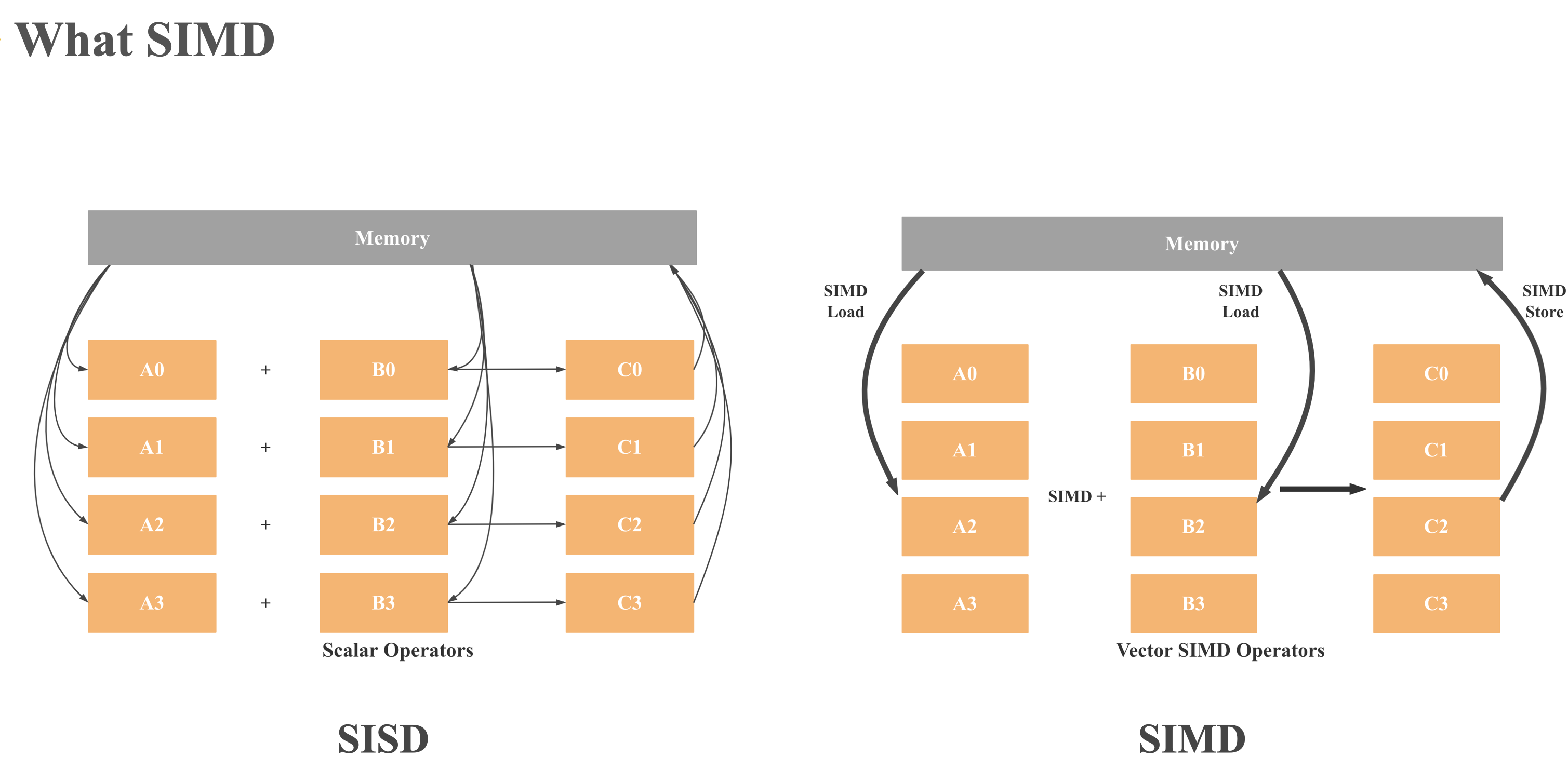
The following video explains the importance of alignment specifically in the context of the AVX intrinsics we will be using later.
SIMD and vectorization using AVX intrinsic functions (Tutorial)
This tutorial on SIMD by Joel Carpenter provides excellent context for why we are so concerned with memory alignment.
Please watch the segment on memory alignment requirements. The key takeaway is that while modern CPUs have reduced the penalties for unaligned access, aligning data to a cache line boundary (64 bytes) is still best practice to guarantee a vector block doesn't spread across two cache lines. Also watch the brief explanation of aligned allocation, which reinforces what you learned in the previous lesson.
Your Task: Refactor the Vector Storage
It's time to modify your project. You will replace your simple malloc with a more sophisticated allocation strategy that incorporates padding to ensure each vector is aligned.
Here are the steps to follow, along with code snippets to guide you. Assume you have your safe_aligned_alloc function from the previous lesson available.
-
Define Alignment and Calculate Stride:
In your data storage file (e.g.,database.c), define the alignment you want. 64 bytes is an excellent choice as it matches the cache line size on most modern CPUs. Then, calculate the stride.#define VECTOR_ALIGNMENT 64 // Inside your function that allocates memory for vectors... // Let's say you have 'db_header->num_vectors' and 'db_header->dimensions' // The actual size of one vector's data size_t vector_data_size = db_header->dimensions * sizeof(float); // Calculate the padded size (stride). This rounds up vector_data_size to the nearest multiple of VECTOR_ALIGNMENT. size_t vector_stride_bytes = (vector_data_size + VECTOR_ALIGNMENT - 1) / VECTOR_ALIGNMENT * VECTOR_ALIGNMENT; // We can also store the stride in floats for easier indexing later size_t vector_stride_floats = vector_stride_bytes / sizeof(float); // Store this stride in your database header/struct for later use. db->vector_stride = vector_stride_floats; // Or in bytes, be consistent! -
Allocate Aligned and Padded Memory:
Calculate the total size needed based on the stride and allocate the memory using your aligned allocator.// Total size is based on the stride, not the raw data size size_t total_alloc_size = db_header->num_vectors * vector_stride_bytes; // Allocate the main block, aligned to 64 bytes db->vectors = safe_aligned_alloc(VECTOR_ALIGNMENT, total_alloc_size); if (db->vectors == NULL) { // Handle allocation failure return -1; } -
Create an Accessor Function:
Since the vectors are no longer tightly packed, you can no longer use simple pointer arithmetic likedb->vectors + i * dimensions. You must use the stride. It's best practice to create a helper function for this./** * @brief Gets a pointer to the beginning of a specific vector in the database. * * @param db The database instance. * @param index The index of the vector to retrieve. * @return A pointer to the first float of the requested vector. */ static inline float* get_vector(const Database* db, size_t index) { // Here we assume db->vector_stride is in units of floats return db->vectors + index * db->vector_stride; } -
Update Your Code:
Go through your k-NN search function and any other code that accesses vectors. Replace all direct calculations of a vector's address with a call to your newget_vector()helper function.For example, a loop in your brute-force search might change from this:
// Before
for (size_t i = 0; i < db->header.num_vectors; ++i) {
    float* db_vector = db->vectors + i * db->header.dimensions;
    // ... calculate distance ...
}
To this:
// After
for (size_t i = 0; i < db->header.num_vectors; ++i) {
    float* db_vector = get_vector(db, i);
    // ... calculate distance ...
}
This refactoring is a significant step towards a truly high-performance system. You are now explicitly controlling data layout in a way that "respects the silicon," paving the way for massive speedups with SIMD.
Conclusion
In this lesson, you have taken a critical step from academic understanding of memory alignment to practical, low-level implementation. By refactoring your vector storage, you have done more than just fix a potential performance issue; you have fundamentally changed your data layout to prepare for advanced instruction-level parallelism.
Key Takeaways:
- Optimal memory access requires not only that the start of a data block is aligned, but also that individual elements within it are aligned, especially when preparing for SIMD.
- We can enforce alignment for each vector by calculating a stride—the size of the vector's data padded out to the next multiple of our desired alignment (e.g., 64 bytes).
- Accessing data in a strided array requires a helper function that uses the stride for pointer arithmetic, abstracting the memory layout from the logic that uses it.
In the next lesson, we will shift focus slightly to improve the efficiency of the search algorithm itself. You will use a bounded max-heap data structure to efficiently track the top 'k' candidates during a search. This will reduce the computational overhead of sorting candidates at the end of the search, which becomes increasingly important as we start to process candidates faster and faster.