Introduction
Welcome to your first lesson in Geomorphology. Given your goal of preparing for the SSC CGL exam, this course is designed to be a concise and high-yield overview of the essential topics. We'll begin our journey by exploring the very foundation of our planet. This lesson addresses the first learning outcome: describing the key characteristics of the Earth's crust, mantle, and core. Understanding this layered structure is a fundamental concept in geography and a frequent source of questions in general awareness sections of exams like the SSC CGL. We will identify each layer, examine its composition and physical state, and learn the specific terminology used to describe them.
Getting Started: A Visual Overview
To begin, let's get a quick visual introduction to the Earth's layers. The following short video provides a simple and clear overview of the four main layers we will be discussing: the crust, mantle, outer core, and inner core.
The Structure of the Earth in 5 minutes! *SIMPLE & EASY*
This video from Mel Teaches, titled "The Structure of the Earth in 5 minutes!", offers a rapid yet comprehensive tour from the surface to the center of the Earth.
Watch the entire video. As you watch, pay attention to the key characteristic mentioned for each layer: The Crust: Note the comparison to an apple's skin and the differences between continental and oceanic crust. The Mantle: Observe its state (semi-solid) and its massive thickness. The Outer Core: Focus on its liquid state and its role in generating Earth's magnetic field. The Inner Core: Understand why it is solid despite being incredibly hot.
The Earth's Layers in Detail
Now that you have a basic mental model, let's solidify that knowledge with more precise details that are crucial for your exam preparation. The image below provides a more detailed cross-section, including approximate thicknesses and the names of the boundaries between layers.
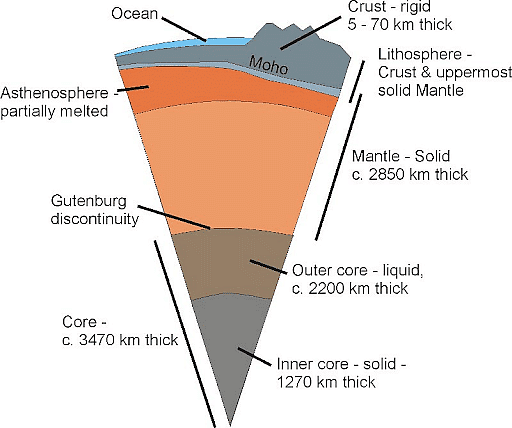
To learn the specific properties of these layers, we will use a resource tailored for competitive exams.
Internal Structure of the Earth, Composition, Properties & Facts
This article from SSCAdda provides the essential facts about each layer in a format perfect for exam revision. We will go through the sections on the crust, mantle, and core one by one.
First, read the section on The Crust. Focus on the key differences in thickness between oceanic and continental crust. Pay close attention to the compositional mnemonics: SIAL and SIMA. Next, move to the section on The Mantle. Note its immense share of the Earth's volume. A critical concept here is the Asthenosphere, the semi-viscous layer that is the source of magma. Also, identify the names of the two major boundaries, or "discontinuities," mentioned: the Mohorovich (Moho) Discontinuity between the crust and mantle, and the Gutenberg Discontinuity between the mantle and the core. Finally, read the sections on the Outer Core and Inner Core. The key compositional mnemonic for the core is nife. It's vital to remember that the outer core is liquid, and this movement is what generates the Earth's magnetic field. In contrast, the inner core is solid because the immense pressure prevents it from melting, despite the extreme heat.
Consolidating the Characteristics
You have a mathematical background, so organizing data systematically can be a very effective way to learn and retain information. The table in the following resource provides an excellent side-by-side comparison of the layers, which is perfect for quick revision.
Structure of Earth UPSC Notes: The Crust, Mantle, & Core - Testbook
This resource from Testbook presents the key features of the crust, mantle, and core in a clear, tabular format.
Locate the table under the heading "Comparison of Crust, Mantle and Core." Study the entire table, comparing the layers across features like thickness, composition, state, and density. This systematic comparison will help you easily recall the distinctions during an exam.
Exam-Focused Reinforcement
Let's conclude by focusing on a few common questions that directly test these concepts. The Q&A format is a great way to check your understanding of the most critical, high-yield facts.
Internal Structure of the Earth, Composition, Properties & Facts
We return to the SSCAdda article to review some frequently asked questions.
Read the answers to the first two questions in this section. The question on the Lithosphere clarifies an important term that combines the crust and the very top part of the mantle. The question on SIAL, SIMA, and NIFE provides a concise summary of the key compositional mnemonics you need to memorize.
Conclusion
In this lesson, we have constructed a complete picture of the Earth's internal structure, focusing on the details relevant for your SSC CGL preparation. We have moved from the surface inward, examining each layer's unique properties.
Here are the key takeaways:
- The Crust: The Earth's thinnest, outermost solid layer. It is divided into the thicker, less dense continental crust (SIAL: Silica + Aluminium) and the thinner, denser oceanic crust (SIMA: Silica + Magnesium).
- The Mantle: The thickest layer, making up about 83% of Earth's volume. It is mostly solid, but its upper portion contains the semi-liquid Asthenosphere, which is the source of magma.
- The Core: The innermost layer, composed mainly of Nickel and Iron (NIFE). It is divided into a liquid Outer Core, whose motion generates Earth's magnetic field, and a solid Inner Core, which remains solid due to extreme pressure.
- Key Boundaries: Remember the two main discontinuities: the Mohorovičić (Moho) Discontinuity (crust-mantle) and the Gutenberg Discontinuity (mantle-core).
You now have a solid foundation in the Earth's structure. In our next lesson, we will build directly upon this by examining the materials that make up the crust and mantle: rocks. We will learn to differentiate between igneous, sedimentary, and metamorphic rocks, which is another essential topic in physical geography.