Hello! Welcome back.
In the last few lessons, we've taken a deep dive into the "big three" of ideal gas power cycles: the Otto cycle (for gasoline engines), the Diesel cycle (for diesel engines), and the Brayton cycle (for jet engines and gas turbines). You've done a fantastic job understanding how each one works on its own.
Now it's time to do what engineers do best: compare them. It's rare that there's one "perfect" solution for everything. Usually, we have to make trade-offs based on our goals. Is maximum efficiency the only thing that matters? Or are there other constraints, like cost, size, or material strength?
Today, our goal is to solve comparative problems for different ideal gas power cycles. We'll put the Otto and Diesel cycles head-to-head under different conditions to see which one comes out on top. This will sharpen your engineering judgment and help you understand why different engines are used for different jobs.
Let's get ready to put these cycles to the test.
The Rules of Engagement: How to Compare Cycles Fairly
If we want to compare two engines, we need a fair basis for comparison. Just saying "which is more efficient?" isn't enough. We need to fix some parameters so that we're comparing apples to apples. In thermodynamics, there are two classic ways to do this:
- For the same compression ratio and heat input: Imagine we build an Otto and a Diesel engine that are physically similar—the piston sweeps the same volume, so they have the same compression ratio (). We also supply them with the same amount of fuel energy (). Which one will be more efficient?
- For the same maximum pressure and heat input: Now imagine we have a constraint on our materials. The engine block and cylinder head can only withstand a certain maximum pressure (). If we design both an Otto and a Diesel engine to operate right up to this pressure limit, and we give them both the same , which one will be more efficient?
These aren't just academic exercises. The compression ratio is a fundamental design choice, and the maximum pressure directly relates to the cost, weight, and safety of an engine.
Cage Match 1: Same Compression Ratio and Heat Input
Let's start with the first scenario. We have an Otto cycle and a Diesel cycle. Both have the same compression ratio, , and we're adding the same amount of heat, .
The Intuitive View: T-S Diagram
Remember our efficiency equation: .
Since we've declared that is the same for both cycles, the cycle that is more efficient will be the one that has the lowest heat rejection ().
Let's visualize this on a Temperature-Entropy (T-S) diagram. Remember that heat transfer is the area under the process curve on a T-S diagram.
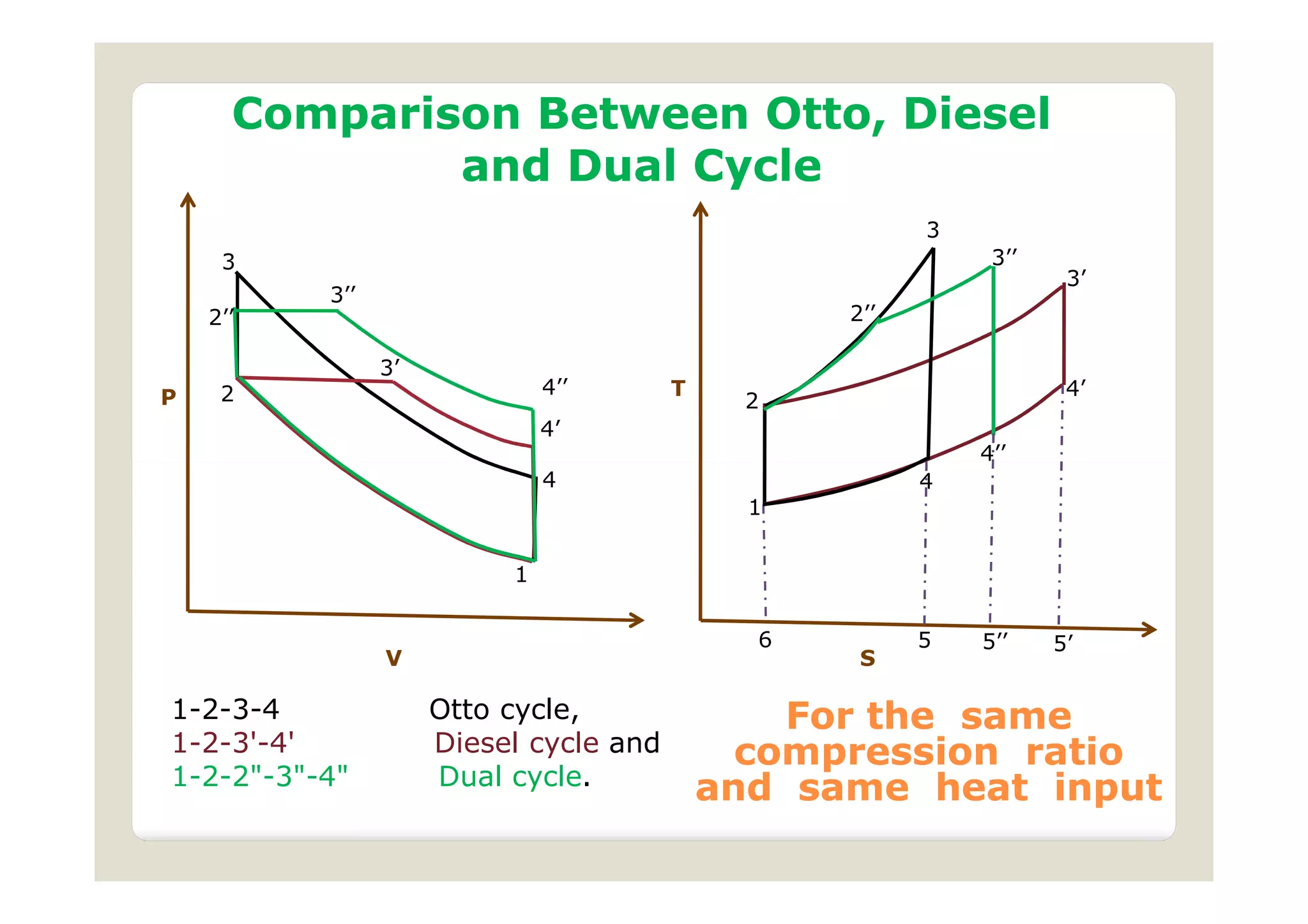
Let's break down the T-S diagram on the right:
- Process 1 → 2 (Isentropic Compression): Both cycles start at the same state (1) and are compressed to the same minimum volume. Since it's the same compression ratio, this process is identical for both. They both end up at state 2.
- Heat Addition:
- Otto (2 → 3): Heat is added instantly at constant volume. This is a steep curve going up and to the right on the T-S diagram.
- Diesel (2 → 3'): Heat is added at constant pressure. This is a less steep curve. Since (the area under the curve) must be the same for both, the Diesel process has to extend further to the right to a state we'll call 3'.
- Process 3 → 4 and 3' → 4' (Isentropic Expansion): Both cycles expand back to the initial volume.
- Heat Rejection (4 → 1 and 4' → 1): This is where we find our answer. is the area under the heat rejection curve.
- For the Otto cycle, is the area under the curve 4 → 1.
- For the Diesel cycle, is the area under the curve 4' → 1.
Look closely at the diagram. Because the Diesel cycle's heat addition goes to a higher entropy, its expansion ends at a higher temperature (state 4' is above state 4). This means the area under its heat rejection curve (4' → 1) is larger than the area under the Otto cycle's curve (4 → 1).
Since the Diesel cycle rejects more heat for the same heat input, it must be less efficient.
Conclusion: For a given compression ratio, the Otto cycle is always more efficient than the Diesel cycle.
To dig a bit deeper into this comparison, the following resource provides a concise explanation.
SMEA1405 – Applied Thermodynamics
These notes from a university course on Applied Thermodynamics directly address the comparison we're making. Focus on the section that explains the relative efficiencies when the compression ratio is the same.
Please read the section titled 'For the Same Compression Ratio and the Same Heat Input' (around page 12). Pay close attention to the P-V and T-s diagrams and the final conclusion about which cycle is more efficient.
The Real-World Wrinkle
This brings up a huge question: If the Otto cycle is more efficient, why do we even have Diesel engines?
The answer lies in a practical limitation of gasoline engines. Remember, the Otto cycle compresses an air-fuel mixture. If you compress it too much (i.e., use too high a compression ratio), the temperature will rise so much that the fuel will ignite on its own before the spark plug fires. This is called knocking or auto-ignition, and it's destructive to the engine. Because of this, gasoline engines have a limited compression ratio, typically around 8 to 12.
Diesel engines don't have this problem. They only compress air. Then, at the top of the stroke, fuel is injected into the super-hot, high-pressure air, and it ignites immediately. Since there's no fuel during compression, you can use much, much higher compression ratios—typically 14 to 24.
So, while a theoretical Otto cycle is more efficient than a Diesel cycle at , a real-world Diesel engine running at can be significantly more efficient than a real-world gasoline engine running at . It's a classic engineering trade-off!
Cage Match 2: Same Maximum Pressure and Heat Input
Let's change the rules. Now, our main constraint is the strength of our engine block. Let's say it can handle a maximum pressure of 7000 kPa, and no more. We design an Otto and a Diesel engine to both peak at this pressure, and we give them the same .
The Intuitive View: T-S Diagram Again
This scenario is a little different. Let's trace it on the diagrams from the resource LINK (Fig. 6).
- State 1 (Start): Both cycles start at the same point.
- Heat Addition & Peak Pressure:
- Otto: Pressure spikes during the constant-volume heat addition (2 → 3). To avoid exceeding , the compression ratio () for the Otto cycle must be relatively low.
- Diesel: The peak pressure is the pressure during the constant-pressure heat addition (2' → 3'). This means the Diesel cycle can afford a much higher compression ratio to reach the same peak pressure.
- Heat Rejection: Again, we look at which cycle rejects less heat. If you examine the T-S diagram for this case (like in Fig. 6 of the
SMEA1405notes), you will see that the Otto cycle now has to reject more heat. The Diesel cycle's expansion process goes to a lower temperature and entropy, resulting in a smaller area under its heat rejection curve.
Conclusion: For a given maximum pressure, the Diesel cycle is more efficient than the Otto cycle.
This makes sense in the real world. Diesel engines are built to be heavy and robust to handle very high pressures, and this is a key reason they can achieve high efficiencies, making them ideal for long-haul trucks and ships where fuel economy is paramount.
Test your understanding!
- An engineer is designing a high-performance racing engine where light weight and high RPM are critical. Which cycle, Otto or Diesel, is a better starting point and why?
- Another engineer is designing an engine for a massive cargo ship that will run for weeks at a time. The top priority is fuel efficiency to minimize costs. Which cycle is the better choice?
- Why can't we just build a gasoline engine with a 20:1 compression ratio to get the best of both worlds?
Show answer
- The Otto cycle. The need for light weight goes against the heavy construction required for the high pressures of a Diesel cycle. Otto engines can be built lighter and can generally operate at higher rotational speeds.
- The Diesel cycle. The high compression ratios and resulting high thermal efficiency are perfect for an application where fuel cost is the dominant factor and the engine's weight is not a major concern.
- Because of knocking. The air-fuel mixture in a gasoline engine would self-ignite long before the piston reached the top of its stroke at such a high compression ratio, leading to engine damage.
The Dual Cycle: A Realistic Compromise
Before we get to the problems, let's briefly mention the Dual Cycle. As its name suggests, it's a mix of the Otto and Diesel cycles. Heat is added in two stages: first at constant volume (like Otto), and then at constant pressure (like Diesel).
This is actually a more realistic model for modern, high-speed Diesel engines. The fuel injection isn't instantaneous, but it's not slow enough for the pressure to remain perfectly constant either. The result is a cycle that sits right between the two. Its P-V and T-S diagrams are sandwiched between the Otto and Diesel diagrams (as you saw in the LINK image), and its efficiency is also in between:
Let's Do the Math: Worked Problems
Time to apply these concepts with some numbers. For air, we'll use .
Worked Problem 1: Same Compression Ratio
An ideal Otto cycle and an ideal Diesel cycle operate with a compression ratio of 15. The Diesel cycle has a cutoff ratio () of 2. Compare their thermal efficiencies.
-
Goal: Calculate and and compare.
-
Given: , (for Diesel), .
-
Step 1: Calculate Otto Cycle Efficiency.
- Formula:
- Calculation:
- Answer:
-
Step 2: Calculate Diesel Cycle Efficiency.
- Formula:
- First, calculate the term in the brackets (the "penalty factor"):
- Now, plug it into the full formula. We already know is 0.3385.
- Answer:
-
Comparison: As predicted, with the same high compression ratio, the Otto cycle (66.2%) is more efficient than the Diesel cycle (60.4%).
Worked Problem 2: Same Maximum Pressure
An Otto cycle has a compression ratio of 9:1. Air is at 100 kPa and 300 K at the beginning of compression. Heat addition is 1800 kJ/kg.
A Diesel cycle operates with the same initial conditions (100 kPa, 300 K) and the same maximum pressure as the Otto cycle.
Find the thermal efficiency of both cycles. (Use kJ/kg·K and kJ/kg·K).
-
Goal: Find for the Otto cycle, then find using that and compare it to .
-
Part A: Otto Cycle Analysis
- Step 1: Find .
- Step 2: Find (peak temperature).
- Step 3: Find (which is ).
First find : .
For the constant volume process 2-3:
So, kPa. - Step 4: Find .
- Step 1: Find .
-
Part B: Diesel Cycle Analysis (with kPa)
- Step 1: Find the Diesel's compression ratio ().
The max pressure in the Diesel is .
Notice how much higher this compression ratio is! - Step 2: Find temperatures and .
For constant pressure heat addition:
- Step 3: Find the cutoff ratio ().
. For an ideal gas at constant pressure, .
- Step 4: Find .
- Step 1: Find the Diesel's compression ratio ().
-
Comparison:
- Otto Cycle Efficiency: 58.5%
- Diesel Cycle Efficiency: 64.1%
When constrained by the same maximum pressure, the Diesel cycle was able to use a much higher compression ratio (24.5 vs 9), which allowed it to be more efficient, just as our theory predicted.
Conclusion
What a great session! We've moved beyond analyzing single cycles and into the more practical engineering task of comparing them. This is where the rubber really meets the road in thermodynamics.
Key Takeaways:
- There is no single "best" cycle; the most suitable choice depends on the constraints and goals.
- For the same compression ratio, the Otto cycle is theoretically more efficient because its instant heat addition is thermodynamically superior to the slower constant-pressure heat addition of the Diesel cycle. ()
- For the same maximum pressure, the Diesel cycle is more efficient. It can leverage a much higher compression ratio to reach that peak pressure, and higher compression ratio is a key driver of efficiency. ()
- Real-world gasoline engines are limited by knocking, which restricts their compression ratio. Diesel engines, compressing only air, can use much higher compression ratios, often making them more efficient in practice.
You've now completed our module on Gas Power Cycles. You have a solid foundation in the three most important ideal cycles that power our world.
Preview of the Next Lesson
Next, we're going to make a significant shift. So far, our working fluid has always been a gas (air). But what about the massive power plants that generate most of the world's electricity? They use water, which boils into steam and then condenses back into water. This involves phase changes, which we haven't dealt with in our cycles yet.
In our next lesson, we will begin our study of vapor power cycles by analyzing the ideal Rankine cycle, the fundamental model for steam power plants. Get ready to enter the world of boilers, condensers, and steam turbines