Hello! Welcome back.
In our last walk-through, we dove into the world of open systems and uncovered a crucial piece of the puzzle: flow work. We learned that for fluid to move into or out of a device, work must be done to push it against the existing pressure. This "pushing work" is an energy cost, and its formula is simply .
So, when a packet of fluid is flowing, it's not just carrying its internal energy (); it's also carrying this "flow energy" () with it. Every analysis we do on an open system will involve these two terms together: the internal energy of the fluid itself, and the work associated with its motion.
Today, we're going to introduce a powerful concept that makes our lives as engineers much, much easier. We're going to bundle these two types of energy—internal energy and flow work—into a single, convenient property called enthalpy. Understanding enthalpy is key to simplifying the analysis of almost every open system you'll encounter, from jet engines to refrigerators.
The Total Energy of a Flowing Fluid
Let's imagine a small packet of water flowing down a pipe. What is the total energy this packet carries?
- Internal Energy (): This is the energy stored in the molecular bonds and motion within the packet itself. It's the energy it has just by existing at a certain temperature.
- Flow Work (): This is the energy that was required to push this packet of water into its current position in the flow, displacing the water in front of it. It's the energy it has by virtue of flowing under pressure.
So, the total energy of this flowing packet (for now, let's ignore its kinetic and potential energy) is the sum of these two:
This combination, , shows up so frequently in thermodynamics that we give it its own name: Enthalpy, symbolized by the letter .
That's it. Enthalpy is not some mysterious, abstract concept. It's simply a convenient package that contains both the internal energy of a substance and the flow work associated with it.
An Analogy: The Magician's Rabbit
To build a strong intuition for this, let's use a brilliant analogy. This comes from a discussion by physicist Daniel Schroeder that many students find very helpful.
The following discussion on the Physics Stack Exchange provides a fantastic analogy for understanding what enthalpy represents. It tackles the common confusion about enthalpy being 'heat content' right from the start.
Please read the two answers provided by users 'Steeven' and 'Mitchell'. Focus on Steeven's 'magician's rabbit' analogy. This is a powerful way to visualize the two components of enthalpy. Pay attention to Mitchell's explanation of the U term being the energy to 'create' the system and the PV term being the energy to 'make room' for it. His analogy of stretching your arms in a box is also very relatable.
Let's break down that magician analogy:
Imagine a magician wants to conjure a rabbit out of thin air. The total energy cost for this trick has two parts:
- The energy to create the rabbit: This is the rabbit's internal energy (). It includes all the chemical energy in its cells, the thermal energy from its body heat, etc.
- The energy to make room for the rabbit: Before the rabbit appears, its space was occupied by air. The magician must do work to push that air out of the way to make a rabbit-sized hole in the atmosphere. This is the flow work ().
The total energy the magician must spend is the sum of these two costs. That total energy cost is the rabbit's enthalpy.
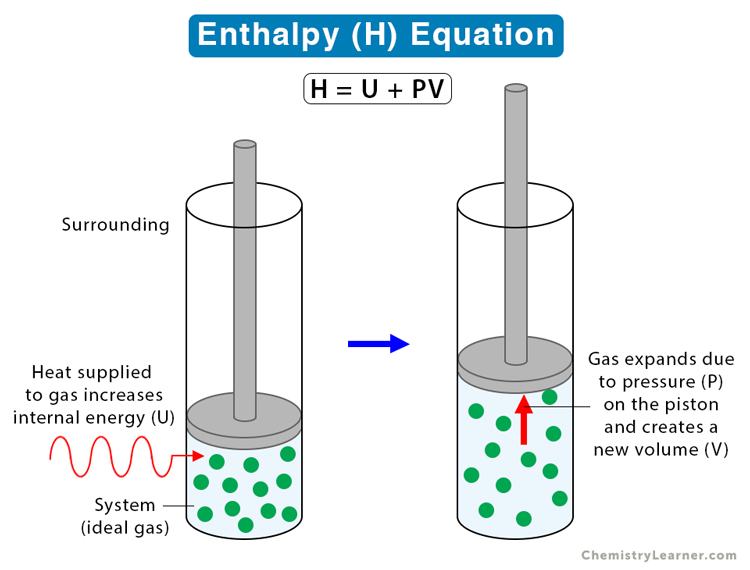
So, when we say a kilogram of steam flowing into a turbine has an enthalpy of 3000 kJ, we mean that each kilogram carries 3000 kJ of total energy, combining its own internal energy and the flow work that was needed to get it there.
Enthalpy as a Convenience: Cleaning Up the Math
Why did we bother creating this new property? Because it simplifies our energy balance equations tremendously. Let's see a quick preview of how this works.
FLOW WORK & Energy Conservation in Open Systems in 11 Minutes!
In our last lesson, we derived the concept of flow work. This short clip from 'Less Boring Lectures' shows exactly where enthalpy comes from in the full energy equation and why it's so useful.
Watch from 1:46 to 4:08. The first part is a quick recap of flow work (which we covered last time). The key part is from 3:45 onward, where you'll see the internal energy (u) and flow work (pv) terms being grouped together to create enthalpy (h). This is the 'aha!' moment for why enthalpy exists.
As the video shows, when we write out the full energy conservation equation for an open system, we get terms like this:
Energy In = ... + m_in * u_in + m_in * (P_in * v_in) + ...Energy Out = ... + m_out * u_out + m_out * (P_out * v_out) + ...
This is messy. By defining specific enthalpy as , we can clean this up beautifully:
Energy In = ... + m_in * h_in + ...Energy Out = ... + m_out * h_out + ...
Enthalpy isn't changing the physics; it's just better notation that packages related concepts together. It allows us to treat the total energy of a flowing fluid as a single property.
Test your understanding!
A fluid enters a turbine with a high enthalpy and leaves with a low enthalpy (). Where did that energy go?
Show answer
The drop in enthalpy () represents the energy extracted from each kilogram of fluid by the turbine. This energy is converted into the mechanical work that spins the turbine's shaft. In an ideal turbine, this entire enthalpy drop becomes useful work.
Enthalpy and Heat: A Common Point of Confusion
Your professor might have called enthalpy "heat content." As you rightly suspected, this is misleading but comes from a very specific and important special case. Let's clear this up.
Consider a closed system (like our trusty piston-cylinder) undergoing a process at constant pressure.
- The First Law for a closed system is: .
- If the only work is the piston moving (boundary work), then .
- Substituting this in: .
- Rearranging for heat: .
Now for the key step. Because the pressure is constant, the term is mathematically the same as the change in the product , or . So we can write:
And since we defined , this means:
This is a very important result! It states that for a closed system undergoing a quasi-static, constant-pressure process, the heat transferred is exactly equal to the change in enthalpy.
This is why enthalpy is used to measure the heat of reaction in chemistry labs. Most reactions happen in open beakers at constant atmospheric pressure. The heat you measure being released or absorbed is the enthalpy change () of the chemical system.
So, is enthalpy "heat content"? No. Enthalpy is a property of a system. Heat is energy in transit. But under the specific condition of constant pressure, the change in enthalpy tells you exactly how much heat was transferred.
A Real-World Example: Throttling Valves
Let's look at a practical device where enthalpy is the star of the show: a throttling valve. This is any device that restricts flow, causing a large pressure drop, like a partially opened valve or a thin capillary tube in your refrigerator.
Thermodynamics: An Engineering Approach
The textbook 'Thermodynamics: An Engineering Approach' has a great section on throttling valves that shows enthalpy in action.
Read the section on 'Throttling Valves'. Focus on how the energy equation simplifies down to h₂ ≈ h₁. The text then breaks this down: u₁ + P₁v₁ = u₂ + P₂v₂. This is a perfect real-world demonstration that enthalpy is the quantity that's conserved in this process.
In a throttling process:
- No heat is transferred ().
- No work is done ().
- Changes in kinetic and potential energy are usually negligible.
When you apply the energy balance to this device, everything cancels out except for the enthalpy terms. You are left with:
A process where enthalpy remains constant is called an isenthalpic process.
This is fascinating! Even though the pressure drops significantly (and the temperature often changes too), the combination of internal energy and flow energy () on one side equals the combination on the other. The fluid's internal energy and flow energy adjust themselves to keep the total enthalpy constant. For example, if the flow energy () decreases, the internal energy () must increase to compensate, often resulting in a temperature change. This is the principle behind refrigeration!
Worked Numerical Problems
Let's put the enthalpy equation to work.
Problem 1: Calculating Enthalpy of Steam
A power plant uses superheated steam. At one point in a pipe, the steam is at a pressure of 2 MPa (2,000,000 Pa) and has a specific volume of 0.1255 m³/kg. At this state, its specific internal energy is measured to be 2945.2 kJ/kg. What is the specific enthalpy of the steam?
Show step-by-step solution
Step 1: Identify the goal.
We need to find the specific enthalpy, . The formula is .
Step 2: List the knowns.
- Specific internal energy, kJ/kg.
- Pressure, MPa = 2,000 kPa.
- Specific volume, m³/kg.
Step 3: Calculate the flow work term ().
Be careful with units! Pressure is in kPa and specific volume is in m³/kg. The product is a kJ.
Since 1 kPa·m³ = 1 kJ:
Step 4: Calculate the specific enthalpy ().
So, each kilogram of this flowing steam is carrying a total of 3196.2 kJ of energy.
Problem 2: Heating Water at Constant Pressure
You have a pot of water on the stove, open to the atmosphere (which is at a constant pressure of 100 kPa). You add 840 kJ of heat to 1 kg of water, turning some of it into steam. What is the change in enthalpy () of the water?
Show step-by-step solution
Step 1: Identify the goal and the process type.
We need to find the change in total enthalpy, .
The process is happening in an open pot, so it is a constant-pressure process.
Step 2: Recall the relationship between heat and enthalpy for a constant-pressure process.
We derived that for a quasi-static, constant-pressure process in a closed system (or a system with a boundary open to a constant-pressure atmosphere), the heat added is equal to the change in enthalpy.
Step 3: Use the given information.
- Heat added, kJ.
Step 4: State the result.
The enthalpy of the 1 kg of water increased by exactly the amount of heat that was added. This is a direct application of the relationship.
Conclusion
Fantastic work today. We've introduced one of the most important and useful properties in thermodynamics. It might feel a bit abstract at first, but the more we use it, the more natural it will become.
Our Key Takeaways:
- Enthalpy () is a composite property defined as .
- Intuitive Meaning: It represents the total energy cost of a system—the energy needed to create it () plus the energy needed to make room for it ().
- Utility in Open Systems: For a flowing fluid, specific enthalpy () represents the total energy carried by each unit of mass. This is incredibly convenient for analyzing devices like turbines, pumps, and compressors.
- Utility in Closed Systems: For a system at constant pressure, the change in enthalpy () is exactly equal to the heat () transferred during the process. This is why it's vital in chemistry and material science.
Preview of the Next Lesson
We've now defined all the key energy terms for an open system: internal energy, flow work (packaged as enthalpy), kinetic energy, and potential energy. We are finally ready to write the complete energy balance.
In our next session, we will derive the Steady-Flow Energy Equation (SFEE). This equation is the First Law of Thermodynamics applied to open systems, and it is the workhorse for analyzing a huge range of engineering devices. We will bring everything we've learned together to build this powerful tool.