Hello again! Ready for our next session?
In our last chat, we built a fantastic mental picture of an ideal gas using the Kinetic Molecular Theory. We saw gases as collections of tiny, zipping particles, and we understood that pressure comes from their collisions and temperature is a measure of their energy. That was the why.
Today, we're going to take that beautiful intuitive model and forge it into one of the most useful tools in all of engineering thermodynamics: the Ideal Gas Equation of State. This equation is like a universal translator for gases. If you know a few things about a gas (like its pressure and volume), you can use this equation to figure out other things (like its temperature or mass).
Our goal is to apply the ideal gas equation of state (PV=mRT) to solve for unknown properties in a system. By the end of this lesson, you'll be able to confidently take a real-world scenario—like air in a tire or a tank—and calculate its properties like a seasoned engineer.
Let's begin our walk.
From Intuition to Equation
Remember our discussion about gas behavior? Let's take a simple balloon as our system. Based on what we know from the Kinetic Molecular Theory:
- If you squeeze the balloon (decrease Volume, V), the particles hit the walls more often, and the Pressure (P) goes up. So, pressure and volume seem to work against each other.
- If you heat the balloon (increase Temperature, T), the particles move faster, push the walls outward, and the Volume (V) increases. So, volume and temperature seem to work together.
- If you blow more air into the balloon (increase the amount of gas), the Volume (V) also increases.
It looks like the volume of a gas is related to its temperature and the amount of gas, but inversely related to its pressure. We can combine these ideas to build the equation.
To see how this comes together beautifully, let's watch a video from Khan Academy. It uses the balloon analogy to derive the ideal gas law from these simple, observable relationships.
The ideal gas law (PV = nRT) | Intermolecular forces and properties | AP Chemistry | Khan Academy
This video will walk us through combining the individual gas laws (Boyle's Law, Charles's Law, and Avogadro's Law) into a single, powerful equation. Notice how each piece we just discussed fits into the final puzzle.
Watch from the beginning to 6:19. Focus on how the relationships between P, V, T, and the amount of gas (n) are combined to form the ideal gas law, PV=nRT.
As the video explained, when you put all those relationships together, you get this elegant and famous equation:
This is the Ideal Gas Law. Let's break it down piece by piece, because every letter here is important.
Deconstructing the Ideal Gas Law: PV = nRT
This equation is usually first presented in its "chemistry" form, using moles (n). We'll soon adapt it for our engineering needs, but let's master this version first.
-
P is for Pressure: This is the force the gas exerts on the walls of its container.
- CRITICAL POINT: In thermodynamics, we almost always use ABSOLUTE pressure. Remember from our earlier lesson,
P_absolute = P_gauge + P_atmospheric. Gauge pressure is what a tire gauge reads—it's the pressure above atmospheric pressure. Absolute pressure is the total pressure, including the weight of the atmosphere. The gas molecules don't care if they're inside a tire or out in the open; their collisions create a total pressure, and that's what we must use.
- CRITICAL POINT: In thermodynamics, we almost always use ABSOLUTE pressure. Remember from our earlier lesson,
-
V is for Volume: This is the space the gas fills, in cubic meters (m³).
-
n is for Moles: This is the "amount of substance." Think of it like a "dozen." A dozen is always 12. A mole is always particles (this is Avogadro's number). Since we can't count individual molecules, we group them into these huge bundles called moles.
-
T is for Temperature: This is the measure of the average kinetic energy of the gas particles.
- CRITICAL POINT: Just like with pressure, we must use an ABSOLUTE temperature scale—almost always Kelvin (K) in SI units. The equation only works if your temperature scale starts at absolute zero, where molecular motion theoretically ceases. Remember, .
-
R is for the Universal Gas Constant: This is the magic number that makes the equation balance. It's a fundamental constant of nature. Because it's "universal," its value is the same for any ideal gas, as long as you are using moles (
n).- In SI units, its value is . The subscript 'u' is often used to denote that it's the universal constant.
Making It Practical for Engineering: PV = mRT
In engineering, it's often more practical to work with mass (m) in kilograms than with moles (n). You can weigh a gas tank to find the mass of the gas inside, but you can't "weigh" the number of moles.
So, how do we switch from moles to mass? We use the Molar Mass (M), which is the mass of one mole of a substance. For example, the molar mass of Oxygen (O₂) is about 32 g/mol or 0.032 kg/mol.
The relationship is simple:
Mass = (Number of moles) × (Mass per mole)
We can rearrange this to get . Now, let's substitute this into our ideal gas law:
- Start with
PV = nRT_u. (I'm using to be clear it's the universal constant). - Substitute
n = m/M:PV = (m/M)R_uT. - Let's rearrange it slightly by grouping the constants together:
PV = m (R_u/M) T.
This expression in the parenthesis, (R_u/M), combines the universal constant with the molar mass of a specific gas. We call this new term the specific gas constant, or just the gas constant, R.
This new R is different for every gas because every gas has a different molar mass (M). Now, our equation becomes:
This is the form we will use most often in engineering thermodynamics.
Let's see this in action for air, which is the most common gas we'll deal with.
Thermodynamics – Basic Concepts
This document from Durham College does a great job of showing exactly how to calculate the specific gas constant R for air, transitioning from the PV=nRT form to PV=mRT.
Please read the subsection titled 'Ideal Gas Law'. Focus on how they use the molar mass of air (28.97 g/mol) to convert the universal gas constant (R = 8.314) into the specific gas constant for air (R = 287).
So, for air, the specific gas constant is:
.
You will use this value so often that it's worth remembering!
Recap Break
Let's pause. We've taken our intuitive understanding of gases and formalized it into two versions of a powerful equation:
PV = nR_uT: The "chemistry" version, using moles (n) and the universal constant (R_u).PV = mRT: The "engineering" version, using mass (m) and a gas-specific constant (R).
We also stressed the importance of using ABSOLUTE pressure (in Pascals) and ABSOLUTE temperature (in Kelvin) for these equations to work correctly.
Now, let's put this tool to use.
Applying the Ideal Gas Law: Worked Examples
Before we start, here's a simple, robust strategy for solving ideal gas problems.
Problem-Solving Strategy:
- Sketch the System: Draw a simple picture of the tank, balloon, or piston. Label the states (e.g., "State 1: Before heating," "State 2: After heating").
- List Your Knowns: Write down every value the problem gives you (P, V, m, T).
- List Your Unknowns: Clearly state what you need to find.
- Unit Conversion: This is the most common place for errors! Convert everything to standard SI units:
- Pressure to Pascals (Pa). (1 kPa = 1000 Pa, 1 bar = 100,000 Pa)
- Temperature to Kelvin (K). (K = °C + 273.15)
- Volume to cubic meters (m³). (1 L = 0.001 m³)
- Solve: Rearrange the equation
PV = mRTto solve for your unknown, then plug in the numbers. - Check Your Answer: Does the result make sense? If you heated the gas, did the pressure or volume go up? A quick sanity check can catch a lot of mistakes.
Example 1: How Much Does the Air in a Room Weigh?
Problem: A classroom is 10 m long, 8 m wide, and 3 m high. The air in the room is at a pressure of 100 kPa and a temperature of 22°C. What is the mass of the air in the room? (Use )
Solution:
- Sketch: Imagine a box representing the room.
- Knowns:
- Volume,
- Pressure,
- Temperature,
- Gas constant for air,
- Unknown: Mass,
- Unit Conversion:
- Pressure:
- Temperature:
- Solve:
- Start with our equation:
- Rearrange to solve for mass
m: - Plug in the values:
- Check: That's about the weight of 3-4 people! It seems reasonable that the air in a large room would have a substantial mass. The answer makes sense.
Example 2: Temperature Change in a Piston
Let's use the problem shown in this image.
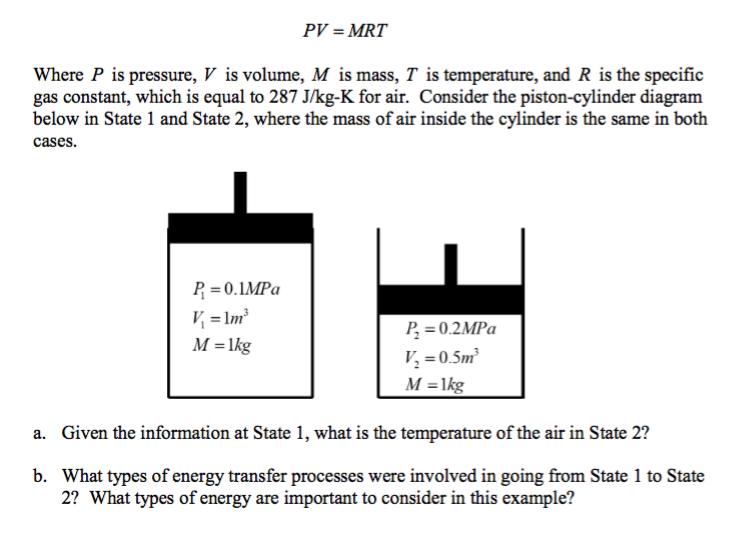
Problem: As shown in the image, a piston-cylinder device contains 0.2 kg of air. In State 1, the pressure is 150 kPa and the volume is 0.1 m³. After a process, the air reaches State 2, where the pressure is 600 kPa and the volume is 0.04 m³. What is the temperature of the air in State 2, in Celsius?
Solution:
- Sketch: The image provides the sketch. We are interested in State 2.
- Knowns (for State 2):
- Mass, (mass doesn't change)
- Pressure,
- Volume,
- Gas constant for air,
- Unknown: Temperature at State 2, (in °C).
- Unit Conversion:
- Pressure:
- Solve:
- Start with the equation for State 2:
- Rearrange to solve for temperature :
- Plug in the values:
- The question asks for Celsius, so we convert back:
- Check: The gas was compressed significantly (volume down, pressure up), so we expect its temperature to have increased substantially. A final temperature of ~145°C seems plausible.
Example 3: Before and After (The Ratio Trick)
Sometimes, you don't know the mass or volume, but you know how things change. This is where the "ratio trick" is incredibly useful.
Problem: A car tire is inflated to a gauge pressure of 220 kPa when the air temperature is 10°C. After driving for a while, the air temperature inside the tire rises to 45°C. Assuming the volume of the tire is constant, what is the new gauge pressure? (Assume atmospheric pressure is 101 kPa).
Solution:
- Setup: We have a "State 1" (cold) and a "State 2" (hot).
- State 1: ,
- State 2: ,
- Unit Conversion (Very Important Here!):
- Pressures to Absolute:
- Temperatures to Kelvin:
- Pressures to Absolute:
- The Ratio Trick:
- Write the ideal gas law for both states:
- State 1:
- State 2:
- Now, divide the second equation by the first:
- The problem states the volume is constant (), and the mass of air (
m) and the gas constant (R) are also constant. We can cancel them out!
- This simple relationship is called Gay-Lussac's Law, but you don't need to memorize the name. You can derive it every time from the ideal gas law.
- Write the ideal gas law for both states:
- Solve for the unknown absolute pressure, :
- This is the absolute pressure. The question asks for gauge pressure.
- Check: The temperature increased, so the pressure should increase. It did. The answer is reasonable.
Test your understanding!
Question 1: Why is it so important to use absolute pressure and absolute temperature in the Ideal Gas Law? What would happen if you used Celsius?
Show answer
The Ideal Gas Law is built on the direct proportionality between properties and the underlying molecular energy.
- Absolute Temperature (Kelvin): Temperature in the equation represents molecular kinetic energy. The Kelvin scale starts at 0 K (absolute zero), which is the point of zero theoretical energy. A temperature of 200 K has twice the molecular energy of 100 K. The Celsius scale doesn't have this property; 20°C does not have twice the energy of 10°C. Using Celsius would break this direct relationship. For example, if you put 0°C into the equation, it would imply zero pressure or volume, which is incorrect.
- Absolute Pressure (Pascals): The pressure in the equation is caused by all molecular collisions. The gas molecules inside a container are creating a total pressure, regardless of the atmospheric pressure outside. Gauge pressure only measures the difference above atmospheric pressure. Using gauge pressure would ignore the significant pressure already being exerted by the atmosphere, leading to incorrect calculations.
Test your understanding!
Question 2: You have two identical, rigid tanks at the same temperature and pressure. One is filled with Helium (He, Molar Mass ≈ 4 g/mol) and the other is filled with Nitrogen (N₂, Molar Mass ≈ 28 g/mol). Which tank contains a greater mass of gas?
Show answer
The tank filled with Nitrogen will have a greater mass.
Here's why:
- We use , which is .
- Rearranging for mass gives .
- Since P, V, and T are the same for both tanks (and is a universal constant), the mass
mis directly proportional to the molar massM. - Because Nitrogen has a much higher molar mass (28 g/mol) than Helium (4 g/mol), its mass will be much greater to produce the same pressure and temperature in the same volume. Intuitively, you need a lot more of the "heavier" Nitrogen molecules to create the same conditions.
Lesson Summary
Excellent work today! We've taken a huge step from conceptual understanding to practical calculation. You now have a key tool for your thermodynamic toolbox.
Key Takeaways:
- The Ideal Gas Law relates pressure, volume, temperature, and the amount of a gas.
- The engineering form, , is incredibly useful.
Ris the specific gas constant, which is different for each gas (). For air, .- You must use absolute pressure (Pa) and absolute temperature (K) in your calculations.
- The "ratio trick" is a powerful way to solve "before and after" problems by canceling out constant terms.
Preview of the Next Lesson
So far, we have been talking about a single, pure gas in a container. But the most common gas we experience—air—is actually a mixture of Nitrogen, Oxygen, Argon, and other gases. How do we handle mixtures?
In our next lesson, we will learn about Dalton's Law of Partial Pressures. This will allow us to analyze gas mixtures and understand how each individual gas contributes to the total pressure of the system.